This is an old revision of the document!
Warning: Trying to access array offset on null in /home/especiais/epsatisep/public_html/2017/EPS2017-wiki1/lib/plugins/caption/syntax/reference.php on line 68
Warning: Undefined array key "tpjctpn" in /home/especiais/epsatisep/public_html/2017/EPS2017-wiki1/lib/plugins/caption/syntax/reference.php on line 68
Table of Contents
PlayGround
Report
EscarGO® - The Escargot Nursery

Authors:
- Lauri Borghuis
- Benjamin Calon
- John MacLean
- Juliette Portefaix
- Ramon Quero

Acknowledgement
Team one “Caracol” would like to thank European Project Semester (EPS) and Instituto Superior de Engenharia do Porto (ISEP) for the chance to participate in this project, which is a once in a lifetime opportunity for us to grow and develop ourselves both professionally and personally.
The team would also like to thank the panel of supervisors for the support, help and advice they gave the team on a weekly meeting basis, as well as the teachers that offered some very helpful pieces of advice during the semester.
Glossary
| Abbreviation | Description |
|---|---|
| B2B | Business to Business |
| B2C | Business to Consumer |
| CD | Compact Disc |
| CNISF | Conseil National des Ingénieurs de France |
| COD | Cash On Delivery |
| EPS | European Project Semester |
| EU | European Union |
| FAQ | Frequently Asked Questions |
| IOT | Internet Of Things |
| ISEP | Instituto Superior de Engenharia do Porto |
| LCD | Liquid Crystal Display |
| LED | Light-Emitting Diode |
| PESTLE | Political, Environmental, Social, Technological, Legal and Economic |
| PETA | People for the Ethical Treatment of Animals |
| PMMA | Polymethylmethacrylate |
| PP | Polypropylene |
| PVC | Polyvinyl Chloride |
| RAM | Responsibility Assignment Matrix |
| ROHS | Restriction Of Hazardous Substances |
| SEO | Search Engine Optimisation |
| SMART | Specific / Measurable / Attainable / Relevant / Time Based |
| SWOT | Strengths / Weaknesses / Opportunities / Threats |
| USB | Universal Serial Bus |
| WBS | Work Breakdown Structure |
| 3D | Three-Dimensional |
1. Introduction
1.1 Presentation
The team were undertaking the EPS Project in Portugal, studying at ISEP in Porto. The team named “Caracol”, which means snail in Portuguese, consisted of five students all from different countries, cultures, speaking different languages, and above all with differing knowledge bases. This diversity, which could have been an obstacle, was instead the driving force that enabled the team to make this project unique, creative and innovative.
The team was composed of:
- Lauri Hannah Borghuis, from The Netherlands, studying Biology and Medical Laboratory Research
- Benjamin Calon, from Belgium, studying Product Development
- John MacLean, from Scotland, studying Mechanical Electronic Systems Engineering
- Juliette Portefaix, from France, studying General Engineering
- Ramon Quero, from Spain, studying Engineering and Architecture.
Team “Caracol” (See Figure 1) was a multidisciplinary, hardworking group of people who wanted to improve and develop communication and team working skills as well as other soft-skills, while learning about marketing, ethics and project management. Because of the multidisciplinary aspect of EPS, each team member learned something new from a field of study that they had not experienced before.
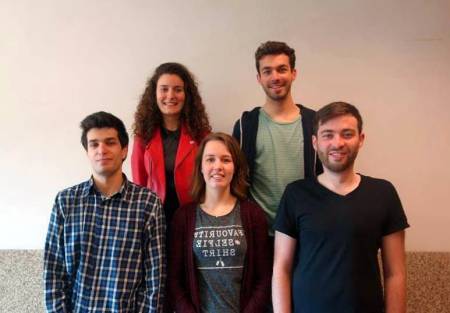
Each member had a personal motivation to enroll on the EPS project:
Lauri Borghuis: “EPS seems to me to be an excellent opportunity to make new social contacts with international students. I chose EPS to work in a group with international students with all different fields of study, so I can learn from their fields, and I can share my knowledge. Furthermore studying for six months abroad is good for my development in the English language”.
Benjamin Calon: “The EPS project trains us in a different way than normal school courses. It gives us soft skills to work with students from different backgrounds (professional and cultural). Going out of my comfort zone, improving my language skills and enjoying the local culture are the ingredients for an extraordinary experience”.
John Maclean: “EPS gives me a chance to live abroad for a few months and experience a different culture. It allows me to meet people from all over Europe and make friends and connections for life. It puts me far out of my comfort zone and also gives me a chance to develop another language”.
Juliette Portefaix: “EPS is for me a great opportunity to discover a new way of working. It is a chance to discover a new culture and new people. EPS also enables me to develop my management skills, and to learn to work in a team. Finally it’s the best way to improve my English”.
Ramon Quero: “I see EPS as a nice chance to improve my teamwork skills by working in a project with colleagues from different nations and backgrounds, an opportunity to speak in a foreign language and to learn other skills like communication, marketing or project management. It is also an unforgettable life experience”
1.2 Motivation
The project that has been chosen was an “Escargot Nursery”. This option was chosen for several reasons.
First of all, this was the subject which allowed the mix of each of the differing specialties thus allowing each member to bring their own experience and skillset from the various specialties.
Another reason for making this decision was that the team believed it was the most original and unusual project. None of the team members had any prior knowledge of escargot before the start of the project which provided its own challenge, but also allows the whole team to learn something completely new. It enabled the team to satisfy their curiosity, and be more open minded to new disciplines.
With this product the team wanted to address some of today's concerns (See following section). They felt passionate about the idea of creating an educational product that could make modern families' lives a little better.
1.3 Problem
In the modern era, more people are aware of the use of genetically modified organisms. Genetic modification is being used to improve food's colour, to make the food look more attractive or to increase the shelf life of the products. There are people who fear genetically modified food, and there are others who believe that it is the future and the way to end world hunger. The problem with genetically modified vegetables is that there is not enough scientific knowledge to prove the long term effects [1].
The digital revolution has improved our communication channels through the likes of social media, mobile phones, and video conferencing, but it has also isolated people becoming addicted to their smartphones and not living real social life. Social media comes with its pitfalls also, with people trying to project the perfect life, and comparing themselves to others. Depression and mental health issues have become more common among young people [2].
The team saw this reality and decided they wanted to crate something that would help towards a happier healthier lifestyle. They realised more people are opting for organic food, and want to know where their food has come from. Also, many more people are wanting to grow their own food at home and want to reduce their carbon footprint. This product fits into this brief well.
One of the problems that comes with this project is that the snails have to be kept within the cage with no chance of escape. One of the issues is the laws in a particular country might not allow the production or domestic use of snails as they are believed to be pests or non native species, which could severely harm the ecosystem, such as the Giant African Snail [3].
1.4 Objectives
The goal is to design and build a unique and innovative product that will help people to produce their own snails at home, whether for recreational purposes or consumption. The main objective is to bring the family together and educate children about animals and food. Additionally the product provides two meals a year for a family of four as the Cornu aspersum grows to the optimal size in six months [4].
The team believes that this product fulfills a genuine desire with families who want to learn more about food, and be more sustainable in food production. Producing food at home allows for a reduction in food travel, as food can travel from all over the world before it ends up in the supermarket. This reduces the carbon footprint of the food that reaches the dinner table. It also provides a project which families can do together to bond.
This product should be sustainable because sustainability and protecting the environment around us is becoming more important because of the impact of climate change. The team is trying to reduce their environmental impact, by creating a low impact system and using low impact materials. The design needs to be simple but attractive.
Temperature and humidity monitoring are also very important, so the sensors need to transmit all the relevant information to the controller, and allow full automation, with little human interaction.
1.5 Requirements
The Escargot Nursery has to meet several requirements:
- Attractive aethetically pleasing design
- Set, display and control the internal temperature, light and humidity
Some other project requirements are:
- Use sustainable materials
- Use low cost hardware solutions
- Stick to the budget (100 €)
- Comply with the following European Union (EU) Directives:
- Machine Directive (2006/42/CE 2006-05-17);
- Electromagnetic Compatibility Directive (2004/108/EC 2004 12 15);
- Low Voltage Directive (2014/35/EU 2016-04-20);
- Radio Equipment Directive (2014/53/EU 2014-04-16);
- Restriction of Hazardous Substances (ROHS) in Electrical and Electronic Equipment Directive (2002/95/EC 2003-01-27);
- Mandatory adoption and use of the International System of Units (The NIST International Guide for the use of the International System of Units)
- Use open source software and technologies.
1.6 Functional Tests
To evaluate the work, the team had to perform certain functional tests. These tests give an insight into whether the Escargot Nursery is ready to be released to the market.
- Temperature + Humidity Sensor: Testing if the sensors work in the right way, it is possible to use ice to lower the temperature, and see if the temperature sensor works. To see if the humidity sensor works, it is possible to put rice around the sensor.
- Light Sensor: Testing if the light sensors work, the lights need to be on, on time. It can be tested by covering the light sensor during day time and see if the lights go on.
- Cooling Fan: Testing if the cooling fan works if the temperature increase above 25 ºC. Putting a heating pack in the “EscarGO” and see if the cooling fan starts to cool the temperature in the enclosure.
- Electric Heater: Testing if the heater works if the temperature decreases below 15 ºC. Putting a cooling pack in the “EscarGO” and see if the electric heater starts to work.
- Liquid Crystal Display (LCD): Testing if the LCD works, if it displayed the temperature, light and humidity.
- Snails: Testing if the snails can survive in the Escargot Nursery. Put snails in the “EscarGO”, care for them and see if they will survive.
1.7 Project Planning
Every project needs to be planned carefully because a project plan gives an overview of all the tasks and deliverables that need to be completed. Having a good project plan and following it well allows the smooth running of the project, and keeps the project running on schedule. Table 1 shows the planning used for this project. In chapter 3.3 there is a comprehensive project plan including a Gantt chart.
| Task | Responsible |
|---|---|
| Project Plan | |
| Task Allocation | All |
| Gantt Chart | Juliette |
| System Diagrams & Structural Drafts | Benjamin |
| System Schematics & Structural Drawings | Benjamin, John |
| Budget Planning | Ramon |
| Research | |
| Target | Benjamin |
| Sustainability Research | Lauri |
| Ethics Research | Juliette, John |
| Marketing Plan | Benjamin, Ramon |
| Research on Materials | All |
| Design | Benjamin |
| Building & Testing | |
| Building Prototype | All |
| Environment | Lauri |
| Programming | John |
| Testing | All |
| Delivery | |
| Report | All |
| Presentation | Juliette |
| Leaflet | Lauri |
| List of Materials & Components | John |
| Paper | John |
| Poster | Lauri |
| Manual | Ramon |
| Website | Ramon |
| Wiki | All |
| Video | Ramon |
| Product | All |
1.8 Report Structure
This report follows a logical sequence, composed of eight chapters. Each of these chapters were divided into sections. The report was organized in such a way as to make the reasoning and explanations as clear as possible. The chapters are:
- Introduction: Presentation of the team, of the reasoning and the motivation behind the choices, the main problems the team faced, and some requirements for the project.
- State of the Art: Existing products, technological system and snail's life-cycle.
- Project Management: Overview of how the team will manage the project, the management tools such as a Gantt chart, cost and time diagrams.
- Marketing Plan: Description of the current market situation and presentation of our marketing strategy.
- Eco-efficiency Measures for Sustainability: Explanation of the choices to make the project as sustainable as possible.
- Ethical and Deontological Concerns : Description of the ethical concerns the team has addressed.
- Project Development: All of the technological choices, tests and results.
- Conclusions: The conclusion the team has garnered from the project, any alternative solutions that may work.


