Table of Contents
Report
EscarGO® - The Escargot Nursery

Authors:
- Lauri Borghuis
- Benjamin Calon
- John MacLean
- Juliette Portefaix
- Ramon Quero

Acknowledgement
Team one “Caracol” would like to thank European Project Semester (EPS) and Instituto Superior de Engenharia do Porto (ISEP) for the chance to participate in this project, which was a once in a lifetime opportunity for us to grow and develop ourselves both professionally and personally.
The Team would also like to thank the panel of supervisors for the support, help and advice they gave the Team on a weekly meeting basis, as well as the teachers that offered some very helpful pieces of advice during the semester.
Glossary
| Abbreviation | Description |
|---|---|
| B2B | Business to Business |
| B2C | Business to Consumer |
| CD | Compact Disc |
| CNISF | Conseil National des Ingénieurs de France |
| COD | Cash On Delivery |
| EPS | European Project Semester |
| EU | European Union |
| FAQ | Frequently Asked Questions |
| IOT | Internet Of Things |
| ISEP | Instituto Superior de Engenharia do Porto |
| LCD | Liquid Crystal Display |
| LED | Light-Emitting Diode |
| PESTLE | Political / Environmental / Social / Technological / Legal / Economic |
| PETA | People for the Ethical Treatment of Animals |
| PMMA | Polymethylmethacrylate |
| PP | Polypropylene |
| PVC | Polyvinyl Chloride |
| RAM | Responsibility Assignment Matrix |
| ROHS | Restriction Of Hazardous Substances |
| RTC | Real Time Clock |
| SEO | Search Engine Optimization |
| SMART | Specific / Measurable / Attainable / Relevant / Time Based |
| SWOT | Strengths / Weaknesses / Opportunities / Threats |
| USB | Universal Serial Bus |
| WBS | Work Breakdown Structure |
| 3D | Three-Dimensional |
1. Introduction
1.1 Presentation
The Team was undertaking the EPS Project in Portugal, studying at ISEP in Porto. The Team named “Caracol”, which means snail in Portuguese, consisted of five students all from different countries, cultures, speaking different languages, and above all with differing knowledge bases. This diversity, which could have been an obstacle, was instead the driving force that enabled the Team to make this project unique, creative and innovative.
The Team was composed of:
- Lauri Borghuis, from The Netherlands, studying Biology and Medical Laboratory Research
- Benjamin Calon, from Belgium, studying Product Development
- John MacLean, from Scotland, studying Mechanical Electronic Systems Engineering
- Juliette Portefaix, from France, studying General Engineering
- Ramon Quero, from Spain, studying Engineering and Architecture.
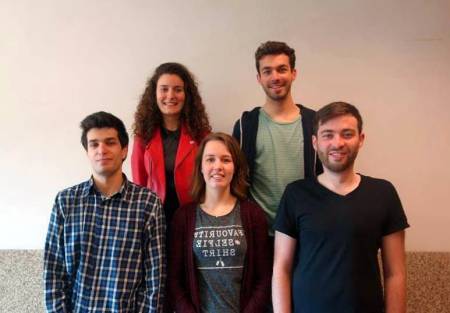
Team “Caracol” (see Figure 1) was a multidisciplinary, hardworking group of people who wanted to improve and develop communication and Team working skills as well as other soft skills, while learning about marketing, ethics and project management. Because of the multidisciplinary aspect of EPS, each team member learned something new from a field of study that they had not experienced before.
Each member had a personal motivation to enrol on the EPS program:
Lauri Borghuis: “EPS seemed to me to be an excellent opportunity to make new social contacts with international students. I chose EPS to work in a group with international students with all different fields of study, so I could learn from their fields, and I could share my knowledge. Furthermore, studying for six months abroad was good for my development in the English language”.
Benjamin Calon: “The EPS program trained us in a different way than normal school courses. It gave us soft skills to work with students from different backgrounds (professional and cultural). Going out of my comfort zone, improving my language skills and enjoying the local culture were the ingredients for an extraordinary experience”.
John Maclean: “EPS gave me a chance to live abroad for a few months and experience a different culture. It allowed me to meet people from all over Europe and make friends and connections for life. It put me far out of my comfort zone and also gave me a chance to develop another language”.
Juliette Portefaix: “EPS was for me a great opportunity to discover a new way of working. It was a chance to discover a new culture and new people. EPS also enabled me to develop my management skills, and to learn how to work in a Team. Finally, it was the best way to improve my English”.
Ramon Quero: “I saw EPS as a nice chance to improve my teamwork skills by working in a project with colleagues from different nations and backgrounds, an opportunity to speak in a foreign language and to learn other skills like communication, marketing or project management. It was also an unforgettable life experience”
1.2 Motivation
The project that has been chosen was an “Escargot Nursery”. This option was chosen for several reasons.
First of all, this was the subject which allowed the mix of each of the differing specialties thus allowing each member to bring their own experience and skill set from the various specialties.
Another reason for making this decision was that the Team believed it was the most original and unusual project. None of the team members had any prior knowledge of snails before the start of the project which provided its own challenge, but also allowed the whole Team to learn something completely new. It enabled the Team to satisfy their curiosity, and be more open minded to new disciplines. The Team believed that this product fulfils a genuine desire with families who wanted to learn more about food, and be more sustainable in food production.
In France, there were not enough snails being produced for the amount of snails being consumed, so the French import a large amount of snails every year. The Team wanted to create a new way of producing food that would be fun for kids, that would include technology and that would provide a comfortable habitat for the snails. If the end user did not want to use the enclosure for producing food then they could also use it to keep the snails as pets. The Team decided that education would be a main objective for the product, and that would be one of the main selling points. The enclosure would be able to house fifty snails, which would take six months to reach full maturity.
1.3 Problem
More people are aware of the use of genetically modified organisms and, consequently, want to know the origins and growth process of their food. Genetic modification is used to improve the colour, smell and taste of food, trying to make it more attractive and durable in terms of the shelf life. However, the problem is that there is not enough scientific knowledge regarding the long-term side effects of genetically modified food on people [1].
The digital revolution had improved our communication channels through the likes of social media, mobile phones, and video conferencing, but it had also isolated people becoming addicted to their smart phones and not living real social life. Social media came with its pitfalls also, with people trying to project the perfect life, and comparing themselves to others. Depression and mental health issues had become more common among young people [2].
The Team saw this reality and decided they wanted to create something that would help towards a happier healthier lifestyle. They realised more people are opting for organic food, and wanted to know where their food came from. Also, many more people wanted to grow their own food at home and wanted to reduce their carbon footprint. This product fitted into this brief well.
One of the problems that came with this project was that the snails had to be kept within the cage with no chance of escape. One of the issues was the laws in a particular country might not allow the production or domestic use of snails as they were believed to be pests or non-native species, which could severely harm the ecosystem, such as the Giant African Snail [3].
1.4 Objectives
The goal was to design and build a unique and innovative product that would help people to produce their own snails at home, whether for recreational purposes or consumption. The main objective was to bring families together and educate children about animals and food. Additionally, the product provided two meals a year for a family of four as the Cornu aspersum grew, one of the most commonly consumed breed of snails, to the optimal size in six months [4].
This product should be sustainable and protecting the environment around us since this was becoming more important due to the impact of climate change. The Team tried to reduce their environmental impact, by creating a low impact system and using low impact materials. The design needed to be simple but attractive.
The “EscarGO” must provide a way to produce food at home, as this allowed for a reduction in food travel, since food could travel from all over the world before it ended up in the supermarket. This reduced the carbon footprint of the food that reached the dinner table. It also provided a project which families could do together to bond.
The product should provide a means for people to grow snails in an easy way. Temperature and humidity monitoring were very important, so the sensors needed to transmit all the relevant information to the controller, and allowed full automation, with little human interaction.
1.5 Requirements
The Escargot Nursery had to meet several requirements. It had to:
- Have an attractive aesthetically pleasing design
- Set, display and control the internal temperature, light and humidity
Some other project requirements were:
- Use sustainable materials
- Use low cost hardware solutions
- Stick to the budget (100.00 €)
- Comply with the following European Union (EU) Directives:
- Machine Directive (2006/42/CE 2006-05-17);
- Electromagnetic Compatibility Directive (2004/108/EC 2004 12 15);
- Low Voltage Directive (2014/35/EU 2016-04-20);
- Radio Equipment Directive (2014/53/EU 2014-04-16);
- Restriction of Hazardous Substances (ROHS) in Electrical and Electronic Equipment Directive (2002/95/EC 2003-01-27);
- Mandatory adoption and use of the International System of Units (The NIST International Guide for the use of the International System of Units)
- Use open source software and technologies.
1.6 Functional Tests
To evaluate the work, the Team had to perform certain functional tests. These tests gave an insight into whether the Escargot Nursery was ready to be released to the market.
- Temperature + Humidity Sensor: Test the correct operation of both sensors by using ice to lower the temperature and using a hair dryer to raise the temperature.
- Light Sensor: Test the light sensor by covering the sensor to see if the lights switch on automatically.
- Cooling Fan: Test the cooling fan operation by increasing the temperature above 25 °C, with the help of the hair dryer.
- Electric Heater: Test if the heater activates when the temperature decreases below 15 °C, by placing an ice cooling pack inside “EscarGO”.
- Liquid Crystal Display (LCD): Test if the LCD displays the temperature, light level and relative humidity.
- Water Tank: Test if the water tank works to moist the soil, and check that there are no water leakages.
1.7 Project Planning
Every project needed to be planned carefully because a project plan gives an overview of all the tasks and deliverables that need to be completed. Having a good project plan and following it well allowed the smooth running of the project, and kept the project running on schedule. Table 1 shows the planning used for this project. In Chapter 3.3 there is a comprehensive project plan including a Gantt chart.
| Task | Responsible |
|---|---|
| Project Plan | |
| Task Allocation | All |
| Gantt Chart | Juliette |
| System Diagrams & Structural Drafts | Benjamin |
| System Schematics & Structural Drawings | Benjamin, John |
| Budget Planning | Ramon |
| Research | |
| Target | Benjamin |
| Sustainability Research | Lauri |
| Ethics Research | Juliette, John |
| Marketing Plan | Benjamin, Ramon |
| Research on Materials | All |
| Design | Benjamin |
| Building & Testing | |
| Building Prototype | All |
| Environment | Lauri |
| Programming | John |
| Testing | All |
| Delivery | |
| Report | All |
| Presentation | Juliette |
| Leaflet | Lauri |
| List of Materials & Components | John |
| Paper | John |
| Poster | Lauri |
| Manual | Ramon |
| Website | Ramon |
| Wiki | All |
| Video | Ramon |
| Product | All |
1.8 Report Structure
This report followed a logical sequence, composed of eight chapters. Each of these chapters were divided into sections. The report was organized in such a way as to make the reasoning and explanations as clear as possible. The chapters were:
- Introduction: Presentation of the Team, of the reasoning and the motivation behind the choices, the main problems the Team faced, and some requirements for the project.
- State of the Art: Existing products, technological system and snail's life-cycle.
- Project Management: Overview of how the Team managed the project, the management tools such as a Gantt chart, cost and time diagrams.
- Marketing Plan: Description of the current market situation and presentation of the marketing strategy.
- Eco-efficiency Measures for Sustainability: Explanation of the choices to make the project as sustainable as possible.
- Ethical and Deontological Concerns : Description of the ethical concerns the Team had addressed.
- Project Development: All of the technological choices, tests and results.
- Conclusions: The conclusion the Team had garnered from the project, any alternative solutions that may work.
2. State of the Art
2.1 Introduction
To get started, an explanation of Escargot Nursery was introduced. This chapter also comprised the description and comparison of five existing products meant for home use, and four snail farm products which were already on the market, in order to draw conclusions and to take up relevant ideas that could be used in this product. This chapter contained information about the Cornu aspersum life-cycle and their optimal living conditions. In addition, there was an explanation of technologies used in “EscarGO” required for snail breeding.
2.2 Escargot Nursery
An Escargot Nursery was a product designed to grow snails, providing them with a comfortable living environment. The Nursery needed to be able to host a number of snails with ample space, along with soil coverage and other things they may needed to grow correctly (see Section 2.4 Escargot Research).
“EscarGO” was the commercial name chosen for the indoor snail farm the Team was developing during the EPS program (see Chapter 4. Marketing Plan)
2.3 Existing Products
2.3.1 Products for Home Use
There were some existing products similar to this project as shown in Table 2, meant for home use. These products were the competitors of the “EscarGO” project, since they were designed for domestic use. There was only one direct competitor also designed for snails. Due to the lack of products designed specially for snails, people were using products designed for other pets and because of this, the Team decided to study also some of those alternatives. Most of them were very basic without any technology. The “EscarGO” had to push the boundary and not to be only something technologically better and more advanced than what was already on the market, but also something that was aesthetically pleasing.
| Name | Product | Price (€) | Animals | Technology | Size (cm) | Other specifications |
|---|---|---|---|---|---|---|
| Grow your own escargots by S'cargo [5] | 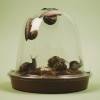 | 46 | Snails | No technology | 30 x 30 x 30 | Bell shaped propagator and saucer as attractive snail farmhouse with sterile bedding. Instructions to help you keep the snails healthy and growing. Some special dry snail food to give them a good start. |
| Aqueon® Glass Aquarium [6] |  | 14 | Fish | No technology | 31 x 16 x 20 | Material: glass, features: no assembly required |
| Zoo Med™ ReptiHabitat® Bearded Dragon 40 Gallon Terrarium Kit [7] |  | 172 | Reptiles | A custom dual screen top provides easy access to the habitat and keeps your reptile safely inside. Including UV lighting. A dual temperature/humidity gauge to maintain temperature. | 91 x 45 x 45 | Lamp bedding, food samples |
| All Living Things® Hermit Crab Habitat Kit [8] | 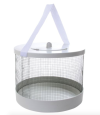 | 30 | Crabs | No technology | 30 x 30 x 25 | Kit includes a soaking dish, seashell palm tree, sponge, sprayer, resin coconut hut and instruction manual. Cage is made from plastic and metal for durability |
| biOrb® FLOW 4 Gallon LED Aquarium [9] | 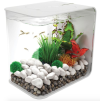 | 90 | Fish | biOrb 12V Transformer. biOrb Air Pump. Airstone. Standard LED light unit. | 21 x 30 x 31 | Ceramic Media 450 g. Filter cartridge. Water Conditioner 5 ml. Beneficial Bacteria liquid 5 ml. Material(s): Acrylic Aquarium |
The Team decided to choose a concept similar to the design of an aquarium, because the product needed to be simple yet attractive. The use of transparent sides would allow the users to see and enjoy the growth of their snails. In order to distinguish the product from the competitors, the Team decided to include several technological aspects in the design, like lighting, temperature and humidity control.
2.3.2 Snail Farm Products
There were already existing snail farms on the market, using different technologies to farm them. Since most of the home-use competitors of the “EscarGO” were not designed for snails, a comparison between bigger snail farming solutions was made. The Team considered this comparison relevant to the development of the product, due to the lack of techniques used in the products for domestic use. These technologies were dedicated to raise a much larger number of snails, whereas this project was designed for a much smaller number and for domestic use (see Table 3).
| Name | Picture | Size (m) | Description | Advantages/Disadvantages |
|---|---|---|---|---|
| Hutch Box [10] | 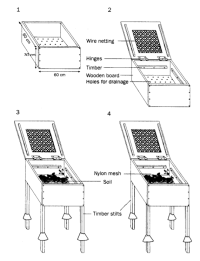 | Not given | This system was a square or a rectangular box. The floor was filled with sieved black soil to a depth of 18 - 25 cm. In addition, at the bottom of the box, there were holes in order to evacuate the excess water. The lid was in wood or steel frame lidded with chicken wire and nylon Mesh. This system was particularly adapted to semi-intensive breeding. | Advantage: easy to move, to feed the animals and to take care of them. Disadvantage: the cost of the system. |
| Trench Pens [11] | 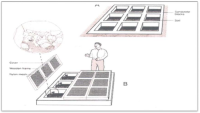 | 0.6 × 0.6 to 1 × 1 | This system was directly inserted into the ground. In addition, the wall consisted of sandcrete blocks or mud bricks in either case. | Disadvantage: needed to kneel to take care of the animals. |
| Mini-Paddock Pens [12][13] | 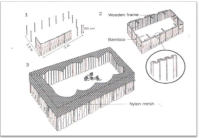 | The walls should be 50 cm high and be dug at least 20 cm into the ground | This system was a small square, usually within a larger fenced area. Built of bamboo, nylon mesh, or timber, chicken wire and nylon mesh. | Advantage: sustainable system because of the materials. Disadvantage: the snails were less protected against predators than the previous systems. |
| Free Range Pens [14] | 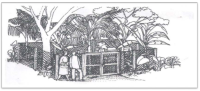 | 10 × 20 | Large system. The vertical fence must be extended inwards, to prevent snails from escaping. | Advantage: mimics the natural environment of the snails so the life conditions were optimal. Disadvantage: it required a lot of space and it may be expensive. |
Unlike “EscarGO”, the systems above were for outdoors and not for indoor use. These, despite following a very different approach to a home product, they had some ideas the Team could look up to.
These did not include any control system on humidity or temperature. They were rather big and expensive and the ease of use seemed not to be one of their priorities. On the other hand, these systems were sustainable and recreated a natural place, and made a clever use of technologies like the curtain system.
The Team agreed on the need for an environmental control system included in the product, but also added the idea of using a nylon mesh to prevent snails from going into the heating system and applying the curtain system (see Subsection 2.5.1 The Curtain System). Additionally, a natural environment had to be recreated
To conclude, the purpose of these large-scale farming technology was only to raise snails for food production. The Team realized that the “EscarGO” had also some different purposes such as promoting sustainability (see Chapter 5. Eco-efficiency Measures for Sustainability), ethics (see Chapter 6. Ethical and Deontological Concerns) and family values, as well as having a much more attractive design.
2.4 Escargot Research
The Helix Pomatia was the most consumed snail. It was a wild snail that did not bear the promiscuity of intensive farming. Moreover, it took one year to grow. The Team decided to use the breed Cornu aspersum because this was one of the most common snail breeds and the most consumed snail in France. This breed was ready for consumption after six months [15].
2.4.1 Life cycle
The Cornu aspersum belongs to the class Gastropoda, they prefer an undisturbed habitat with adequate high moisture and good food supply. The snail is hermaphrodite so a single snail may have male and female reproductive organs. The age of sexual maturity is reached between its first and second year of life and the breeding season is at the beginning of summer. Prior to reproduction, the Cornu aspersum perform courtship behaviours before mating, like reciprocal tactile contact. Just before mating, the snails shoot structures called “love darts”, The use of love darts is a form of sexual selection. The whole mating process takes 4 to 12 hours [16].
After mating, both snails can deliver a set of eggs, which increases the chance of survival. When fertilization occurs, eggs develop. Laying eggs happens about 3-6 days after the copulation. The snails will produce around 80-86 spherical pearly white eggs into crevices in the topsoil or sheltered under stones. Before laying their eggs, the snails build a nest digging a hole in the soil, between vegetation or on the ground. The snail digs with the aid of its ventral foot until obtaining a hole with a depth of 2.5 to 4 cm. The size of the egg is around 4 mm. The Cornu aspersum breed can produce up to six batches of eggs in a single year, each new-born will take one to two years to mature depending on the weather and region [17] [18].
Under favourable conditions, eggs hatch after approximately two weeks. The shells of hatch-lings are fragile and translucent and snails emerge with a soft shell. They therefore need to feed themselves calcium by consuming the remains of their egg and even other eggs that have not yet hatched. Eggs are particularly sensitive to dehydration and cold temperatures. The baby snails have, in addition to a soft shell, an almost transparent body that acquires strength and colour as it grows. The first colour they usually have is bluish but then turns to brown. They grow remarkably fast, but very few reach one year of age. Shells continue to grow with the snail over the course of its life, and the rings it has are indicators of their age. A single snail can live 2 to 7 years [19] [20].
2.4.2 Living Conditions
Cornu aspersum are herbivores, a polyphagous grazer with a wide spectrum diet. It finds its food in fruit, trees, herbs, cereals, flowers and bark of trees but occasionally, they add to their diet organic matter in decomposition. The Cornu aspersum is very sensitive to temperature, light intensity and humidity
Feeding Requirements
The snails move through all of the terrarium, to get food. Snails tend to keep company when feeding, and are generally social creatures. Sometimes several snails feed together on one piece of food, even if there are other food sources available. The snails will prefer to eat plants rich in calcium and reject plants rich in metals like zinc and nickel. There are herbs and vegetables that snails almost always want to eat, like cucumber, but even these lose their attraction if they are not given a change in diet, just like any other creature, they tire of the same food source and need a varied diet. Other vegetables are only taken at certain times of the year. It is also possible to feed the snails with leaves from vegetables, like cabbage, turnip leaves or leaves from carrots and radishes. Kitchen waste from vegetables can be fed as well, for example aubergine peel, tomato slices and cucumber peel [21] [22].
Feeding activity is essentially nocturnal and occurs only when relative humidity is sufficient, around 80 %. The snails don’t eat at random, snails use distance chemoreception and taste to discover their choices, feeding preferences being influenced by the biochemical composition of the plants and especially by secondary metabolites [23].
Environment Requirements
Activity of the snails necessitates a temperature of between 15 and 25 °C and a humidity between 75 and 90 %. The optimal temperature is 21 °C, if the temperature comes below 7 °C, snails hibernate. If conditions are unfavourable, adult snails are able to remain asleep for a few months. They cannot withstand long periods of frost. Micro-habitats are variable, but the snails preferably choose habitats with greater light intensity and structural complexity. The Cornu aspersum lives in coastal dunes, grove and bush land, between rocks. The snail isn’t dependent on a limestone underground, it needs habitats with hiding places in rock and wall crevices or below a deep vegetation cover [24].
The soil is a major part of the habitat because good soil allow the snails to grow well. The snails dig into the soil to lay their eggs, so the soil should not contain too much sand or clay. The organic matter needs to be 20-40 % because this enhances cation exchange capacity of calcium which stimulates growth. In the soil, there needs to be adequate calcium, the primary content of their shells. A good option to introduce calcium is to add ground limestone at a suggested concentration of 4.5 kg per 100 square feet (9.3 m2). Snails need dampness. A soil moisture content of 80 % is recommended. In the hours of darkness, air humidity above 80 % will promote the activity and growth of the snails. The soil needs to be changed every three months [25] [26].
Climate
The Team focused on France, and in most parts of France there is a Cs climate, based on the Köppen climate system. A Cs climate means “Mediterranean climate” a warm temperature climate with dry winters. For the Cornu aspersum this is the preferred climate [27].
Light Requirements
Light is very important to the snails, the light influences their behaviour. To have an optimal reproduction and breeding process, this factor needs to be controlled. The Cornu aspersum needs 16 hours of light. A simple timing device can be set for the time lengths. A system that can be used is watertight fluorescent tubes, they have the capacity to deliver a 40 W power output and spaces at distances. It will acquire a diffusion of light within the reproductive environment [28] [29].
Space Requirements
Population density is also very important, too many snails affects the successful growth and breeding capacity of snails. Snails tend not to breed when packed too densely or when the slime accumulates too much. The slime suppresses the reproduction of the snails. The snails grow slower when they are in a densely populated area. Another disadvantage of high density is the high rates of parasitism and transmission of diseases. An advised density for Cornu aspersum is 1-1.5 kg per m2. An adult snail is around 10 grams, so it is possible to put 100 snails on one square meter [30] [31].
2.5 Escargot Nursery Structure Requirements
In order to host 50 snails in optimal conditions the Team had to provide the snails with enough (half of a square meter) space as stated above (see Subsectioon 2.4.2 Living Conditions - Space Requirements). To increase their living surface while keeping a product’s size that would fit its home use, the Team applied a curtain system (see the following section). It was also important to keep the volume inside the box as low as possible. That way the “EscarGO” required a sustainable amount of power to keep the humidity and temperature at the appropriate intervals.
The materials should also stand the test of time the way the competitor’s product did (see Section 2.3 Existing Products); Polypropylene (PP) plastic was the material the Team decided to use to achieve this.
2.5.1 The Curtain System
A new method for snail farming is the curtain system. The curtains hang in the box and the snails can climb up the curtains. With the curtains, it is easier to keep more snails, because of the larger surface area for the snails to live on [32].
The use of the curtains has many more advantages, the feces of the snails falls down. This method has no impact on the life cycle of the Cornu aspersum. They do not need to be placed in horizontal position, they can also move, mate and sleep in vertical position. It is also easier to make daily inspections because the user has visible contact with the snails without touching them [33].
The curtains can be made of nylon. This is a textile and is easy to clean.
2.6 Advantages and Disadvantages of the Escargot Nursery
Based on the state of the art study, the Team realised some of the product’s Advantages compared to the existing technologies. As per the “space requirements” section, it was possible to put 100 snails on one square meter. This was why the Team had chosen the dimensions 400 mm x 300 mm x 375 mm with a curtain system, so the project takes up less space. With the curtain system that had been chosen there could be a larger concentration of snails in a smaller area.
Another advantage of the “EscarGO” was the inclusion of the environmental control system, that provided a comfortable ambient environment, with little input from the end user. The Team decided the systems of heating and cooling needed to be automatic, so the users did not need to interact with the system much, and did not need to be home at all times such as they do with other pets.
Product’s design was also an advantage compared to other similar products. The product was designed to be sat in a home, such as in a living room or kitchen, so the product needed to be attractive enough that it would blend well with other pieces of furniture.
On the other hand, compared with existing technologies, the “EscarGO” seemed to have some disadvantages. Despite it being useful for the breeding of snails, the addition of an environmental control system to the product made it needed a power source, while the competitors did not need any.
The cleaning of the “EscarGO” would be slightly more difficult than the other products as a result of the inclusion of the curtain system. Despite being easier to clean, the curtains may needed to be cleaned more often than other parts of the snail enclosure.
2.7 Conclusion
To conclude, this state of the art proved that the product must have dimensions of 400 mm x 300 mm x 375 mm in order to breed 50 snails.
Moreover, the study showed that this particular breed of snails is sensitive to humidity, temperature and light. Thus, the Team has decided to add an environmental control system, including light, humidity and temperature control to the “EscarGO” so the user did not need to pay attention to the snails that often because they felt the need to make the product more user-friendly.
Based on the snail farm products, the Team decided to adopt the curtain system to increase the usability of the product because the surface area will be larger. The use of nylon is useful to separate the snails from the heating system.
3. Project Management
3.1 Introduction
According to its definition, a project is above all unique. So, there was no pre-established organisation for its realisation. Thus, project management was the set of tools, techniques and methods that enable the project manager and his or her Team to lead, coordinate and harmonize the various tasks carried out within the framework of the project. The aim of project management was to respect all the relative imperatives related to the projects like time, delays, costs, quality risks. In order to make the project successful, the Team had run the following project management study, including:
- Scope
- Time
- Cost
- Quality
- People
- Communication
- Risk
- Procurement
- Stakeholders Management
3.2 Scope
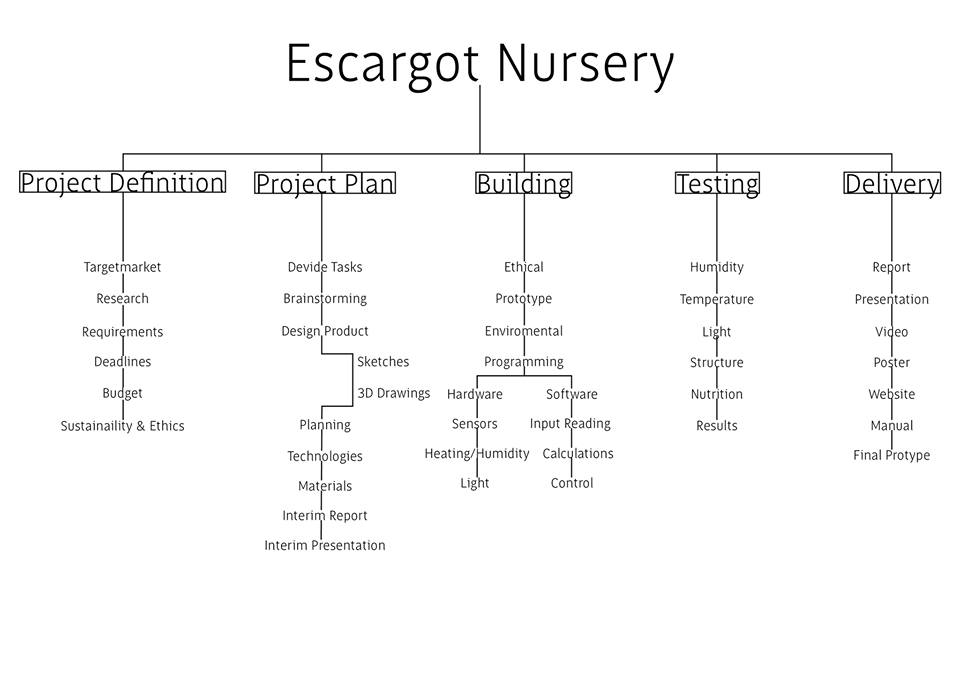
The Work Breakdown Structure (WBS) was an important part of Project Management. The Team had recorded all tasks and divided them into categories. By doing this, the Team could made the WBS as shown in Figure 2.
3.3 Time
Gantt Chart and Deliverables
The Team established the planning of the project using a Gantt chart (see Figure 3).
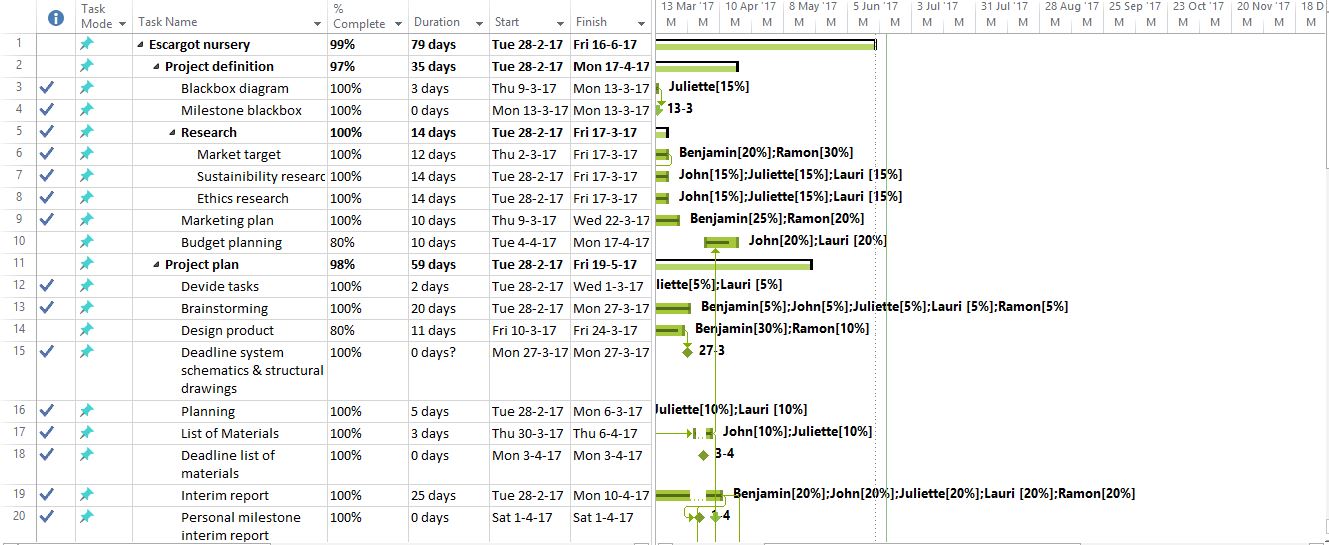
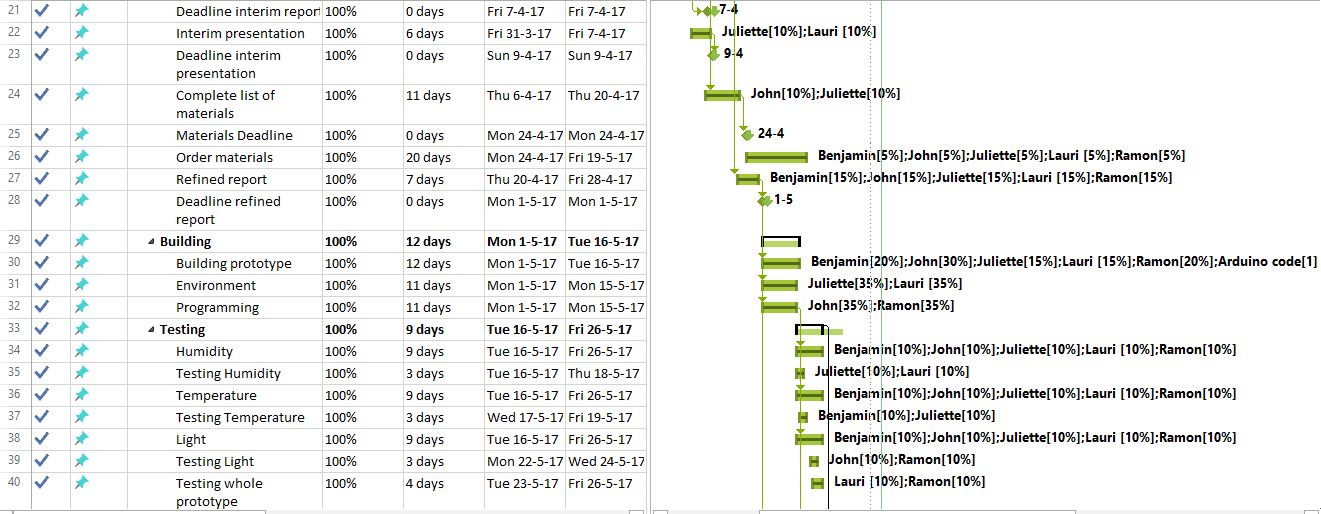
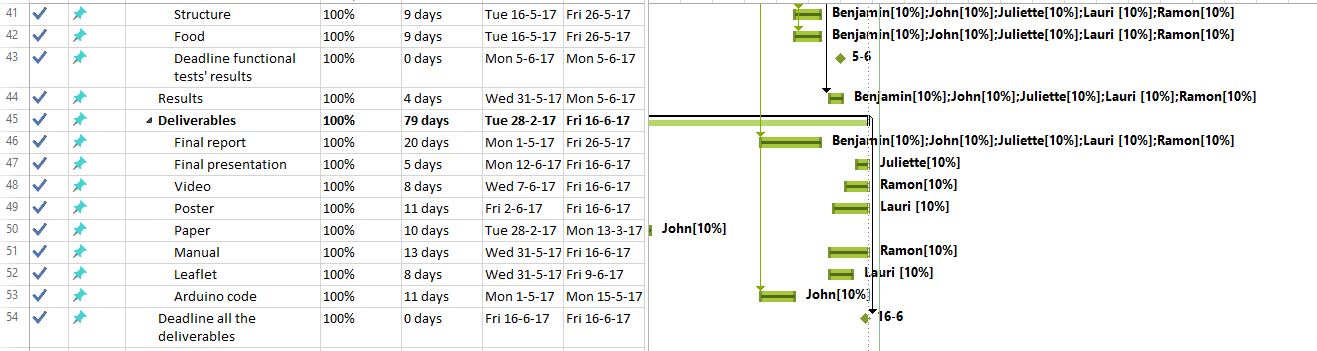
In Table 4 a summary of all the deliverables and deadlines of the project is displayed.
| Deliverable | Deadline |
|---|---|
| Gantt Chart | 2017-03-06 |
| “Blackbox” System Diagrams & Structural Drafts | 2017-03-13 |
| System Schematics & Structural Drawings | 2017-03-27 |
| List of Materials (What & Quantity) | 2017-04-03 |
| Upload Interim Report & Presentation | 2017-04-09 |
| Complete List of Materials (local providers & price) | 2017-04-24 |
| Interim Presentation | 2017-04-20 |
| Upload Refined Interim Report | 2017-05-02 |
| Upload Functional Tests' Results | 2017-06-05 |
| Upload Final Report, Presentation, Video, Paper, Poster and Manual | 2017-06-18 |
| Final Presentation, Individual Discussion and Assessment | 2017-06-22 |
| Hand in a CD with the Corrected Deliverables | 2017-06-26 |
| Hand in the Prototype and User Manual to the Client | 2017-06-29 |
| Receive the EPS@ISEP Certificate | 2017-06-29 |
3.4 Cost
When managing the project, it was essential to monitor the costs to remain within budget. The costs relating to a project were the costs of the materials used and also the costs of the labour or the workforce (see Figure 4).
Cost management could be done through a pre-established process:
- First, the plan for cost management needed to be produced. This meant that all the internal procedures must be established so the budget could be assigned in the correct areas.
- Next a cost estimation needed to be done to evaluate the costs of materials.
- Then the budget can be determined.
- During the project, the Team needed to manage costs. This step consisted of updating project costs and managing changes affecting the base cost reference.
As the budget had been set by ISEP, which was 100.00 € to build the prototype, the principal requirement in regarding to the costs during this project was to manage the costs and stay within the budget.
The material resources for building the prototype are showed in Table 5
| Product | Quantity | Cost (€) |
|---|---|---|
| 16×2 I2C LCD Display | 1 | 8.50 |
| Fan 12V PC Fan | 1 | - |
| Arduino Uno | 1 | - |
| Luminosity Sensor Breakout - TSL2561 | 1 | 6.50 |
| DHT22 | 1 | 9.80 |
| Resistors | 4 | 0.20 |
| NPN Transistor | 2 | 0.98 |
| Solenoid 12 V | 1 | 9.40 |
| Capacitors | 4 | 0.60 |
| LED Strip | 3 | 8.88 |
| Wiring | 2 | 0.50 |
| Arduino Power Supply AC/DC 230 VAC/12 V 2 A | 1 | 7.50 |
| ULN2003 Stepper Motor Driver Board | 1 | - |
| PVC Sheets | 2 sheets of 100 cm x 50 cm | 21.58 |
| Polymethylmethacrylate (PMMA) | 0.137 m2 | - |
| Plastico autocolante black and white | 4 | 5.72 |
| Clear plastic tube | 1.5 meters | - |
| Nylon Mesh | 1 | - |
| UHU Allplast | 1 | 4.00 |
| Shipping costs | - | 8.22 |
| Total | 95.53 |
Thus, the total costs of the materials was 95.53 €.
The work resources for building the prototype shown figure 4

3.5 Quality
According to standard ISO 8402-1986 quality is “the totality of features and characteristics of a product or service that bears its ability to satisfy stated or implied needs”. The quality of a product is a pillar of the success of any business. If the product is of good quality, consumers will be more inclined to buy products from the company again, i.e. Brand Loyalty, but also if people experience a high-quality product and service they are more likely to recommend the product to their friends and family, which has the added bonus of being free advertisement. Quality is the key indicator of the success of the project, but it’s also an obligation since companies must comply with a certain number of standards in terms of quality such as ISO 9000 and ISO 9001. With such high importance being put on quality, most big companies have a department dedicated to quality management [34].
Quality management is a process that started at the very beginning of a product's design. When designing a product, the product designers and engineers made sure that the materials that are used are fit for purpose, for example a hairdryer could not be made from plastic that can melt easily. Using quality management techniques such as acceptance sampling, engineers could determine if the materials that were used within the product were of satisfactory standards. If a company is using a particular brand of bolts, they will test 3 % of the batch, depending on batch size, and if the bolts are not accepted then the bolts will be sent back to the supplier [35].
In the “EscarGO” project the materials were purchased from reputable sources, and non-destructive tests were conducted before use of the prototype. Solidworks software was used to build 3D models, and also for the electronics. By using open source software, the design of the electronics were carried out and simulations were undertaken before the electronic components were built and assembled.
Testing the prototype was an important part of the quality, the Team wanted to deliver a product of quality. Figure 5 shows that all the parts that needed to be tested, sensor of humidity, temperature and light were be tested one by one. This was important because when a test failed, the Team knew instantly what the reason was. After testing the parts one by one, the whole prototype was tested.

Quality needed to be ensured for the duration of the life of the product, by providing after sales service in case of any problems and a warranty. The after sales service was also a measure of the success of the “EscarGO” society because if customer problems were solved quickly, they would be more satisfied.
3.6 People
Human resource management or people management was an important part of project planning. It included the activities and processes, in which each team member was involved. The tasks were assigned to an individual, but each person assisted the others with input in team meetings. The tasks were assigned on a skills basis. The Team consisted of so many differing backgrounds and specialisms which brings something unique to the Team (see the following section).
3.6.1 RAM
The group used a Responsibility Assignment Matrix (RAM) (see Table 6) as an essential part of their project planning.
| Task | Benjamin | John | Juliette | Lauri | Ramon | Supervisors |
|---|---|---|---|---|---|---|
| Gantt Chart | A | R | A, C | |||
| BlackBox | A | R | A, C | |||
| Structural Drafts | R | A | A, C | |||
| State of the Art | R | R | R | R | A, C | |
| Eco-effiency Measures for Sustainability | R | R | R | A | A, C | |
| Ethical and Deontological Concerns | A | R | R | A, C | ||
| System Schematics | A | R | A, C | |||
| Structural Drawings | R | A | A, C | |||
| Cardboard Model | R | R | R | R | R | A, C |
| Marketing Plan | R | A | R | A, C | ||
| Project Management | A | R | R | A, C | ||
| List of Materials | R | A | I | A, C | ||
| Interim Report | R | R | R | R | A, C | |
| Interim Presentation | R | A | R | R | R | A, C |
| Building | R | R | A | R | A, C | |
| Programming | A | R | I | T | A, C | |
| Testing | R | T | T | T | T | A, C |
| Website | A | I | R | A, C | ||
| Video | R | A | R | A, C | ||
| Leaflet | R | A | R | R | A, C | |
| Paper | R | R | A | A, C | ||
| Poster | A | R | R | A, C | ||
| Manual | I | A | R | A, C | ||
| Final Report | R | R | R | R | R | A, C |
| Final Presentation | R | R | R | R | R | A, C |
- R: Responsible
- A: Approval
- C: Consultant
- I: Informant
- T: Tester
3.7 Communication
In order to achieve the best possible project, it was essential to ensure good communication within the group. Since everyone came from different countries, with different languages there may be problems with comprehension. Thus, it was very important to be clear, rigorous and to repeat the explanations if necessary.
Moreover, as everybody came from different specialties, all having differing knowledge bases, that was why it was very important to communicate in order to develop ideas, and consider perspectives from fresh eyes. In addition, communication was essential in order to resolve any problems that may arise within the group. To work in good conditions, it was important that there was a good atmosphere without underlying problems.
There were many means of online communication that could be used to improve communication when the Team was not together at school.
First of all, when the Team wanted to organise meetings, ask their colleges for help or divide the tasks, the Team could use the Messenger application in Facebook. Messenger was very useful when several people wanted to work on the wiki because, it was not possible to work at the same time as the work would be lost. The Team also used both Dropbox and Google Drive so everyone could upload their work to a shared online platform and furthermore, different people could work at the same time on the same document on Google Docs. This was also good for a backup safeguard. The fact that everyone had access to everything, allowed the whole Team to have a view on the whole project. So, everyone could express their opinion on the work accomplished.
The Figure 6 represents the distribution of the various means of communication mentioned above. Oral communication represents half the diagram because the Team spent a lot of time in school working together. Google Drive was used more than Dropbox because it allowed the Team to write in a shared document, several at the same time and that was more convenient. The Team also used a lot of Messenger because it allowed them to talk in real time even if they were not together. At the beginning WhatsApp was used but since it was not practical for everyone, it was abandoned as a means of communication.
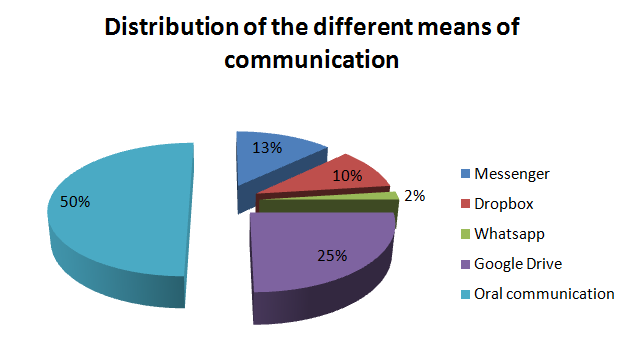
Table 7 shows the communication matrix.
| What | Why | Who | When | To whom |
|---|---|---|---|---|
| Deliverables | To develop the project | The Team | On the date of the deadline | The supervisors and the Team |
| Weekly supervisor meetings | To discuss about the progress of the project | The Team | Every Thursday | The supervisors |
| Agenda | To inform supervisors about the topics of the meeting | Team member who was responsible for the agenda that week | Before every Thursday | The supervisors |
| Brainstorming sessions | To discuss about the different ideas, project planning | The Team | Multiple times a week | Other team members |
3.8 Risk
Risk management was an ongoing process that identifies the risks involved with each task and provided a solution to mitigate risks to the health and safety of the individual or group that were involved in the task. In this project, to avoid risk, the Team decided to identify and analyse all the potential risks that may arise and think about possible solutions.
Risk management included the following six processes:
- Establish objective
- Identify risks
- Assess impacts
- Assess risks
- Risk control
- Monitoring
Table 8 shows the risk management.
| Risk | Cause | Effect | Trigger | Response | Impact | Probability | Rank |
|---|---|---|---|---|---|---|---|
| Broken components | Poor quality of the components | It will be not possible to build a fully working prototype of the product | Prototype testing failure | Quality check of components on arrival (mitigate) | High | Medium-low | 4 |
| Not meeting the interim deadlines | Bad planning | Lower grade | Teachers and coordinators bad input | Good planning. Weekly tasks. Communication (avoid) | Medium-low | Low | 8 |
| Illness of the team members | Bacteria, virus or a work accident | Slowing down the work rate and quality | Team member feels sick | Follow a healthy lifestyle (accept and transfer) | Medium | Low | 6 |
| Faulty components delivered | Components broken because of bad protection while transporting | Cannot build the prototype before the deadline | Material delivery check | Check for shop's reviews before buying (avoid) | High | Low | 5 |
| Tests fail | Bad or wrong components | A non-working prototype | Prototype testing | Test all the components one by one, before testing the entire prototype (accept and mitigate) | High | Medium-low | 3 |
| Inappropriate material selection | Bad materials research | Impossible to construct the designed model | Prototype resting | Ask teachers and supervisors for advice (mitigate and transfer) | High | Medium | 2 |
| Conflict with stakeholders | Bad communication | Slowing down the development of the project | Communication with the stakeholders | Implement communication plan and measure and meet stakeholders expectations (avoid) | Medium | Low | 7 |
| Electronic problems | Insufficient knowledge about electronics | Product will not work | Electronic schematic is not finished | Ask for help (accept) | High | High | 1 |
3.9 Procurement
Procurement was the process of acquiring and buying products, goods or services from external suppliers. The process was used to make sure that the Team received products at the best possible price but also high quality compared with other external suppliers, i.e. the best value.
For this project, the Team was only allowed to choose suppliers from Portugal, which meant that there were more restrictions on what could be used in the final product. In some countries, the components that were needed to build the prototype, were cheaper, better quality than in Portugal and in some cases, could not be found with Portuguese suppliers. This produced a design challenge and made the Team think harder about the materials that were contained in the design solution.
3.10 Stakeholders Management
Stakeholder management was an important part to make the project successful. The stakeholder was a person that had influence over the Team or was influenced by the Team, whether that be an investor in the business, or someone who's livelihood is tied up in the business. A part of the stakeholders management could be, making sure that the Team was meeting the deadlines, making a product of good quality and that the product was going to make money.
In this project, there were different stakeholders with different expectations. The stakeholders in this project were the supervisors, the Team members and the university. Table 9 shows the stakeholders.
| Who | Role | Expectations | Power | Influence |
|---|---|---|---|---|
| The Team | The Team develop the project | Learn new skills and develop a working product | High | High |
| Supervisors | Supervise the project | Receive an interesting project and a working product | High | High |
| Teachers | Give information about different subjects | Gain knowledge that is necessary and receive an interesting project | Low | Medium |
| Suppliers | Provide materials | Sell the materials | Low | Low |
| Consumers | Buy the product | Receive a good working product | Low | Medium |
| ISEP | Sponsor | Receive interesting projects | High | Low |
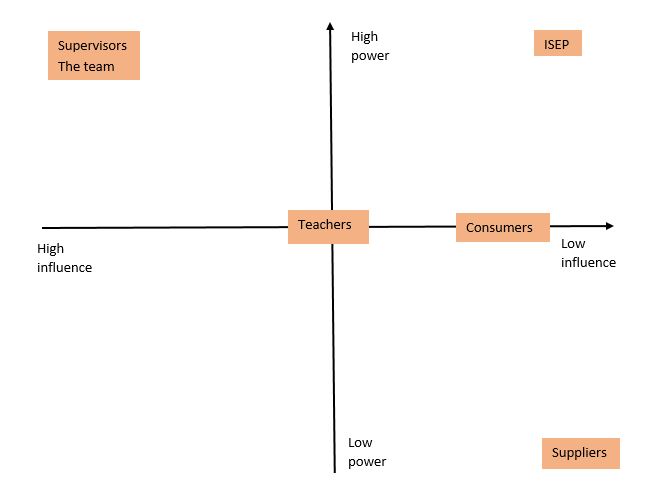
The graph in Figure 7 gave another view of the influence of the stakeholders.
3.11 Conclusion
To conclude this chapter, project management was one of the main aspects of the realisation of the project. Project management was a useful and important tool for the team members to identify all the tasks and time limits, to guide the cost and the budget, to measure the risks and to analyse the responsibilities of the people that were involved.
The main objective was to organise the project planning in an efficient manner. The project planning ensured each team member was clear of their responsibilities, identified the time limit and the tasks that needed to be done. The Team made a Gantt Chart with all the time limits and tasks highlighted for each team member. With using the Gantt Chart, the Team was up to date with all the tasks and time limits.
In the next chapter the marketing aspect of “EscarGO” is introduced.
4. Marketing Plan
4.1 Introduction
Marketing was the set of actions undertaken to encourage people to buy a product or service. In this chapter, an explanation about the market situation analysis, potential customers, segmentation and target market, strategies, product, price and promotion was also discussed. The analysis started from a macro level, going closer to the own business. All levels had an impact on the activities and decision making of the company. Taking into consideration this data, the Team provided a suitable marketing plan for the product, explaining the necessary actions to achieve the marketing objectives covering the first year of the product launch.
4.2 Market Analysis
4.2.1 Macro Environment
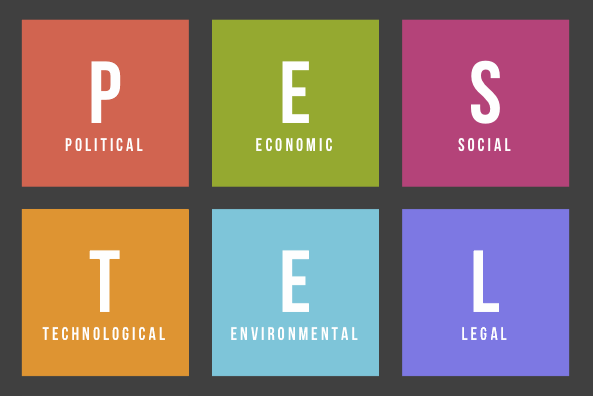
The first step of the market analysis was a Macro Environment Analysis where the Team tried to define possible opportunities and threats within the industry. These factors were external and uncontrollable by the Team, they affected the performance and decision-making. The macro environment could be divided using the Political, Environmental, Social, Technological, Legal and Economic (PESTLE) model (see Figure 8).
Political/Legal
The political/legal factor defined to what extent politicians, the government and legal directives had an influence within the industry. In the case of the Escargot Nursery, many governments supported the idea of home production of food [37]. Also, food education is a big topic, as big budgets are spent for healthy students. The Escargot Nursery could be used at home, but also for educational purposes in school.
Since this product used living animals and these may be used for cooking at home, care needed to be taken about norms related to living creatures as well as nutrition and health laws. In order to release the “EscarGO”, the Team had to comply with E.U. legislation related to selling consumer goods in Europe (see DIRECTIVE 1999/44/EC OF THE EUROPEAN PARLIAMENT AND OF THE COUNCIL of 25 May 1999) and product safety (see DIRECTIVE 2001/95/EC OF THE EUROPEAN PARLIAMENT AND OF THE COUNCIL of 3 December 2001), but also food contact materials regulation (see Food Contact Materials - Regulation (EC) 1935/2004 ).
Environmental
The carbon footprint of the food was reduced in different kinds of ways. First of all, it eliminated the food transportation from the other side of the world to the dinner table. Moreover, molluscs and insects were used instead of meat as protein source, because meat production spills enormous amounts of fresh water and energy. Special attention was needed when choosing materials for the product. Instead of using production techniques for assembly of a product with a linear life cycle (production to landfill), circular life cycle should be considered.
Social
The social environment analysis defines cultural, demo-graphical and behavioural trends, values and norms. Social media was becoming increasingly important in our culture [38]. That was why the project needed to incorporate social media when it came to marketing but also improve the real-life contact between the users. It had to connect the different members of the family in order to improve social cohesion. Other social trends like going back to the basics, growing your own food and food education work in favour of the home Escargot Nursery.
Technological
Technological trends focused on the change in use of technology. Automation of some processes like temperature and humidity control made maintenance much easier. Internet Of Things (IOT) was already used in a lot of products and its use was only expanding. Therefore, it would be a possibility to implement it in the Escargot Nursery future development as it also improved social connection. Technology was needed to improve and optimize the life cycle of the snails (heating/humidity/light).
Economic
Economic factors described elements of the economy that had an effect on the industry and the company itself. These factors could be the price of energy, inflation, income etc. Escargot were expensive as food and with the Escargot Nursery customers could produce the snails themselves for home use or for (small) commercial interests.
4.2.2 Micro Environment
The micro environment was external factors not controlled by the Team, which directly affected the decision-making and performance the Team had to undertake. These elements were: customers, suppliers, intermediaries, public and competitors.
Customers
The consumers were the intended target group for which the Escargot Nursery was designed. The needs of the customers had to identified, implied, satisfied an anticipated. It was important not only to sell the product, but also realise a long-lasting customer relationship.
There are two different customers:
- The home user: the home user wanted a product to grow snails for the purpose of consumption. Snails were a delicacy and were therefore not cheap.
- The educational user: the educational user focused more on the development of the snails than on using them for food.
Suppliers
Suppliers provided the necessary resources that enables the company to make its products or services. The Escargot Nursery contained many electronic parts, such as sensors, user interface, controller, heating and cooling device. There was also the material needed to build the casing and the interior of the terrarium. All of these components were bought in Portugal. To get the best parts and materials at the lowest prices, extensive research was needed.
Intermediaries
Intermediaries stand between the customers and the company. They are the middlemen who promote, distribute and sell the product to the users. The Escargot Nursery would be sold Business to Business (B2B) and mainly as Business to Consumer (B2C) as well. Because the nursery was a relatively new product, potential customers would not know of its existence. The B2B market gave the company a wide reach and product visibility. In addition to the B2B market, the company could sell directly from the website. These days, internet selling is a standard practice and done by almost all companies.
Public
The public was a broader and more general term than targeted customer, but they also had actual or potential interests in the product. While designing, making and selling the Escargot Nursery the Team had to take into account some groups beside the intended consumer. One of these groups were the animal protection groups like People for the Ethical Treatment of Animals (PETA). The product had to be of decent quality, and provide the snails with a very comfortable habitat so consumer protection groups would not protest. Another group to take in account was the media. They had great power to make or to break the sales of the product.
Competitors
Competitors also influence the actions made by the company, because they offered similar products or services. There was a difference between direct and indirect competitors.
The one and only direct competitor was the GROW YOUR OWN ESCARGOTS by S’cargo (see Subsection 2.3.1 Products for Home Use). S’cargo was a company owned by Helen and Rachel Howard who were artisan food producers. The product had a bell-shaped propagator and saucer. Additionally, there was a detailed care instruction to help keeping the snails healthy and growing. Before the consumer could start, he had to send a card to receive the escargots and dry food at home. The price was 35 £ Sterling and the dimensions are approximately 29 cm x 28 cm x 29 cm.
The advantages of this product were the low price and small dimensions. There was no technology included in the product which makes it easy to use and consumed no energy.
Disadvantages were the high number of attention needed to grow the snails. The dimensions were small, so only a small amount of snails could be kept inside. Temperature and humidity was not controlled so the snails could die without the right care. Carbon monoxide poisoning was also a problem as the whole structure is sealed
Indirect competitors made product that were similar to the snail farm, but were meant for other purposes. Some snail enthusiast kept their pets in aquariums or terrariums. For these product, there was a much bigger market. They existed in every price class and with different amount of technology. Professional snail farms made their own snail huts. Usually they were made from wood and/or nets and the focus was on food production, not usability, aesthetics or education. But these professional snail farms needed a lot of care and attention.
4.3 SWOT Analysis
This Strength, Weaknesses, Opportunities, and Threats (SWOT) analysis was used to warn the Team about the dangers that developing this product may have had, and also to help the Team make the most of their possibilities. These four factors must be divided into external (opportunities and threats) and internal (strengths and weaknesses). Internal factors were those the Team could control, while the ones that were outwith the Team's control are the external factors, most likely consumers and competitors (see Figure 9).
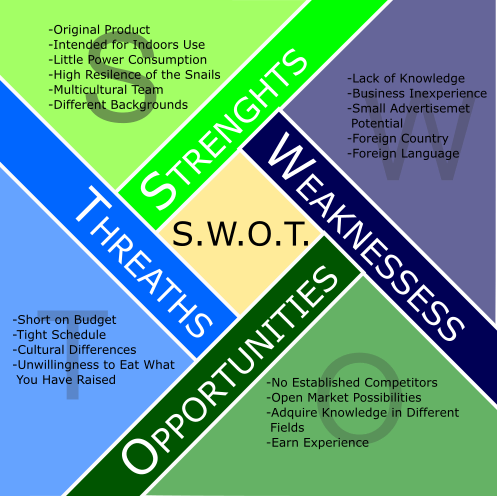
The project had some weaknesses. First of all, before the start of the project, none of the team members knew anything about snails and their breeding which was an obstacle to overcome. In addition, none of the “EscarGO” Team really have had any serious business experience and since the product did not have direct competitors, they could not study their marketing strategies. The Team had a small advertising potential because, at the time, snails were not known to the general public as pets. Many people found snails disgusting and the idea of raising snails was really odd for them. The team members came from different countries and did not speak the same first language, which could represent a weakness to communicate with one another and made their points of view clear, but the Team saw this as a benefit, as it brought a wide range of knowledge, and meant that the sources that could be used for research could be in many different languages. Everyone communicated in English, which the Team spoke to differing levels.
This product also had many strengths. It was an original product because it did not exist on the market. So, the idea was very innovative and would prove to be a curiosity for potential customers.
As one of their main objectives was to make the product as sustainable as possible, the product did not require a lot of power since it was intended for indoor use, reducing the need to change the atmospheric conditions of the inside of the “EscarGO”
The Team needed to take advantage of the opportunity to be a leader in the market. “Caracol” had no competitors, and that could be an opportunity to develop the product and start a new and wide market. This was a project where team members came from different degree programs in their home Universities, they could acquire knowledge from the others and improve their own skill set. Moreover, it was an opportunity to learn how to lead a Team, and simulate a project in a professional environment.
Despite the opportunities, the project also had threats. The Team had a budget of 100.00 €. “Caracol” had to make choices in order to remain under the budget. Additionally, the Team had a tight schedule which they found to be difficult to manage the time. There was also the issue where the workshop was only open at certain times and could only be used for 3 hours at a time. To conclude, other potential threats were that a lot of people do not want to eat the snails they have bred. For instance, most people who raise rabbits, or any edible animals, found the idea of eating them inconceivable as they were pets.
4.4 Strategic Objectives
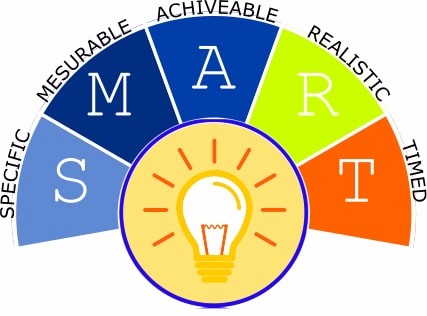
In Table 10, in order to achieve the long-term success of the “EscarGO” product, the Team stated the Specific, Measurable, Achievable, Realistic, Timed (SMART) objectives that were used as a reference to measure the past, present and future of the company in a realistic approach (see Figure 10 ).
| Objective | Description | Time |
|---|---|---|
| Final product | Build the final fully-functional “EscarGO”. | August 2017 |
| Launch development | Obtain funding. Reduce production costs. Start the publicity campaign. | September-November 2017 |
| Product launch | Sell the product through the company’s website in the Christmas campaign. Sell at least 20 units. | Christmas 2017 |
| First year | Find a distributor/supplier. Increase the production and sell more than 150 units during the year. | 2018 |
| Expansion | Promote and sell the product in other European countries, like Spain. | 2019 |
4.5 Segmentation
The Team divided the market into smaller segments to be reached more efficiently and effectively. This study helped the Team to be aware of the market segmentation and areas that are more likely to be interested in “EscarGO”.
4.5.1 Geographic Segmentation
In the Geographical Segmentation study, the Team decided which countries would be their target markets. The “EscarGO” product would mainly be sold as an educational and recreational product, but it would also be advertised as a way to grow your own snails at home for consumption, to reach other target markets. For this reason, the Team did research on which countries consume the most snails, in order to find those countries where the cultural barriers related to snails would be less important [39].
Snail meat is healthy and nutritious, and is relatively high in proteins, and in addition there is high amount of omega-3. It is also a source of minerals (mostly Ca, P, K, Mg, and Na) [40], but due to cultural issues it was not consumed globally.
It was estimated that over 400 000 t of snails were consumed every year around the world [41] (it is thought that a higher number was actually consumed due to a large proportion of snails that had been hand-picked from nature) [42].
Only 15 % (67 500 t) of the global consumption came from snail breeding units while the largest amounts of snails traded in the market came from nature (85 %) [43] [44].
The largest consumer markets were located in Europe. Three countries had the highest escargot demand. These were France, Italy, Spain. The difference between France and the other two was notable though (see Figure 11).
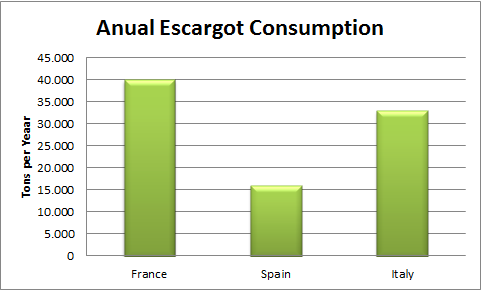
In France, they usually consumed more than 40 000 t of snails a year [45] [46] [47]. Italy ranked second in the list of EU snail meat consumer after France. Italians consumed 37 000 t of snails meat during 2010 [48]. Their usual consumption was around 33 000 t a year [49]. Spanish, in third place, consumed 16 000 tons of snails a year [50].
What held true for the three of them is that all these three countries were heavily in deficit (see Figure 12). Specifically, in France more than 80 % of domestic consumption was covered by imports. In Italy about the 65 % whereas in Spain the 55 % [51].
In France, in 2010 there was a shortfall of 90 000 t snails due to their high consumption that year. Based on this information, it was expected that this need for snails would not be covered even in the next 10 years [52].
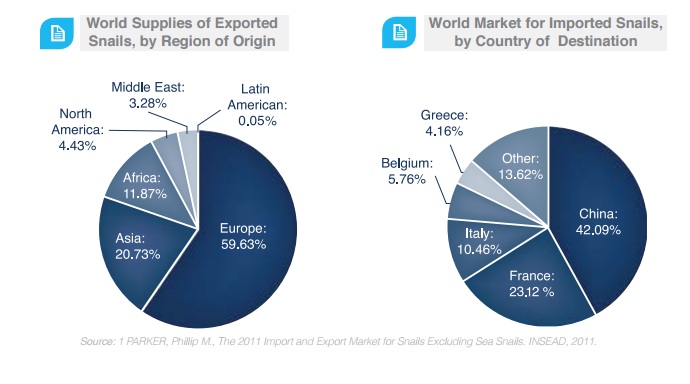
The highest consumption of snails per person had been recorded in Greece; about 40 000 t in 2015 [54], though their average total consumption every year is usually lower. There, according to the Presidential Act 67/81 (FEK 43/A/ 1981) collecting snails from nature is permitted only from March until June [55].
Based on these statistics ,the Team decided to focus the market mainly in France for their first active year. Later on, the Team would consider expanding their business to other countries like Italy, Greece or Spain.
All of these countries had a mild climate without extreme conditions allowing the growth of snails, since the Cornu aspersum is natural from this climate (see Section 2.4 Escargot Research). For this reason, the climate control of the product would not require a non-sustainable amount of power to achieve the optimal living conditions.
4.5.2 Demographic Segmentation
The product’s size was meant for home use, so the marketing strategy tried to approach families living in the big cities of France, for instance Paris, Marseille, Lyon, Toulouse or Niece (see Figure 13).
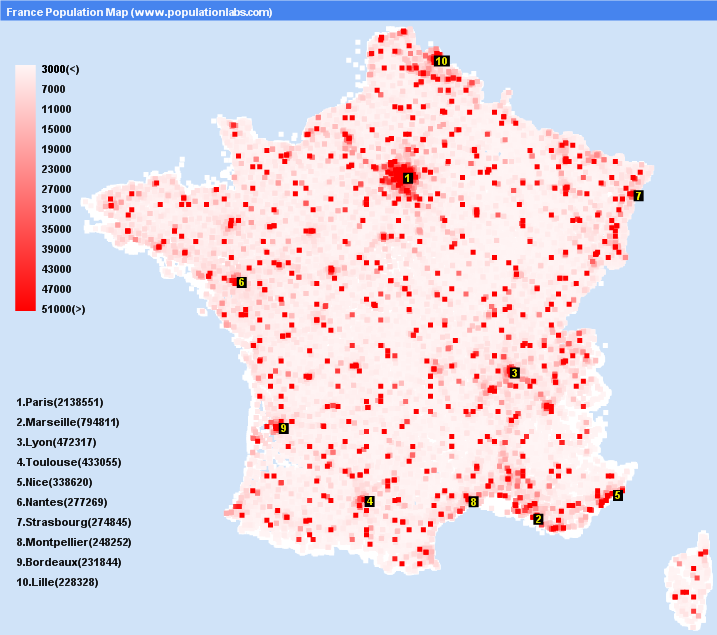
Additionally, the “Caracol” Team decided to focus on the population segment with the following characteristics :
- Age:30 to 35 years old
- Family size: in a couple / married - preferably with children. For educational target purposes
- Income: medium to high
- Type of accommodation & situation: flat in a busy French city center, far away from nature
- Professional situation: working
The Team decided to advertise the “EscarGO”mainly as an educational product and chose to aim for an age range of between 30 and 35, based on statistics (see Figure 14) that showed it was the age when people in France seemed to be starting a family [57]
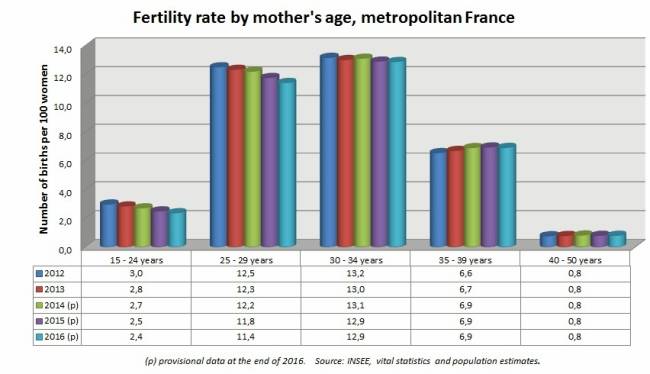
At the time of publication, France had a total population of 66 990 826 people. The age sector of 30 to 35 years old population comprised a total of people 4 947 116 (7.38 %) [58]. This demographic sector of the french population seemed not to be growing or decreasing at the time of the study (see Figure 15).
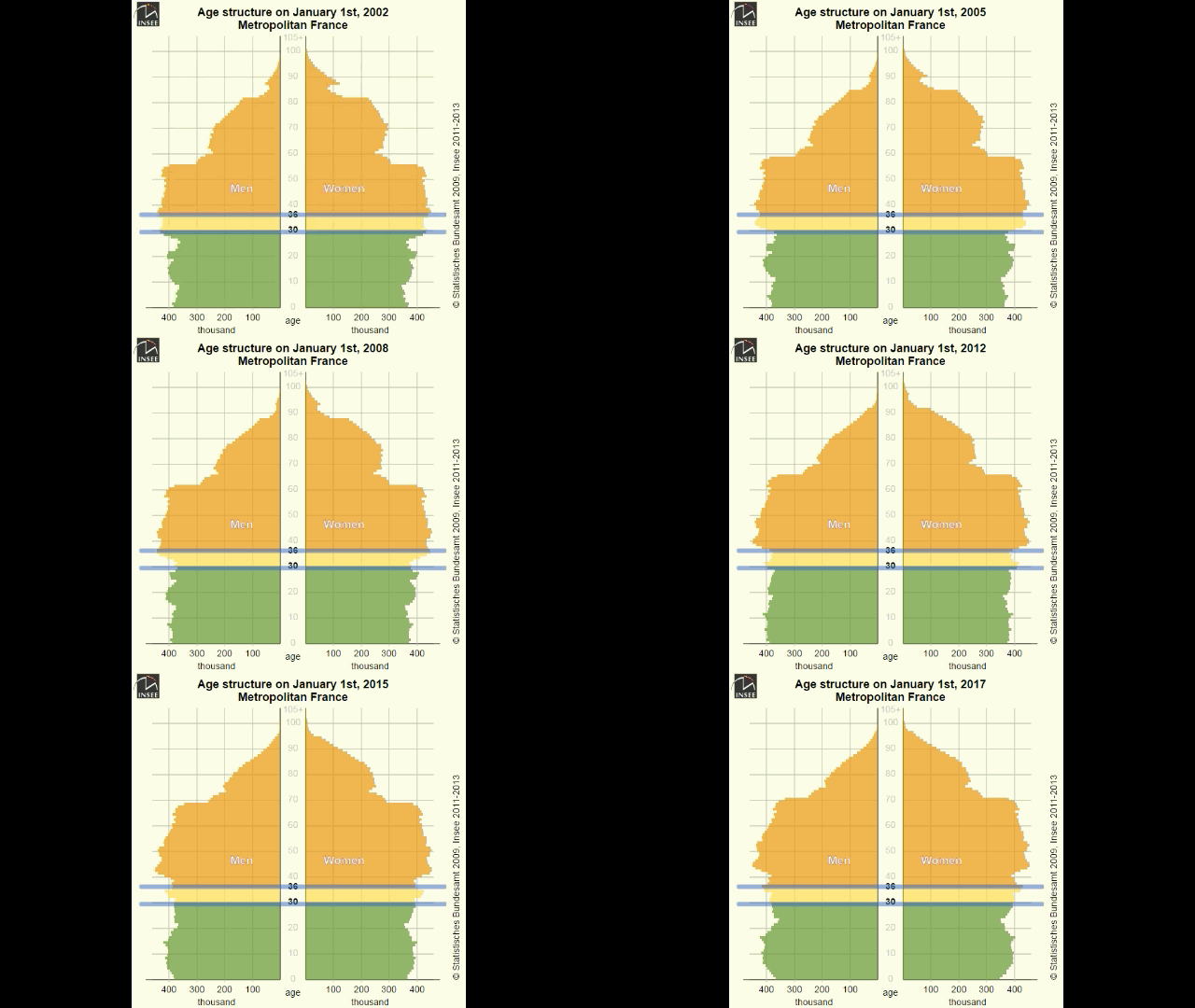
4.5.3 Psychographic Segmentation
The Team, based on the statistics introduced in Geographic Segmentation and Demographic Segmentation chapters, decided to focus on median income working class families who live in a busy environment filled with distractions and technology. Parents craving additional quality time with their children, worried about their education, since they were easily exposed to many different kinds of media coming from TV and Internet. The product the Team decided to make, provided a solution that allowed the user to not have that much interaction with the snails as other pets did (fish, etc.), by the use of automatic humidity and temperature control systems and also because of the high resilience of snails as animals. For these reasons, the group thought this product would be attractive to families living in a busy environment, that may not have that much free time to spend on a pet.
If children asked to have a pet, the “EscarGO” would require less work and time than a dog for example. The “EscarGO” would require much less work, only requiring one cleaning every three months. The rest of the time the only interaction that the snails require is feeding.
4.5.4 Behavioural Segmentation
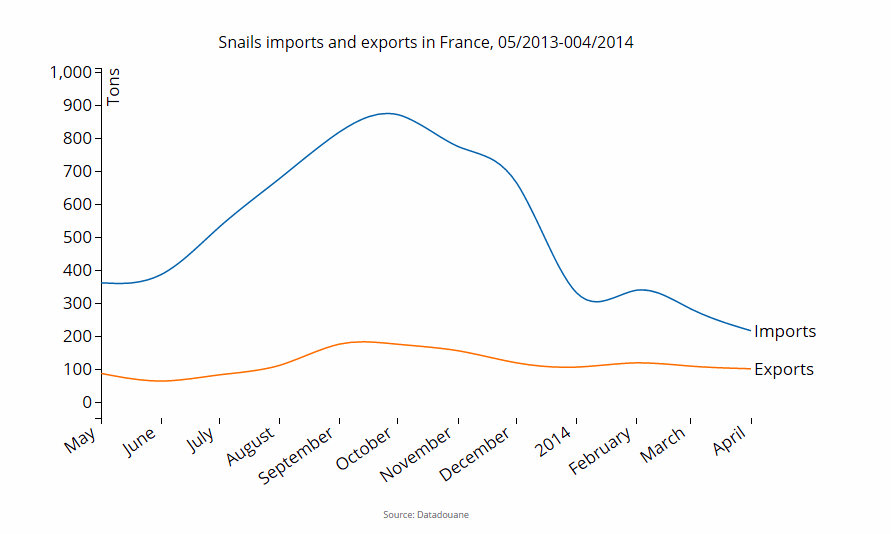
This product aimed to attract modern families who live in a busy environment filled with distractions and technology. The Team also noticed that escargot was a common Christmas dish in France. Two thirds of the French escargot production per year were consumed during the Christmas period [60]. The imports seemed to peak just before the end of the year as a result of this traditional festive dish [61] (see Figure 16).
Customers would only buy this product once. For that reason, loyalty was not as important as user satisfaction and customer reviews were. The aim was to get parents recommending this product to their friends with children, while the children would talk with their friends from school about the fun product they owned.
4.5.5 Levels of Market Segmentation
There were four different levels of marketing segmentation:
- Mass Marketing: same product to all consumers
- Segment Marketing: different products to one or more consumers
- Niche Marketing: different products to one or more segments
- Micromarketing: products suit the tastes of individuals and locations
The Team decided to aim their Mass Marketing strategies towards French people aged 30 to 35 years old. The group applied a Niche Marketing strategy, to advertise the product mainly as an educational and recreational product for families, but also as a gastronomical experience for couples or single people wanting to grow their snails for consumption at home. In the future development of the company, “Caracol” would also advertise themselves for B2B companies that may be interested in the product, like schools and pet shops (education/recreational) or small restaurants or food shops (gastronomy).
4.6 Strategy/Positioning
A clear position in the market provided the company a competitive advantage over other similar products. The positioning strategy allowed the company to differentiate themselves from competitors. It provided an image for the customer and is based on the segmentation section. Besides meeting the needs of the end user, it was also important to find a gap in the existing market.
To determine the company's position in the market, certain tasks had to be undertaken:
- Identifying Possible Competitive Advantages.
- Choosing the Right Competitive Advantage.
- Communicating and Delivering the Chosen Position.
The existing market consisted of one direct competitor (S'cargo) and a lot of indirect ones (see Section 2.3 Existing Products). If the Escargot Nursery was to be different from its competitors the following requirements had to be achieved. The Escargot Nursery focused on ease of use, made possible by sensors and electronics. It was the only technological product specific for raising snails. “EscarGO” could be used to keep snails as pets, as well as food production. The real distinction of the product was the social aspect that the product met. The Escargot Nursery brought families together and taught kids about nature and food production.
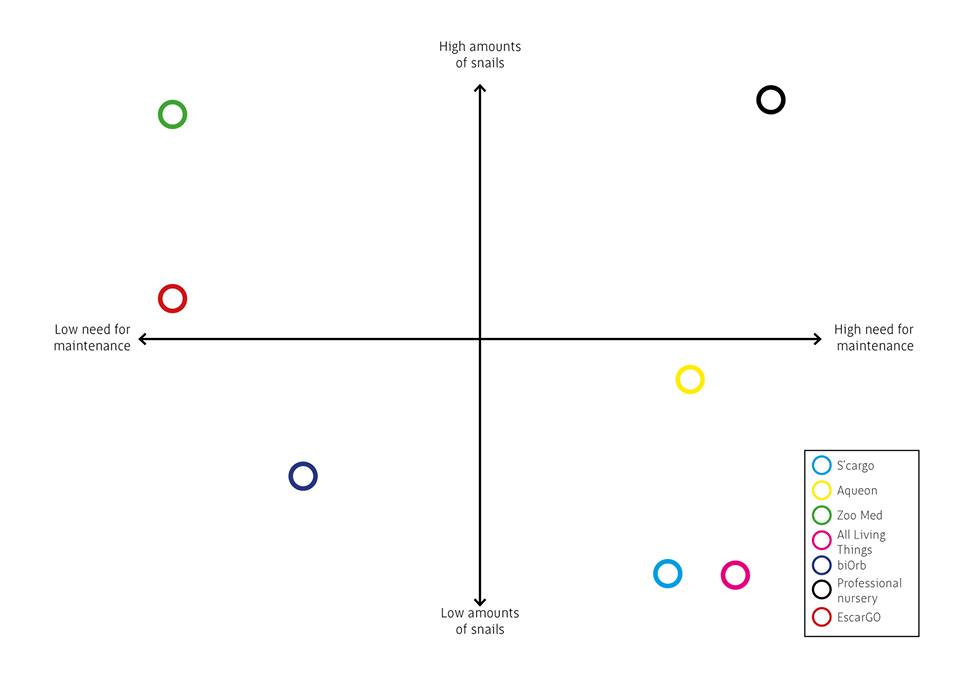
The perceptual map (see Figure 17) shows the connection between need for maintenance and the number of snails the nursery could contain. These two values were important to find a gap in the existing market. All direct and indirect competitors were in the fourth quadrant, which was the one with high maintenance and low number of snails. The quadrant with low number of snails and low amount of maintenance, for example the small led lighted aquarium, had to be avoided because of the size. The professional nursery with high number of snails and high maintenance was not useful for the chosen target market. The only existing competitor in the upper left quadrant were well equipped terrariums for reptiles. The terrarium didn't have to be very large, but big enough for feeding a normal size family for two meals a year.
4.7 Adapted Marketing-Mix
The Team used the marketing mix to adjust their position in the market by taking into consideration the product price, promotion and place (see Figure 18)

4.7.1 Product
The Team decided to use the commercial name “Caracol” for the brand (see Figure 19). The name of the product would be “EscarGO” (see Figure 20). The logos for these commercial brands were designed to be appealing to families and kids.

The product did not have many competitors. Most snail nurseries were not designed to be used as a domestic product. The dimensions of the “EscarGO” had to fit in a normal house or flat. It was also necessary to make the product easy to use so that children could also use it. Since loyalty was not important for a product people would only buy once, the Team wanted to have their clients recommending their product to others.
To comply with legal requirements that all consumer goods sold in the EU had, (see DIRECTIVE 1999/44/EC OF THE EUROPEAN PARLIAMENT AND OF THE COUNCIL of 25 May 1999), the group included a two-year warranty with the product.
4.7.2 Price
To decide the product’s final price, the Team had only one direct competitor to compare it with. “GROW YOUR OWN ESCARGOTS” by S’cargo cost 46.00 € (see Section 2.3 Existing Products). It was only sold online and it did not have any built-in technology. The “EscarGO” could be sold at a higher price since it was a much higher quality product, but the Team had to be careful not to over price the product that it would lead customers to decide to go with the competitors.
It was also a must to take into account the product’s production costs and group’s profit. The Team had a budget of 100.00 € to develop the prototype. Once built and after the tests would be performed, “Caracol” would have to keep the actual production costs of the products around 40.00 to 50.00 €, in order to sell the product on a reasonable profit. Considering these factors, the Team aimed to sell the product at 50.00 to 70.00 € price depending on the economies of scale.
The payment methods their internet site would accept would be PayPal, credit card, and Cash On Delivery (COD), in order to make the sale as easy as possible for the customers. The Team did not plan to add any discounts when buying more units, since this product would not sell large quantities of units to a single buyer. The delivery taxes when sending this product to the metropolitan France would be included in the final price.
4.7.3 Promotion
The Team was very aware of the importance of promotion and advertisement of “EscarGO”. There were a large number of different options available to promote the product, and the right or wrong choices the Team made would determine the success or failure of the product’s launch.
For the Team’s site to reach the target market, the “Caracol” group applied a digital marketing strategy.
It included a careful Search Engine Optimisation (SEO), which consisted on choosing the title of the site, an appropriate description and keywords like “escargot” “pet” or “home” so that the website was accessed through the search providers more effectively.
Another feature of the “EscarGO” site was a Frequently Asked Questions (FAQ) section, along with an explanation video. In the future, the Team would also add a chat option for help. All of these actions were taken to make a more personal approach to selling the product.
The last feature of the Team’s digital marketing strategy was internet advertisement. It allowed the Team to have a full control of the message when promoting the “EscarGO”. The Team decided that pay-per-click Google Ads suited the advertisement of the product in the best way. The website was also optimised for smartphone view, to allow the visitors to enter the site throughout smartphone advertising.
The Team would also consider applying a public relationship strategy that would include giving away the product or the product's poster and leaflet to schools in France for free. The main objective would be the children testing the product at class, while the teachers would test the product as a teaching tool as well.
4.7.4 Place
In this section, the focus was on the marketing and distribution channels for the “EscarGO”.
Thanks to the lack of competitors at the time, the Team decided to sell the product using internet selling and distribution through their website: (https://caracoleps.wixsite.com/escargo) (see Figure 21) The “Caracol” portal is optimised for both desktop and smartphone view. It would include a customer reviews section once the product was launched.

The Team took the decision to sell directly to the consumer through online selling as a main distribution channel. They also considered other marketing channels like specialized pet stores, or supermarkets. These would only be located in crowded cities in France, since there was no need for this kind of product in the countryside. The group decided it was too early for the product to be sold using those channels. The product should be more known before those channels could be used.
4.8 Budget
A budget of 5000.00 € was set aside by the company as marketing budget. This amount of money was used to increase the brand awareness among the French consumers. That way, the Team expected to increase their sales. It included the elements used to get the product ready to be launched to the market and customer communication related actions (see Table 11).
| Action | Budget (€) |
|---|---|
| Leaflet | 600.00 |
| Flyer | 600.00 |
| Website | 1200.00 |
| Google Ads | 1000.00 |
| Social Media | 1600.00 |
| Total | 5000.00 |
4.9 Strategy Control
Strategy control was about the current state and the state in the immediate future of the company. Rather than thinking about past decisions, strategy control controlled the execution of the strategic plans. This control enabled the company to improve and optimize the ongoing processes, but also feedback the ongoing plan to the original plan. The assumptions made by the company in the beginning of the development process about trends, customers and the environment were refuted or confirmed. In order to do this, after the launch of “EscarGO” consumers had to be questioned. This would give the company the right data for the strategic control.
4.10 Target Market Survey
The Team used google forms to make a survey and ask potential customers about their interest in this kind of product and how would they wanted it to be like. The survey was translated into English, French, Spanish and Portuguese. It received 165 responses (see Figure 22) which helped the Team to make some decisions about the development of their product.
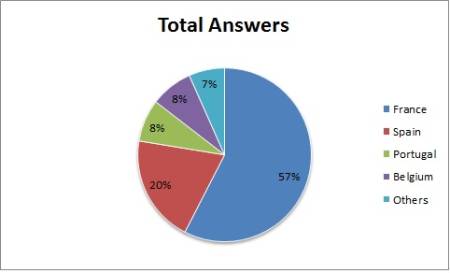
In total, eating snails seemed not to be an attractive option (see Figure 23). But when considering only the french answers, the survey offered more optimistic results (see Figure 24).
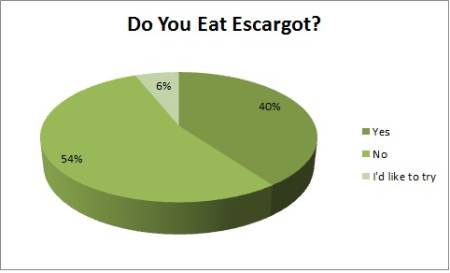
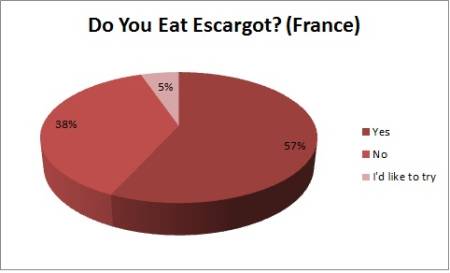
Among the snail consumers, most of them did not eat escargot often in a year (see Figure 25). A home size product like “EscarGO” would host enough snails to satisfy the needs of those customers, since a normal snail dish in France, consists of around 15 snails for 4 people [63].
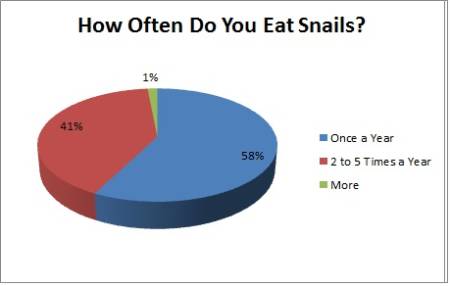
When asked if people would consider having snails as a pet, the survey results were not as positive as expected (see Figure 26). On the other hand, when asked if they would grow snails at home if it was possible, all the positive answers highly increased in all of the countries. This may mean there was an interest for this kind of product (see Figure 27). In both questions, more “Maybe” answers were registered. People seemed to be interested in a product like “EscarGO”, but could not visualize what it would be like with ease.
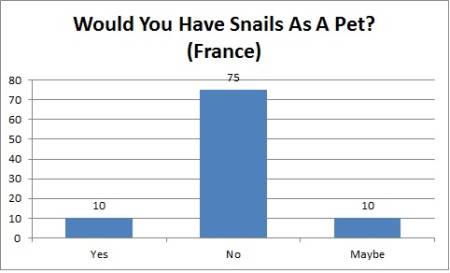
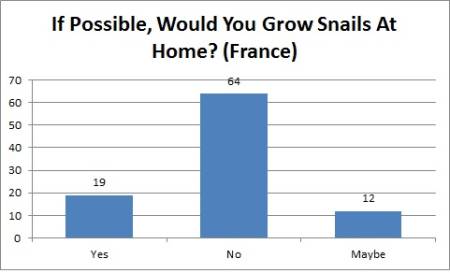
It was clear for the Team to see that their potential customers were not interested in a very technological product, but a rather simple product with just the necessary technology (see Figure 28). To accomplish that, the products design was kept clean and simple.
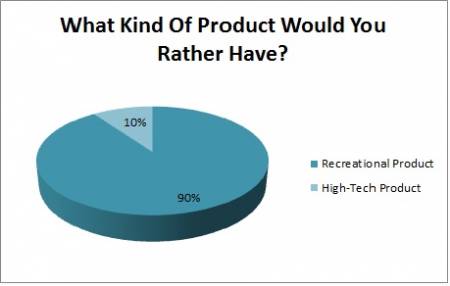
Another conclusion extracted from this survey was the lack of competitors on the market. Few people were aware of the existence of a similar product to “EscarGO” (see Figure 29).
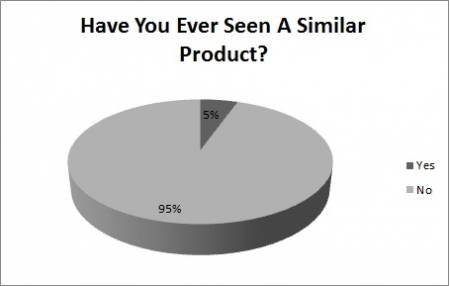
4.11 Conclusion
In this chapter, the logos and commercial names were chosen and it was decided that the product would be sold on the internet. The Team became aware of the difficulties the launch of this product may involve. To diminish these difficulties, the Team looked for the target market the “EscarGO” would fit into. It was decided that France would be the country where the product was launched, since the cultural barriers related to snails appeared to be less important there. They would try to reach two different kinds of customers: the gastronomic user wanted to raise snails at home for self-consumption, and also the user that wanted an educational and recreational product.
Within this chapter the Team developed their marketing plan and applied changes to the “EscarGO” as a result. The product was decided to be a domestic product and therefore its dimensions were not to be bigger than any other appliance such as a microwave that people could have in their kitchens. At the same time, for the ‘gastronomic’ customer to be happy with the product, it was decided that these dimensions should be big enough to host around 50 snails, satisfying this way the customers snail related eating habits.
“Caracol” had to create a product with a simple design and ease of use based on the survey results. Despite the lack of competitors in the existing market at the time of publication, the Team would have to find a way to keep the production costs low enough to sell the product at a competitive price and at a profit of around 50.00 to 70.00 €.
5. Eco-efficiency Measures for Sustainability
5.1 Introduction
Due to this course, the Team thought more about how to be sustainable in production and manufacture, but also within the company. The idea was to reuse as many materials as possible and upcycle as much as possible for the prototype and to use sustainable materials for the final product. This reduced waste but also kept costs down. Natural materials were what was preferred where possible, and natural vegetation for feed rather than synthetic man-made pellets or feed. Another possibility was to use food waste from the kitchen for feed, which was very good for the sustainability aspect of the project.
This project promoted sustainability at home. The Escargot Nursery would be a fascinating way to teach children about where their food came from and what it took to produce food instead of buying from the supermarket. The Team increased the service intensity by using the curtain technique. This technique was already used in big snail farms to increase the liveable surface area. Increased hygiene was also a positive side effect of the curtain method. For this project, the Team used two curtains. This way the same amount of energy was used, but a larger number of snails could be kept in the enclosure.
The Team believed that this project fulfils a genuine need in the market, and sustainability and protecting the environment around us was becoming more and more important to people, as humans had become consumer oriented and did not produce their own food as most used to at the start of the 20th century.
As can be seen in Figure 30, sustainability was a widespread issue, with many sub-sections. Economic, environmental and social issues. It was the consideration of all these concepts that made sustainable development more and more important and all contributed to the Teams understanding of sustainability.
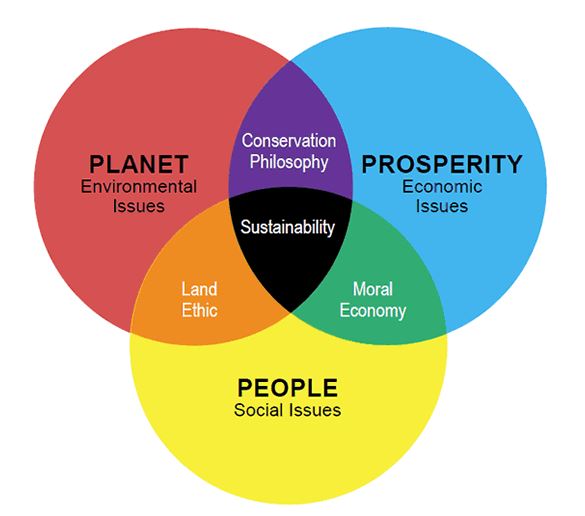
5.2 Environmental
Environmental sustainability referred to the protection of the natural environment and its resources to protect the planet. Environmental sustainability referred to the ability to reuse materials or resources indefinitely, so the use of trees, for wood and paper because trees could be grown back easily. Avoiding the use of fossil fuels as once consumed cannot be regenerated. Once the world's oil supplies have been depleted then that means that polymer plastics cannot be created anymore. Recycling waste thermoplastics was essential in reducing the dependence on new production and allowed for more resources to be available in future. The Team could also recycle glass and metals, which limited the need for additional mining and damage to the natural environment. If the resources and materials used cannot be reused or reproduced indefinitely then they cannot be defined as sustainable [65].
Being able to recycle the product was not enough, because if the rate of yield was larger than the rate of recycling then this was not a sustainable model. Waste needed to be controlled carefully as the ability for the planet to absorb our waste is at an unsustainable level. Landfill sites were not able to handle the amount of waste humans produce, and the fact that people dispose of plastic, a non-biodegradable material, in landfill, and in the sea, is a huge issue. Landfill sites have many pockets of harmful gases such as methane, ammonia, sulphides and carbon dioxide that got trapped when the landfill was buried, this produced another harmful effect as these gases can ignite. If they ignited these releases more harmful elements to the environment and contributed more to the greenhouse effect [66].
There is also a huge problem of plastic ending up in the sea, and on natural animal and bird feeding grounds. Animals and fish are getting caught up in plastic waste and die prematurely because they get stuck in plastic rings from beer, or even eating plastic because its mixed up in their feeding grounds. This causes illness because animals cannot digest the plastic.
Therefore, in accordance with the reasons above, it was essential for this project to use environmentally friendly materials such as natural materials or materials that could easily be recycled. Nevertheless, the used materials should meet the expected properties to withstand humidity and higher temperatures. By using recycled and sustainable materials to build this product, the families who bought the product would be able to buy the product in good conscience.
The Team increased the service intensity by using the curtain technique. This technique was already used in big snail farms to increase the surface area. Increased hygiene was also a positive side effect of the curtain method. For this project, the Team used two curtains. This way the same amount of energy was used, but a larger number of snails could be kept in the box.
During operation, energy was used in a smart way. Only when the temperature dropped below 15 °C, the heater started to work and switched off at 20 °C, to allow for lag time for heat dissipation. Above 25 °C the fan blew air in the nursery, without heating from the heating device.
Led lights only worked when the amount of light emitted by the sun was not sufficient. The humidity sensor measured the humidity level so water was added only when needed. The screen where the temperature and the humidity could be seen, dimmed when it was not used by the user.
5.3 Economical
Economic sustainability was the ability of an economy to support a defined level of economic production indefinitely. In a sustainable economy, growth strengthens competitiveness and an increase in employment is combined with better management of space, the protection of nature and a reduction in environmental impact [67].
In most countries in the developed world, if a company was a high polluter then it had to pay more taxes. What that meant was more companies were prepared to reduce their carbon footprint and act in a more environmentally friendly way to save money if not for the environment. This kind of legislation helped to change mentalities and encourages people and businesses to act in a more ethical, sustainable manner. If people were having to be more environmentally friendly at work and being educated and made aware about the issues when at work, then they were more than likely to take these kind of behaviours and practice home with them, and educate their families on these issues [68].
The introduction of eco-friendly and innovative products such as the Escargot Nursery benefits the market and economy, as there were more choices for consumers. Sustainability was the modern way and was a trend at the moment of publishing so people were more likely to choose such a product.
An important part of economical sustainability regarding to this project was the use of the local economy. This project used local providers and suppliers in Portugal. If the product was designed, built, and produced here and then exported, this model benefited the local economy, producing jobs, addition of taxes to the government, which was then able to be spent on additional services for the people.
5.4 Social
Although for most people sustainable development meant only the protection of nature but, an additional pillar of this concept was the social dimension. The social dimension aimed to promote and improve social equality. Sustainable development should enable everyone to have equal access to concepts such as: food, housing, health, and human rights [69].
There were generational, and social obstacles surrounding sustainability. For example, if a person had been used to never recycling their household waste, it could be a challenge to persuade them to change their habits. There were also those who did not believe in Climate Change which became a problem if they were in positions of power, such as in large companies or in government where they could affect real damage if they were not held accountable. To affect change in attitudes in regards to sustainability and the environment was, above all, a matter of education. The goal for the future was for everyone to participate in sustainable development so we could create a better world together and save our environment from the damage humans have inflicted upon it [70].
Refreshingly, there were more and more people who made sustainable development and respect for the environment a lifestyle. People tried to minimize their “carbon footprint” by favouring local products, which reduced the carbon footprint of the food by not having to travel. In a way, sustainable development was becoming trendy and fashionable [71].
Following on from this point, the Escargot Nursery project fitted perfectly into the social aspect of sustainable development because it promoted education and bringing people together. The project promoted education because it taught children where their food came from and it also taught them the process of raising animals. It taught children that it was essential to protect nature and animals for the continued use of planet earth. In addition, this project allowed families to come together and enjoy time together taking part in a project that the whole family would be involved in, which was a fantastic opportunity for family bonding. Lately, children were playing more and more computer games, spending less time with family, and more time on their smartphone and social media. This project broke the mold and reunited the family.
5.5 Life-Cycle Analysis
From a sustainable development perspective, it was important to analyse the whole life cycle of the product and not only its production. Contrary to what was thought before, the ability to be recycled and the disposal of a product was one of the most important aspects of the product’s life. Figure 31, demonstrates the life cycle of most products. In this part of the sustainability chapter, the Team explained the most important phases of the life cycle. [72].
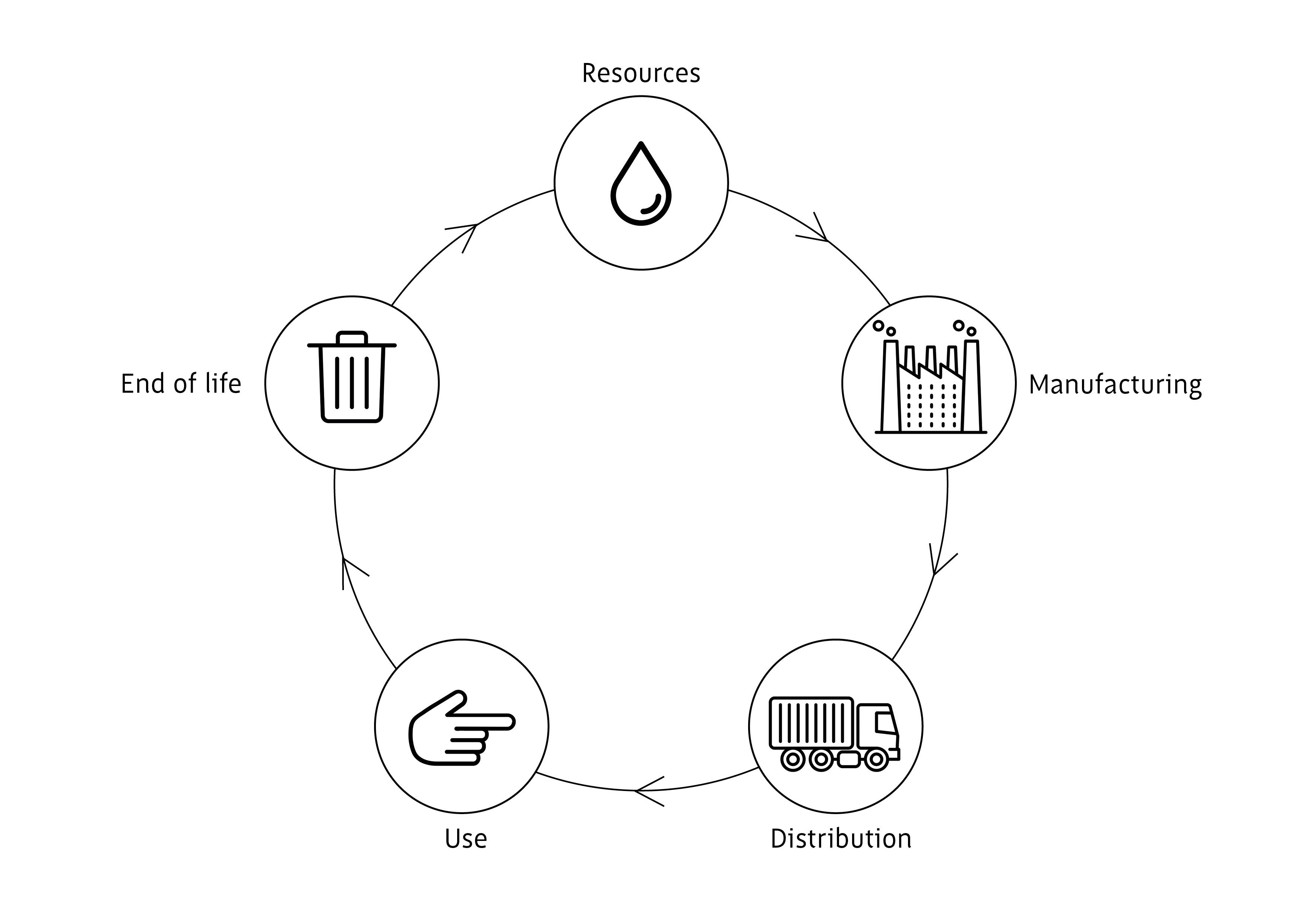
5.5.1 Resources
For the prototype, the Team had to use PVC due the budget assigned. For the final product, PP would be the material for the terrarium. This material was chosen because its impact on the environment was lower compared to other plastics and it was resistant to the growth of bacteria. The impact of PP was 73 mPt/unit while the impact of polyamide, another widely used plastic, was around 700 mPt/unit that was unsustainable [73].
5.5.2 Manufacturing
During the manufacturing of the product, the construction would be made by machines. The factory needed to be sustainable during the construction of the product. The waste in the factory needed to be as little as possible. This not only saved money, but allowed the production of the product to be as environmentally responsible as possible. When there were offcuts of plastic, these would be melted back down and used back in the manufacture process. As the Team used thermoplastics like PMMA and PVC this was possible. It was important to make sure that the plastic’s quality was not affected by the continued melting, so the recycled plastic off cuts would be mixed in with the new incoming plastics.
Energy use was an aspect that needed to be controlled carefully, when possible, the Team would rather use renewable energy sources in the factory, so solar panels would be installed, to save on energy costs, and energy efficient machines would be used as much as possible. The factory would have energy efficient LED lighting, and the Team would endeavour to use as little paper as possible in the office. There would be as much as possible windows in the factory so there would be light from the outside and the LED lighting would be not used that much. Machines, PC’s and lighting would be switched off when not in use, and the Team would endeavour to use as little water as possible. The success of the energy saving methods would be made clear in the energy bills that the company received.
Every year a sustainability report would be completed, to see where the company had done well, and where it needed to improve. This sustainability report would provide a year on year progress report and the company would be able to see gradual improvements over time.
5.5.3 Distribution
As explained in 5.3 Economical the Team used materials from local providers in Portugal. For packaging like mentioned in 7.4 Packaging the product would be sent to the customers assembled, so they did not needed to build the product, as the product was too complex for self-assembly.
5.5.4 Use
The terrarium was for home use, it could be used for recreational purposes or consumption as explained in Section 1.4 Objectives. The terrarium had a power supply for all the components, so when the power was off, the whole terrarium would be shut down. Some components were working with sensors, to save energy. The components turned on and off at different times.
5.5.5 End of Life
After the end of useful life of “EscarGO”, the product can be recycled. Design for disassembly made it easy to break apart and reuse or recycle the different components. Used materials, like PP, were reusable because of their thermoplastic properties. Electronics and precious metals inside could be picked out to use again.
France did not produce enough snails to meet demand (see Figure 32). In fact, from May 2013 until March 2014 there was 6000 tons of snails declared as imports into France. The peak time for consumption was over the festive period, as escargot was considered a festive tradition for example during Christmas. Therefore, the Escargot Nursery met a huge demand for anyone willing to produce them at home. It also reduced the transport costs and therefore the carbon footprint of the food [74].
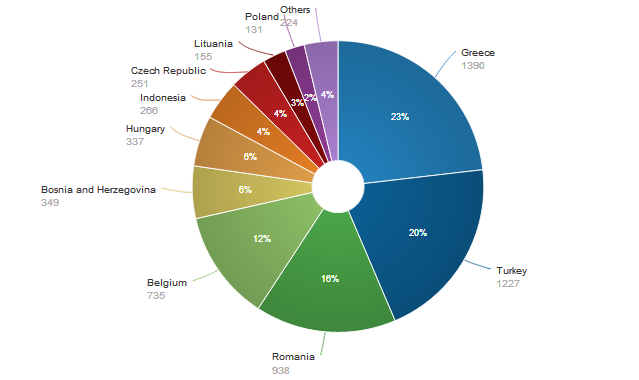
5.6 Indicators to Measure in the Company
To progress toward socio-cultural, economic and environmental well-being, most companies made a sustainability dashboard to identify the activities of the company. For this section, the Team set some indicators which were important for the dashboard.
- Air quality: measure CO2
- Energy consumption in the factory
- Water consumption per product
- Total weight of waste from materials that can’t be used again
- The net difference between the value of exports and imports
- Inequality rate: Measure the difference in income between employees.
These were the most important aspects to improve or reduce in the company. The indicators would be showed on a dashboard during the meetings with the staff and directors. The company will keep people who work the same job equal, then provide a raise every year for good work. This will be based on evaluations and conversations with the employees every 6 months of employment within the company.
5.7 Conclusion
To conclude this chapter, nowadays sustainability is crucial and the Team must take it into consideration when designing the product. Sustainability is a concept which includes the environmental, economic and social concepts. To make “EscarGO” sustainable, the Team needed to take these three concepts into account with equal importance. Based on this study, the Team chose to use PP for the structure for the final product. Due to the budget, the Team had to use Polyvinyl Chloride (PVC) for the prototype.
To comply with the social aspect, the Team has decided to make education for children and cohesion of family one of these main concerns. To conclude, based to this study the Team decided to use the curtain method in order to increase the surface where snails can live. As it increases the efficiency of “EscarGO”, this method is really sustainable.
6. Ethical and Deontological Concerns
6.1 Introduction
Ethics is the set of values that could be applied personally or professionally which dictates a person's actions. Deontology is the set of rules and duties that govern a profession, the conduct of those who practice it, the relationships between them and their clients and the public. For instance, under article 3.04.01 of the code of deontology of engineers, an engineer must apply his or her signature to any document or plan prepared under his or her management. Engineers could decide to refuse a signature, which their values and the code of ethics allowed them to do if the work was not of satisfactory quality or not done in an ethical or sustainable way [76].
The project must respect all the aspects of ethics and deontology in the following areas:
- Engineering ethics
- Sales and Marketing ethics
- Environmental ethics
- Liability
6.2 Engineering Ethics
Since the beginning of the industrial revolution, the profession of engineering, science and research has developed in leaps and bounds and has became a pillar of respectability within companies and society. It was therefore necessary to introduce rules and regulations to govern the professional ethics inherent in this profession. The first ethics code for the engineer appeared in 1910 and it was promoted by the Institution of Civil Engineers in the United Kingdom. During the 20th century, numerous codes of ethics were published in the United States and in others countries [77]. Today, there were several codes of ethics and deontology governing the profession of engineering in most countries.
This project had to respect engineering ethics. In each of those codes, there were some common concepts that the Team had to respect. The Team chose to focus on France because that was the target market for this project. In France, there was an ethics charter for engineers which was drafted by CNISF (Conseil National des Ingénieurs de France) in 2001 [78] [79] [80].
The Team had chosen to present this one because France was the largest market for snails. In this charter, the Team found the following concepts [81]:
- First, there was the concept of engineers in society. Engineers were highly educated, and their specialist knowledge meant they were in a unique position to be trusted to use their education and specialist knowledge. The engineer had to use their knowledge and understanding in an ethical way and a way that protected the environment as much as possible.
- Another aspect was engineering competency. Engineers were source of innovation and progress. They developed products, manufacturing processes, research, problem solving and much more. In addition, engineers had to adopt a rigorous, systematic way of working. They had to admit when they were wrong, take the advice of others and correct any mistakes.
- Engineers had to be open minded, they had to be fair without discrimination and listen to the opinions of everyone and took on board criticism but also be able to assert themselves if the design concept is not safe, or not achievable. They had to respect the culture and the values of the company they work for and the people affected by the work of that company. They had to work ethically i.e. engineers must not plagiarize, make signatures out of convenience, deliberately use harmful materials, etc.
- To conclude, there was the section referring to engineers and their mission. The engineer had to respect the constraints imposed on them while integrating economic, human, financial, social and environmental factors. They had also to anticipate risks and hazards in order to limit negative impacts.
During the process of the project, these values needed to be adhered to. This project responded perfectly to the different points because the Team worked towards sustainable development. Furthermore, the project promoted innovation because, at the time of publication, there was no similar product on the market.
6.3 Sales and Marketing Ethics
Markets presented a battle of interest between different players, such as competition for resources, customers and price. People wanted to have a product of good quality and at the best price, which did not always mean the cheapest price, and companies wanted to increase their gain [82].
Given that the purpose of the project was to build a product that could be sold, the Team also had to respect sales and marketing ethics. Sales and marketing ethics were particularly important for the image of the company. Indeed, the credibility of the company as well as the confidence that the customers had in the company, were at stake. It was also essential to respect sales and marketing ethics in order to avoid sanctions, fines or even legal issues [83].
The Team wanted to develop a long-term relationship with the customers, so one of the most important points that the Team had to take into consideration was not to lie about the benefits of the product. During the advertising campaign the Team had to promote only the real advantages of the product and not to invent or overstate the products benefits. This point was important for the customers trust and also on a legal level [84].
The price was also a concern from the sales and marketing ethics aspect. Firstly, the price had to be fair. The customer needed to know exactly what they were going to pay for the product. The Team wanted to offer a high quality product with fair prices. The price had to be clear. It was important not to hide charges in the price or services that the product would need to work. So, any additional parts or replacement parts after use needed to be made clear to the customer [85].
In addition, the marketing of the product had to respect the cultural diversity and it had to be non-discriminatory towards all people.
During marketing and sales activities companies use surveys, focus groups, and specialists to gather information. To behave ethically companies, have to respect the privacy of the customers and inform them why they are collecting data, and the data needs to be kept relevant and cannot ask more than what is needed for the particular application. Furthermore, the companies cannot sell the gathered information on and they have to destroy it after the data was no longer needed [86].
6.4 Environmental Ethics
Environmental ethics was an aspect of the environmental philosophy and was not just about the relationship between humans and the environment, but was also about the value and the moral status of the environment and its nonhuman inhabitants [87].
The study of environmental ethics focused on the impact of the product on the environment. Humans could not help using and modifying the natural world, since we depended on nature for food, clothing and shelter, for our water supply, and for the air we breathe. But the unforeseen impacts of human actions were creating problems like global warming and the elimination of multitudes of species [88] [89].
There was a product on the market called Molluscicide. This product was used by people to exterminate snails from gardens and vegetable gardens to prevent the snails eating the plants and vegetables. Molluscicide was a chemical product so it was not very ethical. Instead of killing the snails with harmful products, snails could be used for useful purposes. To increase the consumption of snails the “EscarGO” was useful to promote this. So, the snails will be used as pets, for growing and breeding and for eating. It meant increasing the harvesting of garden snails and reducing the use of Molluscicide.
With environmental ethics, the Team could ensure that they were doing their part to keep the environment safe and protected. The design of the “EscarGO” would be created to be as environmentally friendly as possible by using only materials that were not harmful to the environment, for the final product, like PP, which was more sustainable than other plastics.
For the production of the “EscarGO” renewable sources of energy were used, like solar energy and wind energy. The water consumption was reduced to the minimum and the use of harmful chemicals was avoided. Rainwater harvesting was also considered for future development of the company.
During use, energy was used in a smart way. Only when the temperature dropped below 15 °C, the heater started to work, and switched off at 20 °C to allow the heater to cool down. Above 25 °C the fan blew air into the nursery, without heating from the heating device. Led lights only worked when the amount of light emitted by the sun was not enough. The humidity sensor measured the humidity level so water was added only when needed. The screen where the temperature and the humidity could be seen, was dimmed when it was not in use.
After the end of life of “EscarGO”, the product could be recycled. The intelligent manufacturing of the” EscarGO” made it possible to disassemble the Escargot Nursery easily. Used materials, like PP, were reusable because of thermoplastic properties.
6.5 Liability
Liability law determines when someone suffered damage or injury in a particular case caused by another person or company [90]. Team “Caracol” needed to take responsibility in case something harmful happens because of the product or the use of the product, and take all possible steps to avoid this situation.
Legal liability concerns both civil law and criminal law and could arise from various areas of law, such as contracts, torts, taxes, or fines given by government agencies. The primary goal of civil liability is to restore or to compensate for damage suffered [91] [92].
Product liability was an important part of this project. The Team was responsible for the product, also for the injuries this product may cause. It was important to take responsibility towards supervisors and the customers. If something unfortunate happens, the consequences of which were the fault of the company [93].
To complete the creation of the Escargot Nursery, it was necessary that the Team comply with the following EU directives:
- Machine Directive (2006/42/CE 2006-05-17);
- Electromagnetic Compatibility Directive (2004/108/EC 2004 12 15);
- Low Voltage Directive (2014/35/EU 2016-04-20);
- Radio Equipment Directive (2014/53/EU 2014-04-16);
- Restriction of Hazardous Substances (ROHS) in Electrical and Electronic Equipment Directive (2002/95/EC 2003-01-27);
According to the directives above:
- When designing the product, the Team must create a product that did not compromise the safety and health of users.
- The electronic part must be designed with the aim of limiting electromagnetic emissions from equipment in order to ensure that, when used as intended, such equipment did not disturb radio and telecommunication, as well as other equipment.
- The “EscarGO” electrical equipment within certain voltage limits provided a high level of protection for European citizens
- The Team did not need to use hazardous substances in the “EscarGO” electronic equipment.
6.6 Conclusion
To conclude, the Team had to respect all the codes of ethics mentioned above, the Team had to take care with the sales and marketing of the product to make sure it was done in an ethical way. The Team needed to be ethical in every aspect of the construction of the Escargot Nursery to be sure that the product met with the ethical requirements and European directives that were set. Due to this study, the Team worked to promote only the real benefits of the product and to show the value of these aspects. Furthermore, the Team would pay particular attention in respect to the environment, using sustainable materials both for the prototype and the product.
In the next chapter the Team explains the development of the product taking in ethical and deontological concerns.
7. Project Development
7.1 Introduction
In this chapter, the Team showed the development process of the “EscarGO”. The Team described the architecture of “EscarGO” with 2D and 3D drawings. The Team also described the control system and the system schematics to show how the system is connected.
With the control system, the requirements were as follows. The enclosure needed to be able to maintain a comfortable temperature for the snails, but it shouldn't require much energy. It was recommended that the enclosure would stay inside the home, so what had been proposed was a heating element that turned on if, and when, the temperature dropped below 15 °C and switched off at 20 °C to allow for cooling time, and a cooling fan that turned on if the temperature rose above 25 °C. The reason for this was that the market research suggested that people wanted a simple system as possible, that rarely used any energy.
Humidity was another aspect that needed to be controlled. A moisture sensor would be inserted into the enclosure, and there would be a sprinkler hose pipe, or an atomizer, inside to released water if the environment was not humid enough. This must be short bursts as over watering or flooding may drown the snails, and also there was a possibility of a small water tank on the system for the humidity control so that the tank does not need to be fed with a constant water supply.
Another requirement of the system was to display the temperature and humidity on a small LCD screen. Humidity and temperature are easily controlled using Arduino boards and software, which was a great benefit of using Arduino. One of the concerns with the project was that because there needed to be a humid environment for the snails, and they also require oxygen, there was the issue of dampness and humidity getting into the room that the terrarium was stored in. This needed to be carefully controlled and monitored because dampness can cause damage to the room around the enclosure.
The Team considered using solar panels on the top of the nursery to provide some energy, but because the terrarium was designed for use indoors this was no longer an option as there would be no direct sunlight or very little, for the solar panels to work effectively. The cost to benefit ratio proved this option was not feasible.
The product had to have an aesthetically pleasing design and be easy to use. The dimensions that have been chosen were 400 mm x 300 mm x 375 mm for the enclosure, this was to provide an efficient design that combines a compact design which could fit on a work surface, and also allowed for more snails to be housed with the curtain method. Finally, the Team reports on the functional testing.
7.2 BlackBox
The BlackBox diagram (see Figure 33) was the diagram used to describe the main functions of the Escargot Nursery in an early stage.
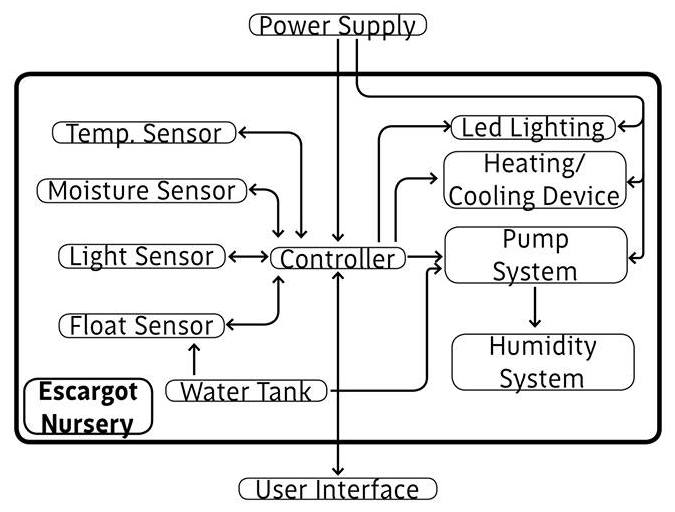
7.3 Architecture
7.3.1 First Structural Drawings
Figures 34 and 35 show the first structural drawings of the “EscarGO”. These drawings were meant to be refined in a later stage, but they served as a good view of how the Team wanted the Escargot Nursery to look like.
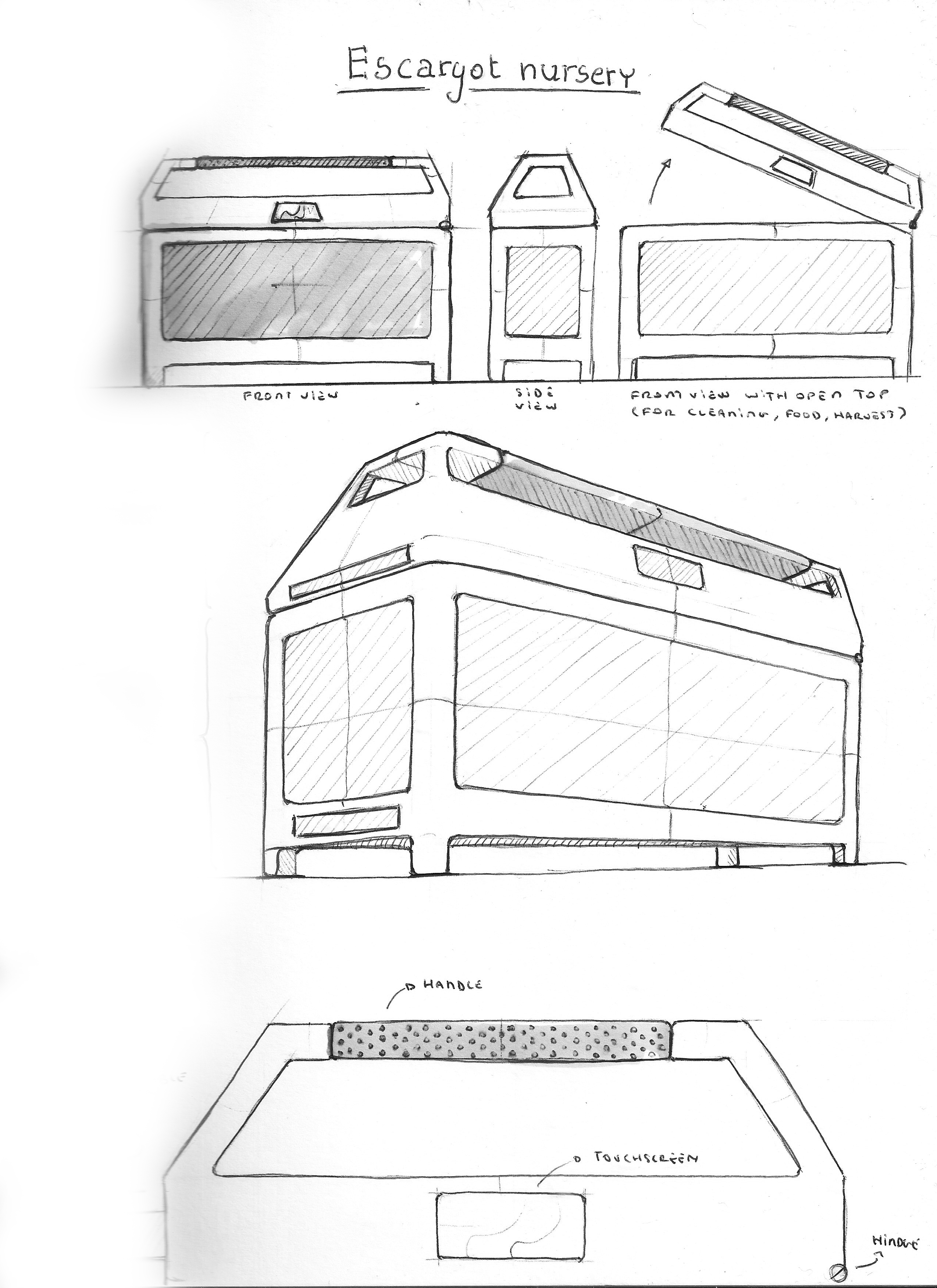
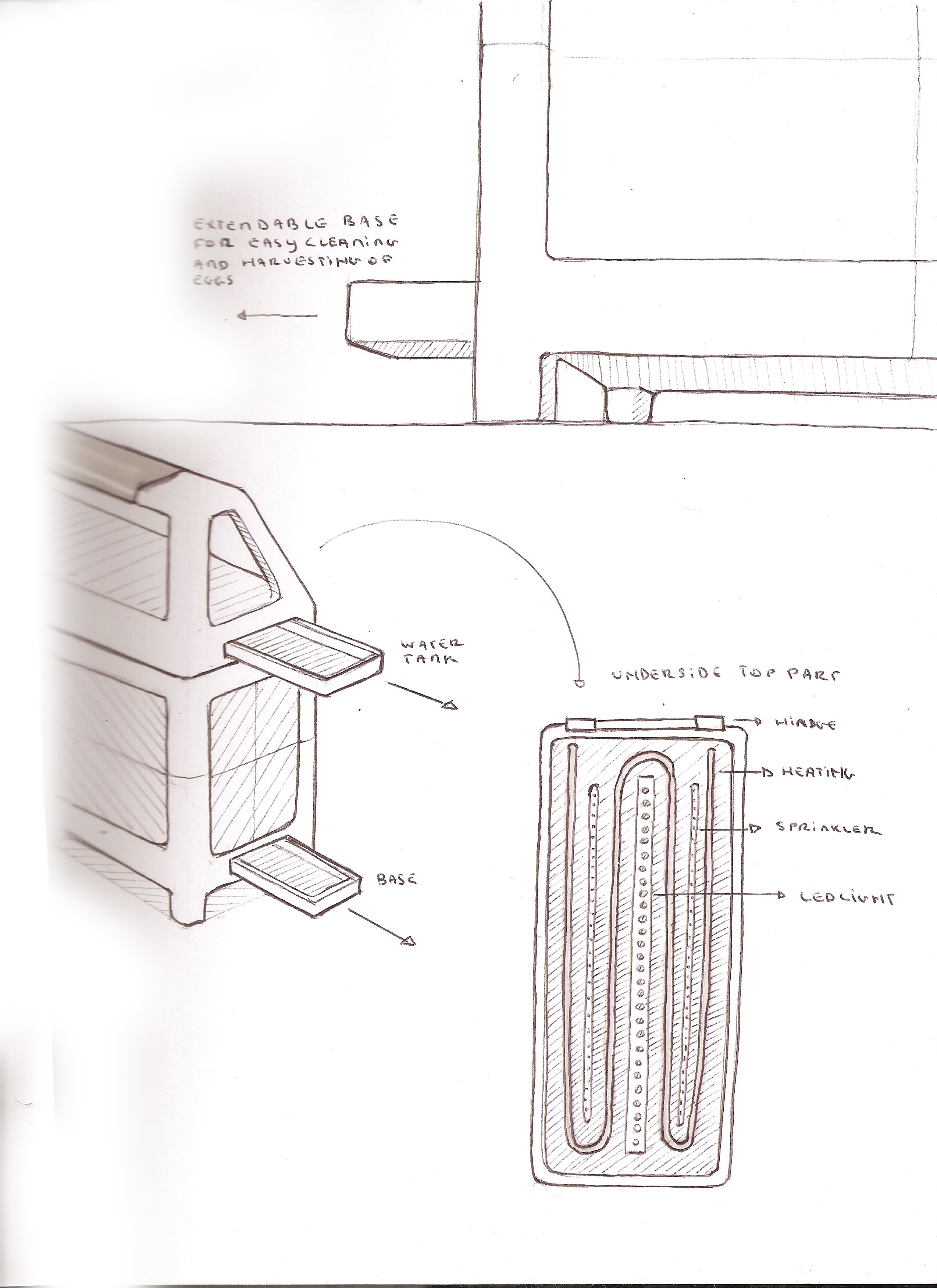
7.3.2 Cardboard Model
To begin with the architecture of the prototype, a cardboard model was made as a first approach to find out the optimal dimensions and opening system of the “EscarGO” that did not require an extra amount of free space around for its movement. The Team also used it to show the curtain system. It can be seen in Figures 36, 37 and 38.
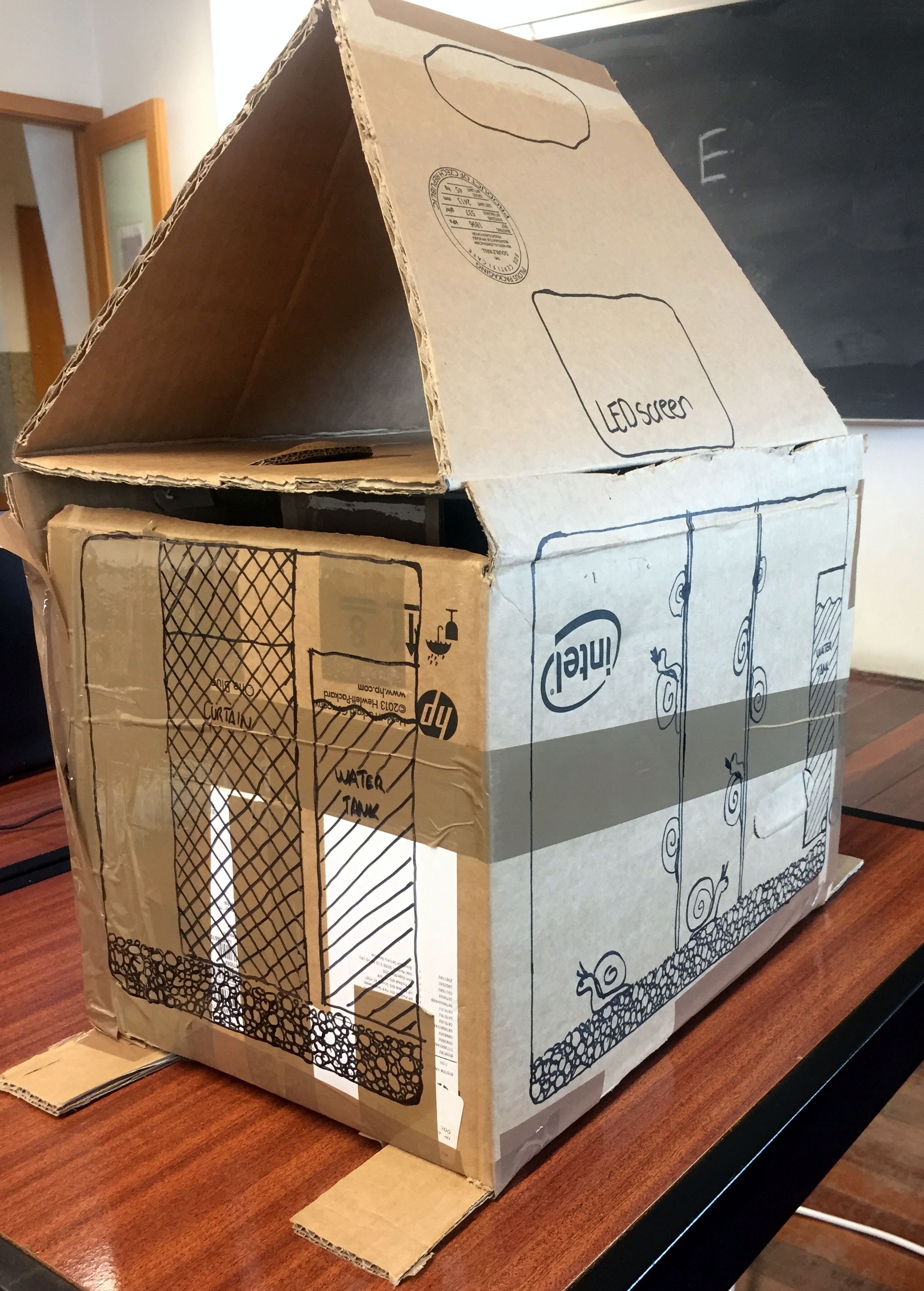
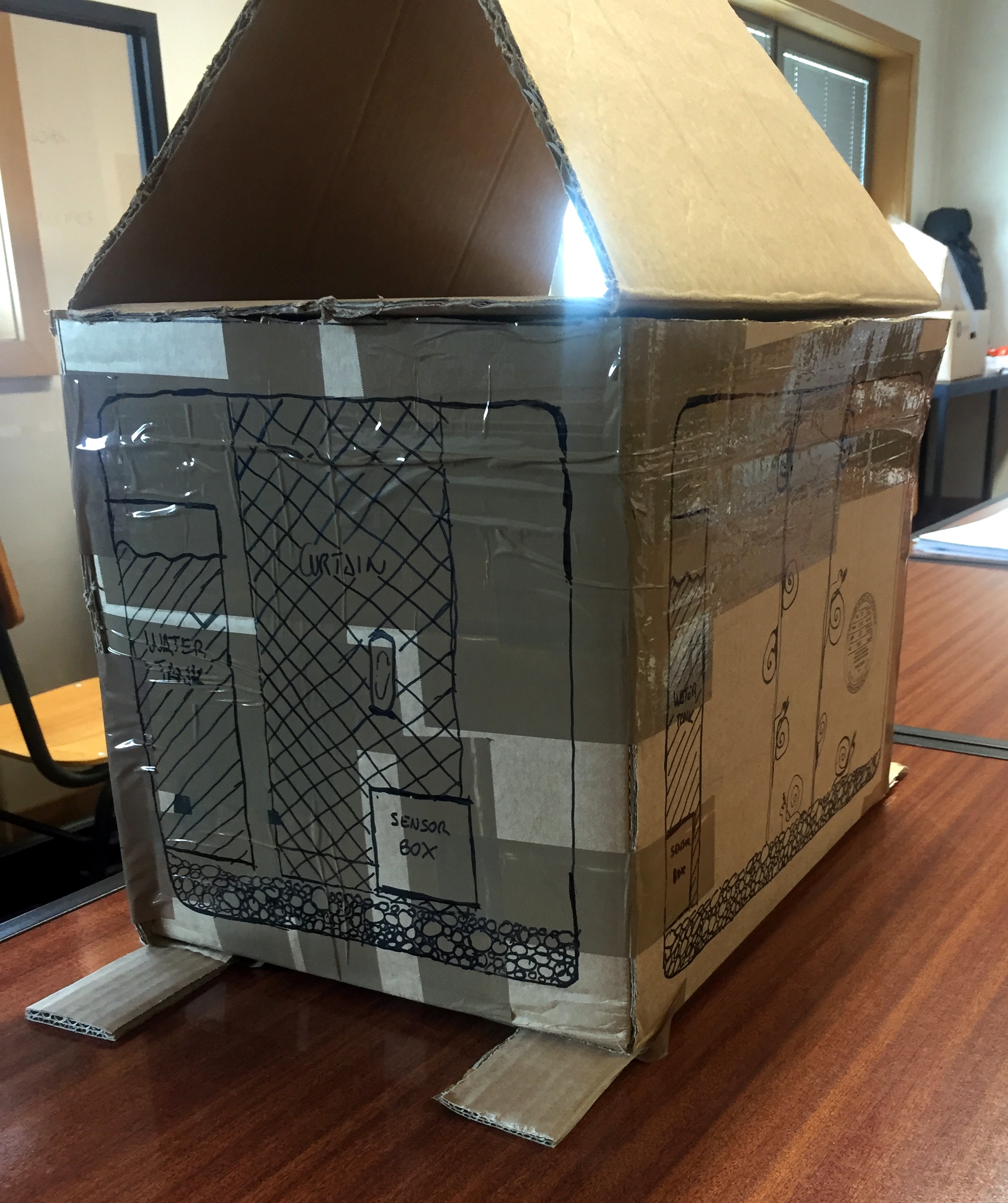
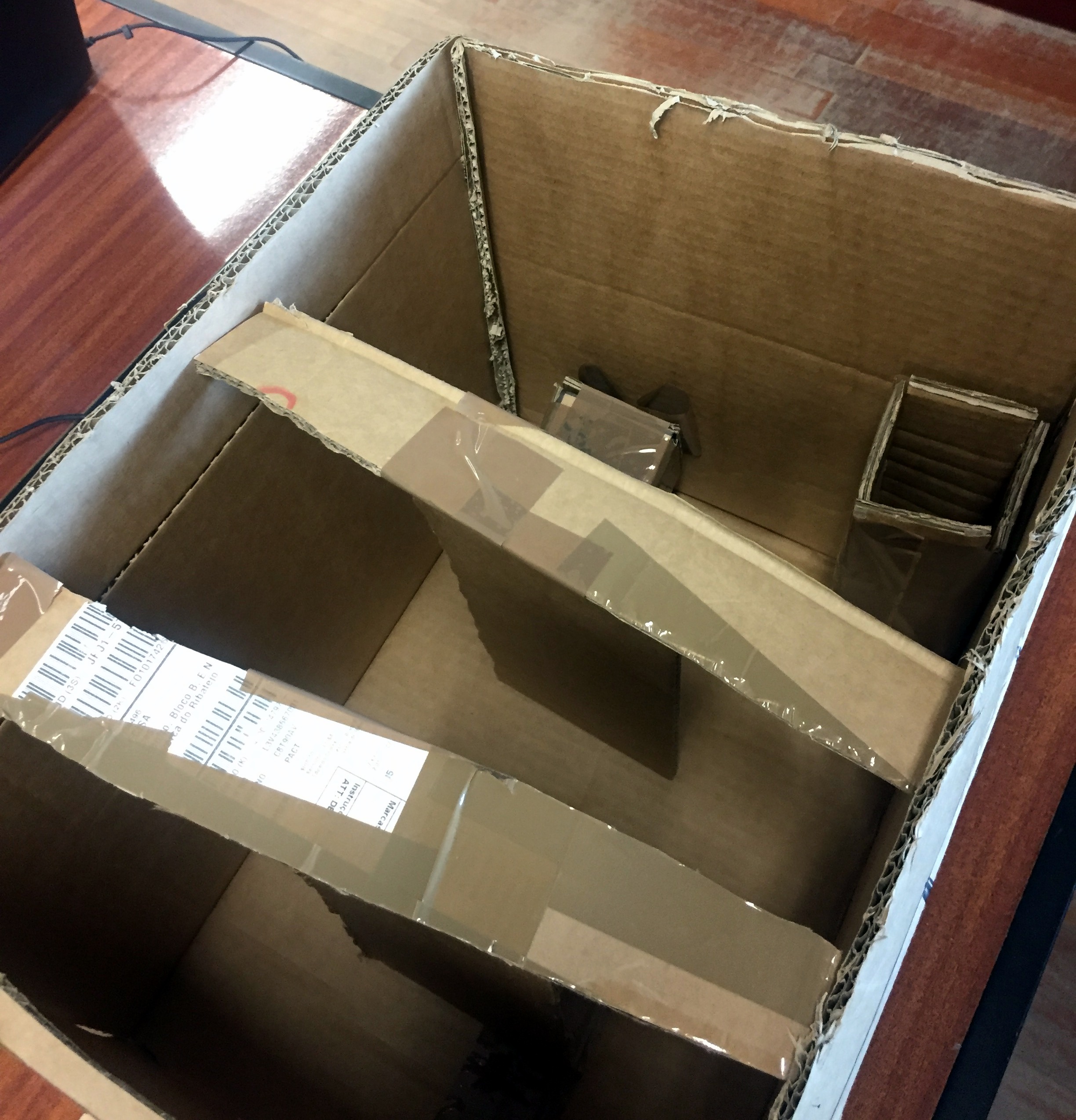
7.3.3 Initial 3D Model
The Team created some initial three-dimensional (3D) models to see how the product would look like at the end of the project.
At this stage, it was decided to remove the feet of the structure, since it did not add anything to the product, and using a plastic rubber band to keep the product from touching the furniture directly.
Figure 39 and Figure 40 show the front view of the product. Curtains were placed inside the cage, so that the snails could climb them, increasing their living surface that way. This permitted the product to house a larger number of snails in the same space, reducing the energy consumption and increasing the product's usability.
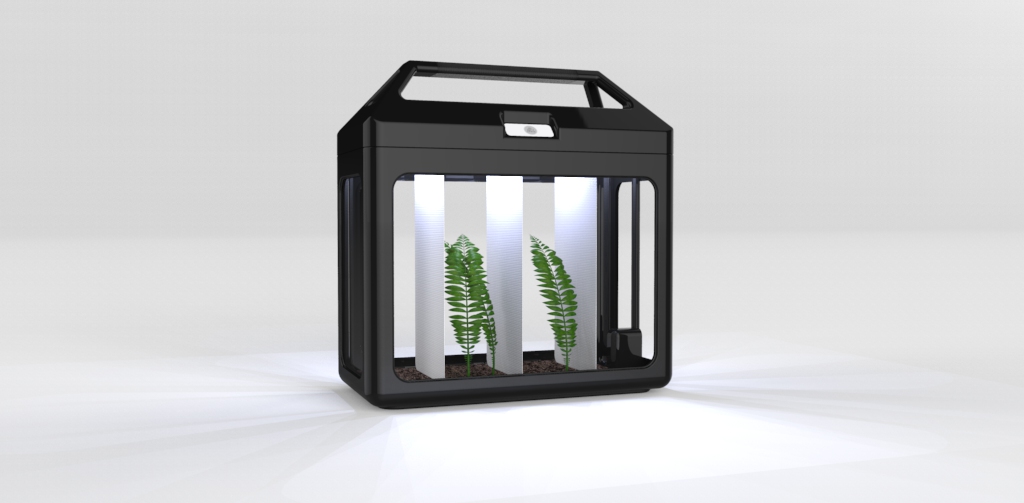
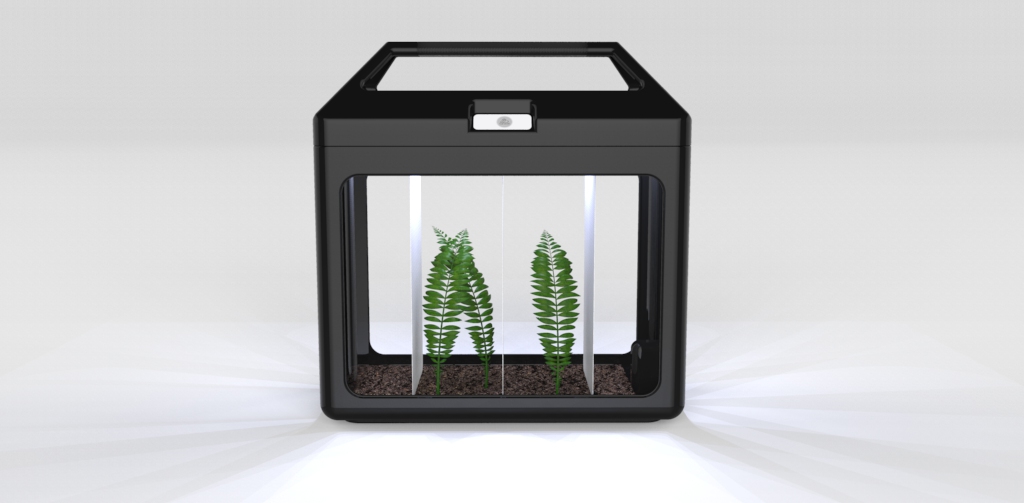
The cover is shown in Figure 41. It included a LCD screen where the user could read the temperature and the humidity inside the “EscarGO”. There was also a handle in the cover to make the cage easy to move to another place.
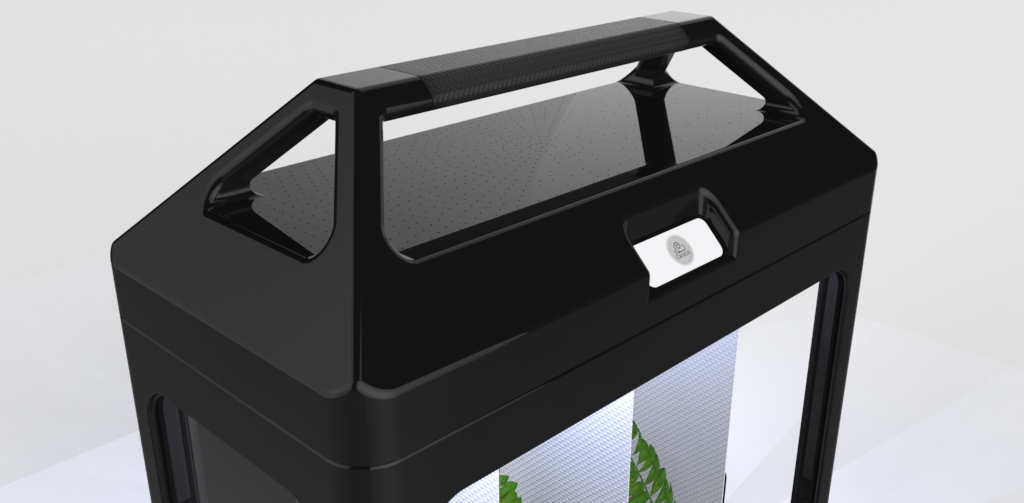
Figure 42 shows some different colour options for the cage. The Team chose these colour possibilities to make the product more attractive for the target customers.
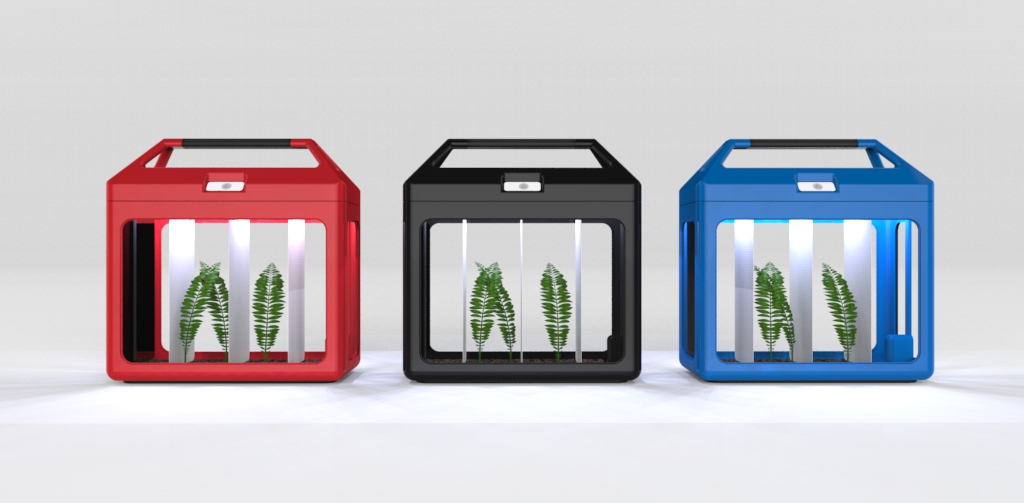
Figure 43 shows how the product is designed to be opened by using a pivoting system.
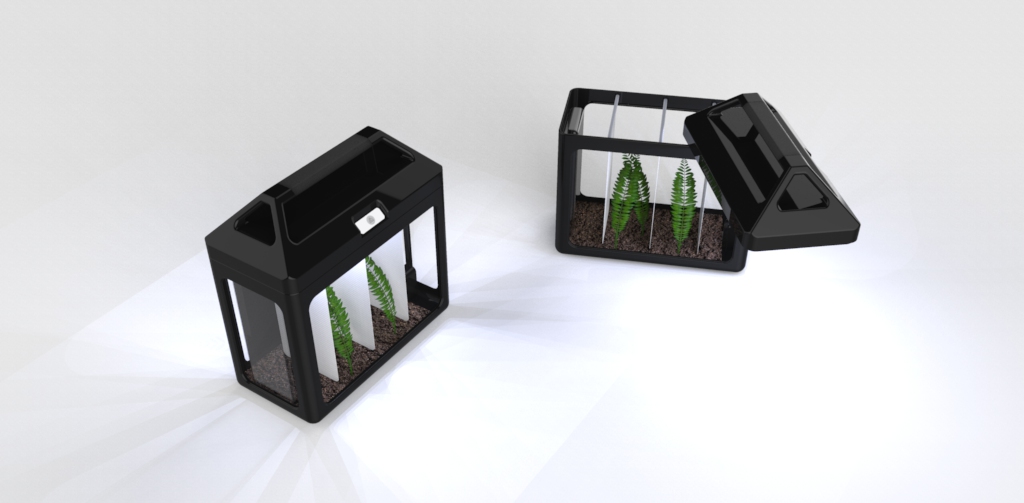
The different components included in the product are shown in Figure 44.
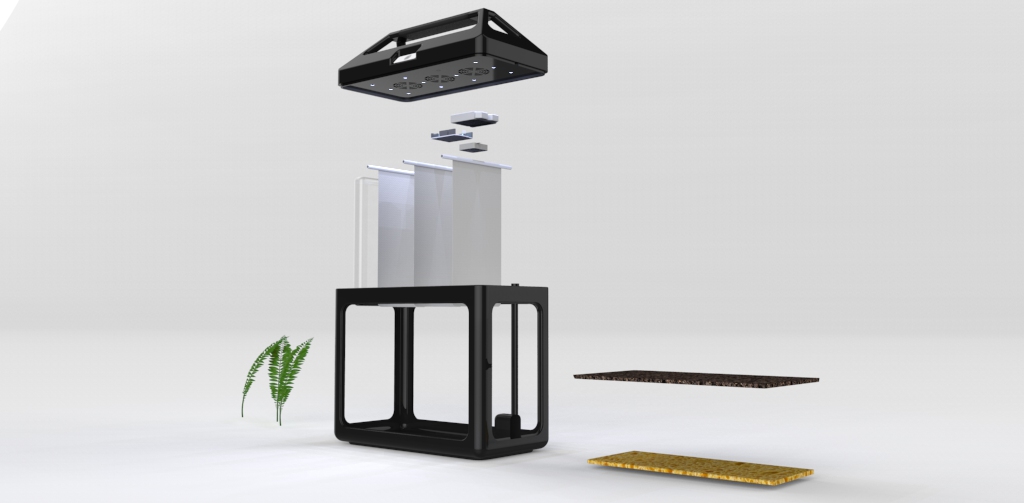
7.3.4 Final Structural Drawings
The Team had to do some brainstorming in order to fix the flaws found in the first design. The original pivoting opening system was not very likely to be long lasting, and therefore unsustainable. In order to keep the cover removal simple, the group decided not to host the technologies inside the cover and add a chamfer instead for that purpose. These changes in the product (see Figure 45) were intended to make the “EscarGO” more user friendly.
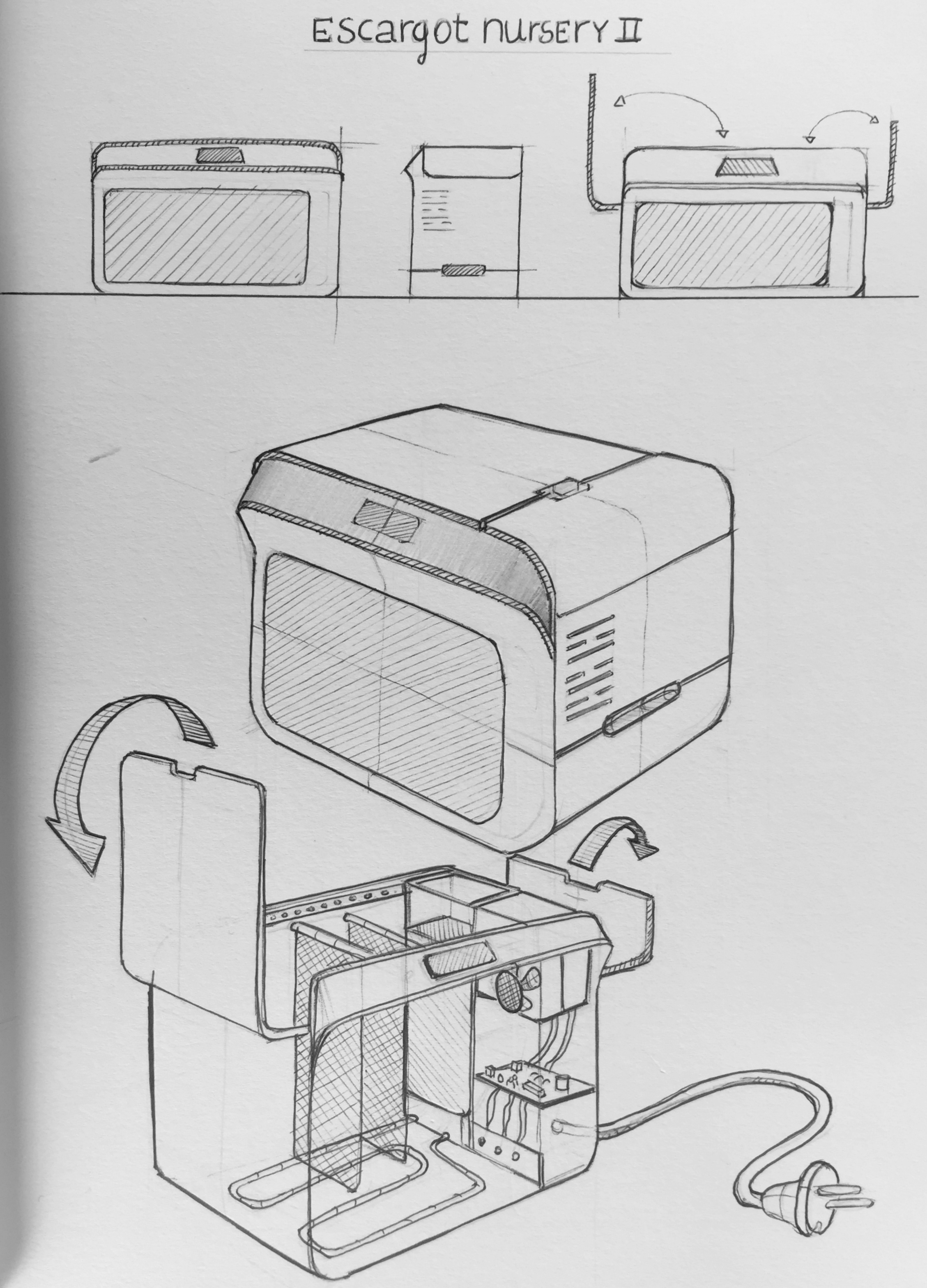
7.3.5 Final 3D Model
In this sub-section, the final 3D model is shown. The Team decided to use another technique for opening the terrarium instead of the pivoting system. The dimensions of the “EscarGO” would be 400 mm x 300 mm x 375 mm. Figure 40 shows an overview of the whole product.
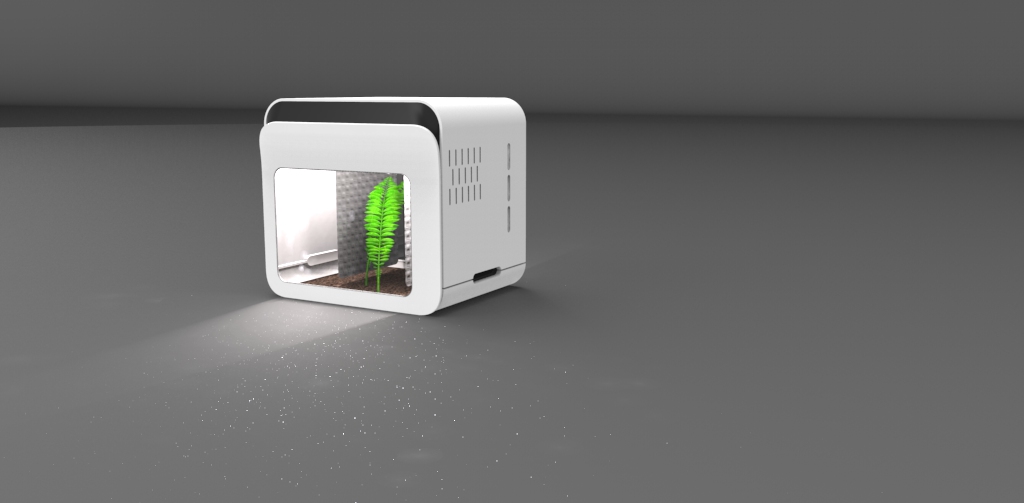
Figures 47 and 48 represent the front view of the product.
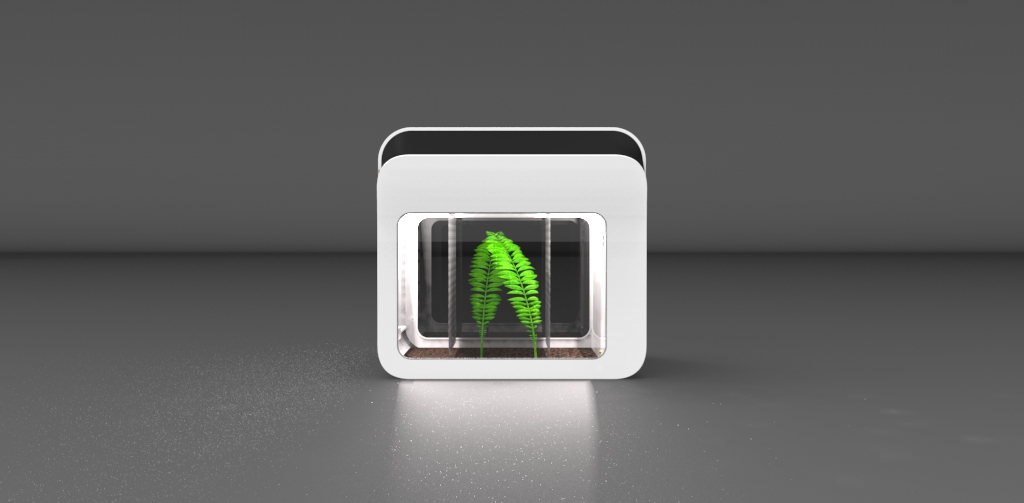
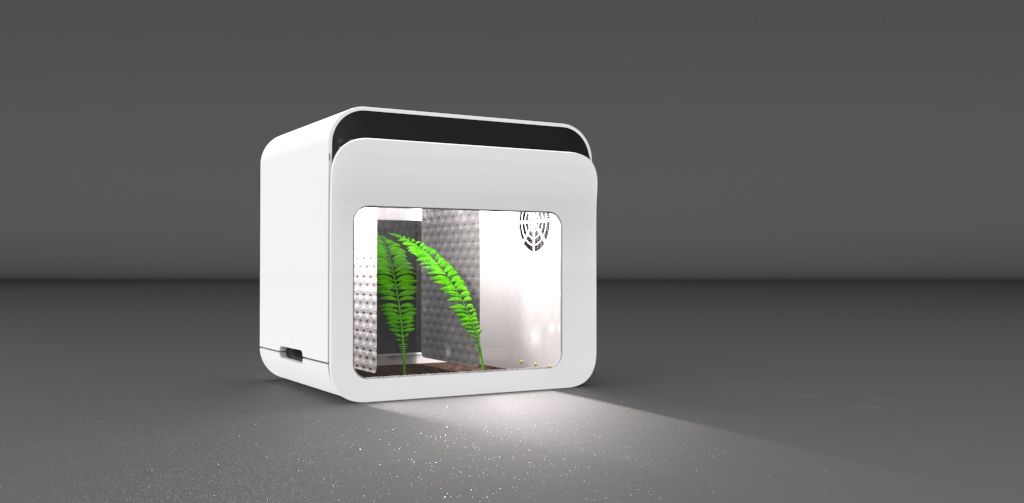
Figure 49 displays a front view and a view of some parts that would be inside the terrarium. This figure shows the curtains and the water tank.
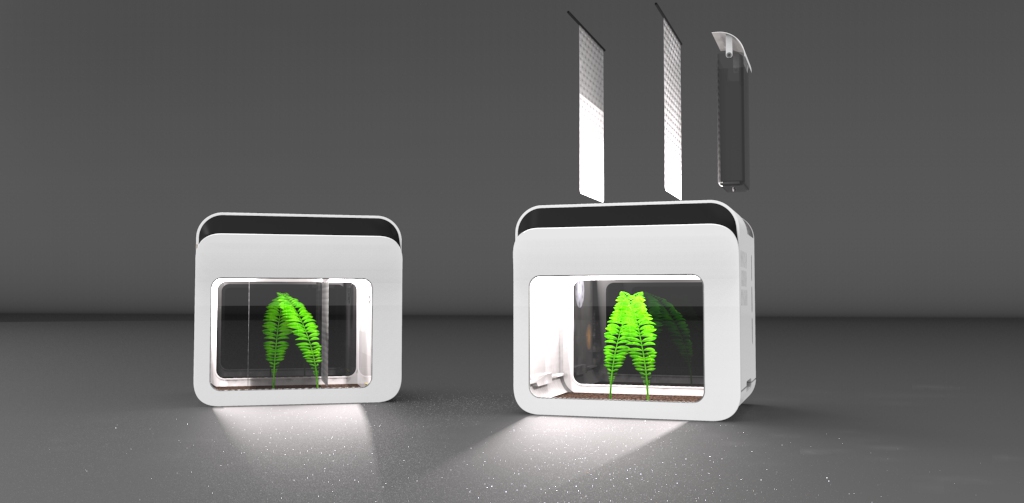
Figure 50 displays the inside of the terrarium. There would be a drain system in the soil and a water tank on the side. On the same side as the water tank, there would also be the technological section with all the sensors (humidity, temperature and light). The curtains are also well displayed in this Figure.
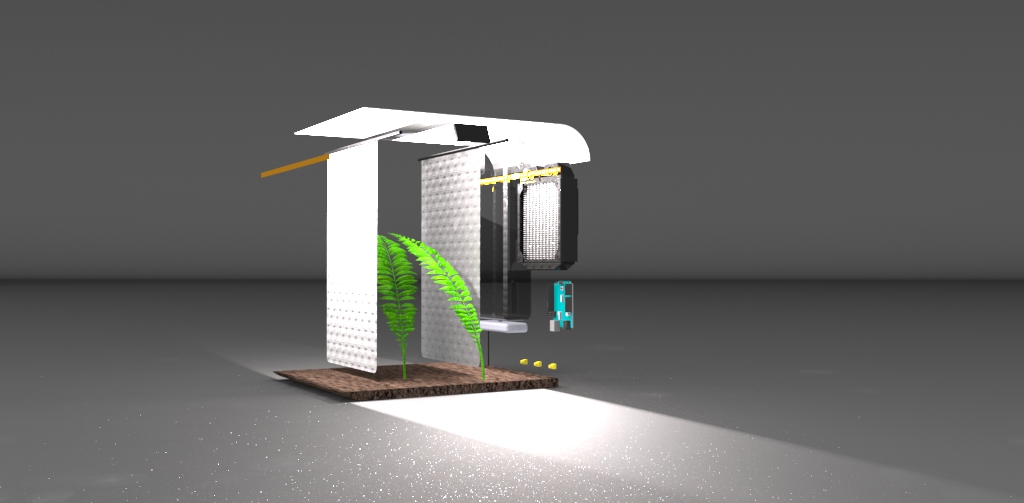
7.3.6 Technical Drawings
These technical drawings were made from the 3D model in Solidworks. These drawings are used as base for the making of the prototype. First of all there is an overview drawing of all components and the quantity is indicated on the bill of materials (see Figure 51).
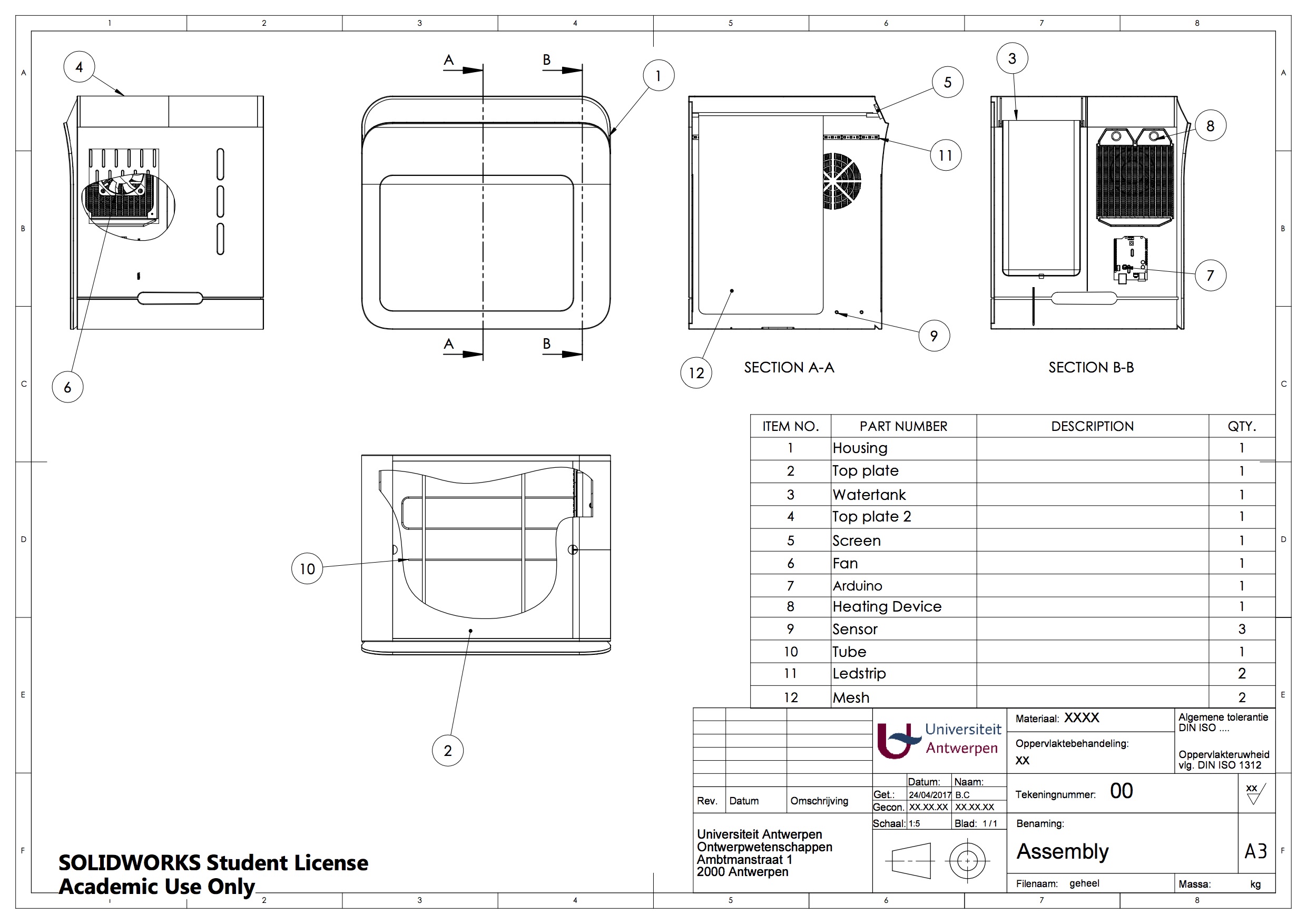
A second assembly drawing is made from the water tank (see Figure 52).
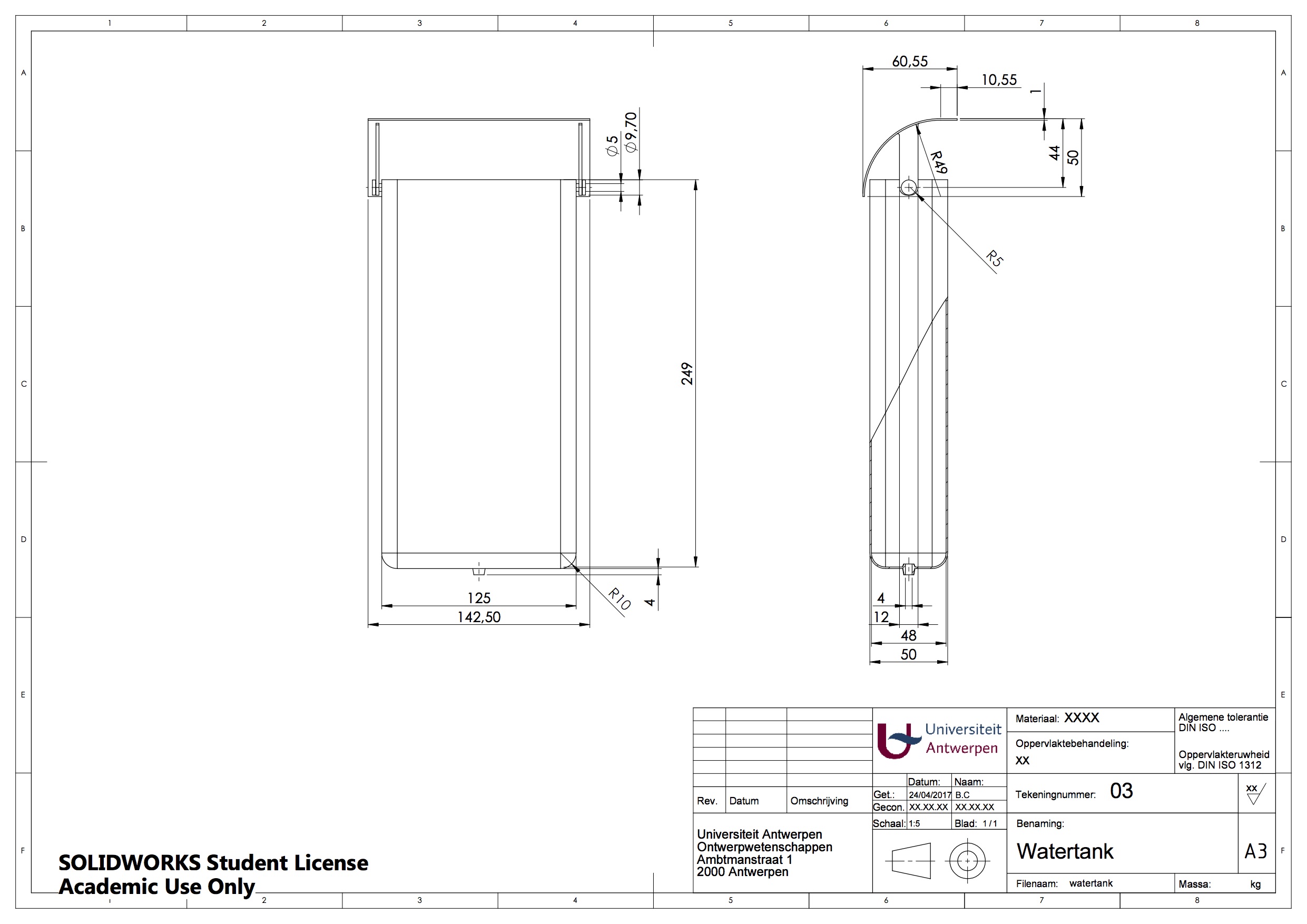
Further a drawing from every part was made beginning with the housing. This part is the most complicated and consists of multiple PP plates (see Figure 53).
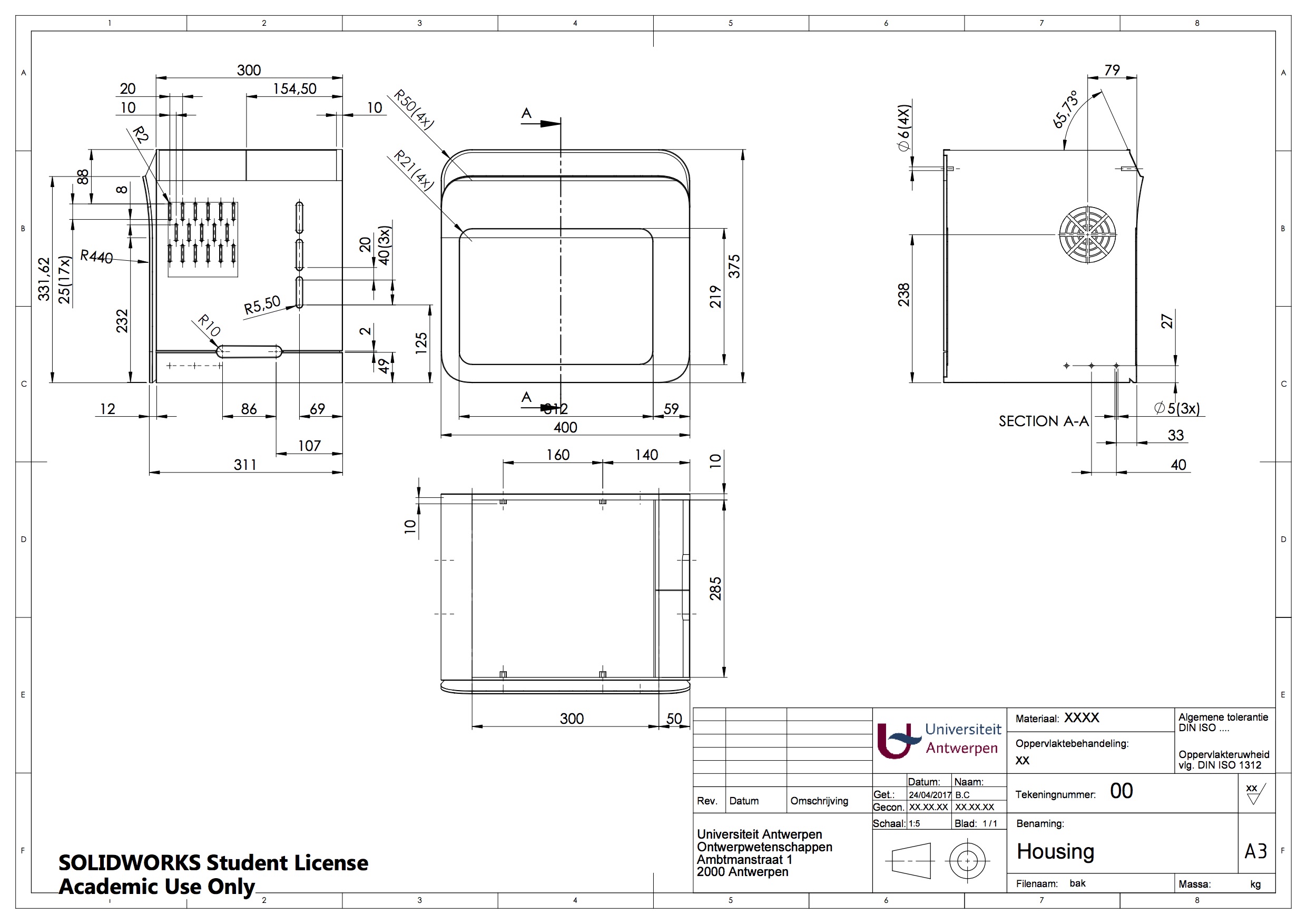
Cut outs for details, such as air vents and handles, are all on the drawing. There are also drawings from the curtains (see Figure 54) and the top plate (see Figure 55).
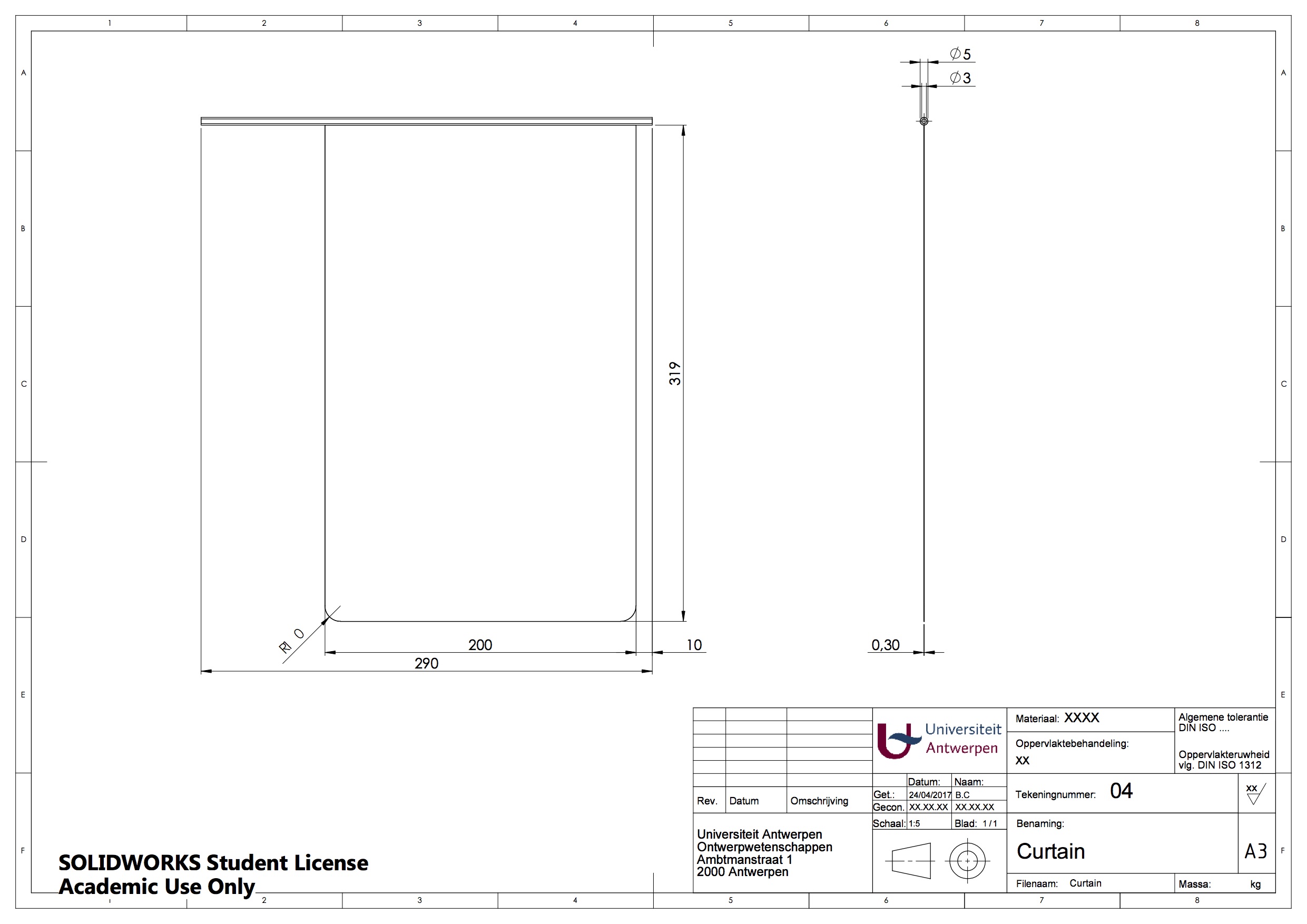
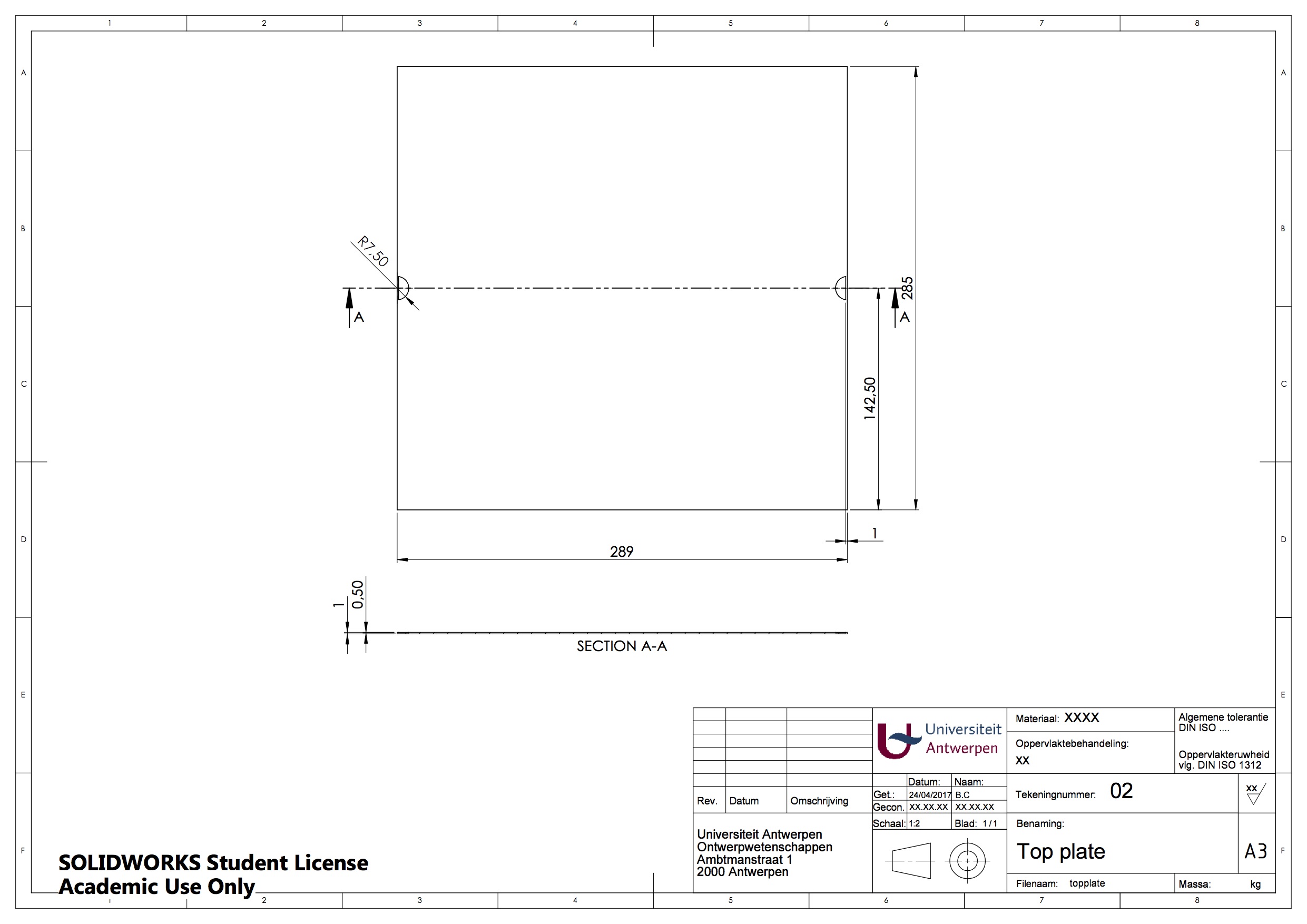
7.4 Packaging
The “EscarGO” will be assembled in a factory so the customers will not have to build the product. The packaging has to protect the nursery while transporting. Additionally, inside the box, foam blocks prevent damage. The packaging has to be attractive and make the customer curious about the product inside. The material of the packaging will be corrugated fiberboard because of its strength and ecological impact. This kind of fiberboard is easy to recycle and reuse.
7.5 Functionalities
The Escargot Nursery needs to achieve certain functions. It has to keep the climate inside at a comfortable level for the snails. For this the humidity needs to be controlled, so a liquid spray system needs to be used to keep the soil moist, the temperature also needs to be kept within the safe range, i.e. between 15 and 25 °C. Lighting in the form of LED also needs to be controlled to ensure the snails have enough light to thrive. The system measure the temperature and humidity inside the nursery and measures the light level outside the nursery. The program stored in the Arduino board then controls each aspect to ensure automation of the climate.
The flowchart of the program is depicted below:


7.6 Components
In the following section, the Team explains the reasons behind the choices of materials.
7.6.1 Controller Boards
Table 12 shows some of the controller boards which the Team could use to build the prototype of the product.
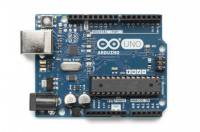
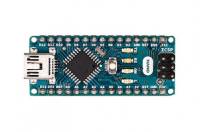
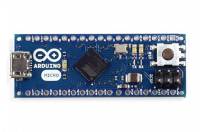
The Team chose Arduino Uno as the micro controller board because it blended perfectly (size, functionality and cost) to suit the project. Arduino uno was very commonly used in online forums so it made it easier for inexperienced people to use. Arduino was chosen because it uses open source software which was the software requirement from the brief.
7.6.2 Sensors
The “EscarGO” needed a light sensor because the Cornu aspersum needed 16 hours of light per day. The light sensor was used to detect the ambient light level in the room and switched on a bank of LED lights if the light level got too low. In Table 13 were possible light sensors presented for the prototype.
| Light sensor | Power (mW) | Resistance (Ω) | Voltage (V) | Current (A) | Price (€) |
|---|---|---|---|---|---|
| LDR GL5528 | 100 | 100 | 150 | 1.5 | 0.50 |
| Analogue Ambient Light Sensor | 70 | up to 10 K | 3.3 - 5 | 14 m to 21 m | 6.30 |
| ADVANCED PHOTONIX NSL 19M51 | 50 | max of 20 M | >100 | max of 20 m | 0.92 |
| Luminosity Sensor Breakout - TSL2561 | 1.8 | 5 K | 3 | 0.6 m | 6.50 |
The Team decided to use the “Luminosity Sensor Breakout - TSL2561” because it was a digital sensor and therefore easier to connect to the control system.
Other sensors the “EscarGO” needed, were a temperature sensor and a humidity sensor. In Tables 14, 15 and 16 were the possible sensor choices.
| Temperature sensor | Voltage (V) | Current (uA) | Accuracy (°C) | Temperature range (°C) | Price (€) |
|---|---|---|---|---|---|
| LM35DZ | 4 - 30 | <60 | 0.5 | -55 to 150 | 1.85 |
| MCP9808 | 2.7 - 5.5 | 200 | 0.25 | -40 to 125 | 6.89 |
| DS18B20 | 3 - 5.5 | not given | 0.5 | –55 to 125 | 5.10 |
| Humidity sensor | Voltage (V) | Price (€) |
|---|---|---|
| Soil Moisture Sensor | 3.3 - 5 | 4.90 |
| Humidity + Temperature | Voltage (V) | Current (mA) | Accurancy | Temperature range (°C) | Humidity range (%) | Price (€) |
|---|---|---|---|---|---|---|
| DHT11 | 3-5 DC | 200 - 500 | ±5 %, ±2 °C | 0 to 50 | 20 to 90 | 4.95 |
| DHT22 | 3-5 | 2.5 | 2 - 5 %, ±0.5 °C | -40 to 80 | 0 to 100 | 9.80 |
| RHT03 | 3.3-6 | 1 - 1.5 | 2-5 %, ±0.5 °C | -40 to 80 | 0 to 10 | 14.76 |
After the Team did researched a humidity + temperature sensor. They chose the DHT22 temperature and humidity sensor because it measured both humidity and temperature into one sensor which streamlines the programming and soldering of parts, and also reduced cost and encroachment into the terrarium. The DHT22 has a better range than the DHT11, so therefore was the better choice.
In Table 17 were water level sensors displayed which could be used to measure the water level in the water tank. If the water tank was almost empty, there would be a notification on the LCD screen.
| Water level sensor | Power (W) | Resistance (mΩ) | Voltage (V) | Current (mA) | Price (€) |
|---|---|---|---|---|---|
| Water Depth Sensor | not given | not given | 3 - 5 | <20 | 3.95 |
| 10W Liquid Level Sensor | 10 | <200 | 100 | 0.5 | 6.20 |
The Team decided to avoid using the water level sensor for a few reasons. The programming was going to be more time consuming and therefore the time taken for the project would be longer, and the Team decided it would be the best to use that time in other areas. There was also the cost aspect, to stay in budget there had to be some cost saving measures.
7.6.3 Heating/Cooling
For the snails to have the optimal living conditions, it was necessary to use a cooling and heating system. When the temperature dropped below 15 °C, the heating system switched on. If the temperature rised above 25 °C, the fan system turned on. Tables 18 and 19 displays different heating and cooling systems.
| Heater | Power (W) | Voltage (V) | Size (mm3) | Price (€) |
|---|---|---|---|---|
| DBK HP04-1/04-24 HEATER | 10 | 30 | 35 x 40 x 8.5 | 15.67 |
| Cooling fan | Power (W) | Current (A) | Voltage (V) | Size (mm3) | Noise Level (dB) | Rotation speed (RPM) | Price (€) |
|---|---|---|---|---|---|---|---|
| Fan 50 mm x 50 mm x 10 mm Sunnon | 1.32 | 0.11 | 12 | 50 x 50 x 10 | 29 | 5000 | 3.65 |
| Fan 12 V 40 mm x 40 mm x 10 mm Velleman | 1.2 | 0.1 | 12 | 40 x 40 x 10 | 25 | 6000 | 3.70 |
| SUNON MC30060V2-0000-A99 Axial Fan | 0.36 | 0.072 | 5 | 30 x 30 x 6.9 | 24 | 7500 | 11.25 |
| MULTICOMP MC36256 | 0.9 | 0.18 | 5 | 40 x 40 x 10 | 27 | 5800 | 6.44 |
The Team decided to use the Fan 12 V 40 mm x 40 mm x 10 mm Velleman because it could be run on 12 V and is not as loud. It was also more cost effective than fans running on 5 V.
7.6.4 LCD display
To present the temperature, the humidity and the heating/cooling values to the user, the “EscarGO” needed to use an LCD display to display these values. In Table 20 are the possible LCD displays presented.
| Heater | Voltage (V) | Type | Size (mm3) | Price (€) |
|---|---|---|---|---|
| Display LCD 16 x 2 | 5 | parallel | 80 x 36 x 12 | 6.10 |
| ITEAD 1602 LCD Shield | 5 | parallel | 83 x 57 x 1.6 | 10.50 |
| Display LCD 16 x 2 Bot'n roll ONE A | 5 | parallel | 80 x 35 x 11 | 6.00 |
| MIDAS MCCOG21605C6W-FPTLWI | 3 - 5 | I2C | 74.2 x 25.2 x 6.3 | 10.97 |
| Display LCD 16 x 2 I2C | 5 | I2C | 80 x 36 x 12 | 8.50 |
The Team decided to use the Display LCD 16 x 2 I2C from Electrofun because it uses an I2C interface so has less interference, also it was cheaper than the other I2C interface that was found.
7.6.5 Lighting
“EscarGO” needed to use lighting when the light level is too low. In Table 21 are the possible LED modules presented.
| Component Name | Voltage (V) | Power (W) | Price (€) |
|---|---|---|---|
| OPTEK TECHNOLOGY OVM12F3G7 LED Strip | 12 DC | 9 | 2.96 |
| Single white LED | 2.4 - 2.7 DC | Not given | 0.35 |
| OPTEK TECHNOLOGY OVQ12S30W7 LED Strip | 12 DC | 1.6 | 12.86 |
| OMC FFSB1 LED Strip | 12 DC | Not given | 15.30 |
The Team had chosen the “OPTEK TECHNOLOGY OVM12F3G7 LED Strip” because it was the most cost-effective option and did not require as much work to connect compared to using single LED and creating a mount for them.
7.6.6 Power Supplies
In Table 22 there are some power supply choices
| Component Name | Voltage (V) | Current (A) | Price (€) |
|---|---|---|---|
| Arduino Power Supply AC/DC 230 VAC/12 V 2 A | 12 DC | 2 | 7.50 |
| Power Supply 230 VAC/12 Vdc 1,4 A | 12 DC | 1.4 | 7.50 |
| Power Supply AC/DC 12 V 3 A | 12 DC | 3 | 8.50 |
The Team decided to choose the Arduino Power Supply AC/DC 230 VAC/12 V 2 A.
7.7 List of Materials
| Material | Quantiy | Price (€) | Source |
|---|---|---|---|
| PVC sheets | 2 sheets of 100 cm x 50 cm | 21.58 | http://www.leroymerlin.pt/Site/Produtos/Madeiras/Vidro/Acrilico/11517310.aspx |
| PMMA | 0.137 m2 | Provided | Manuel (ISEP) |
| Plastico Autocolante Black and White | 4 | 5.72 | http://www.mundoescolar.pt/catalogo.aspx?id=1904&idcat=216&pag=1&pesquisa= |
| Nylon mesh | 1 | Provided | Abel (ISEP) |
| Clear plastic tubing | 1.5 meters | Provided | Abel (ISEP) |
| UHU Allplast | 1 | 4.00 | Papelaria Nova Técnica |


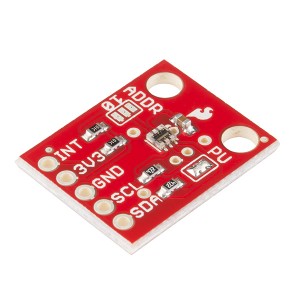



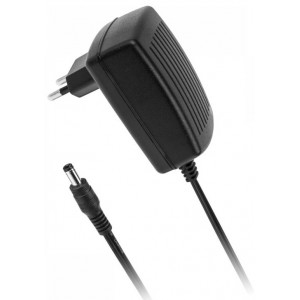
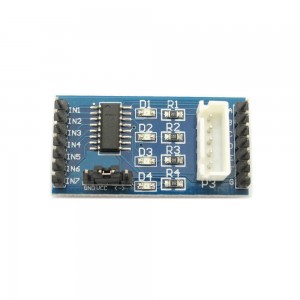

| Supplier | Costs (€) |
|---|---|
| Bottnrol | 3.70 |
| Electrofun | 3.20 |
| Total | 89.00 € |
Although the Team requested different parts, the parts in the table above were the ones that were provided by ISEP. These were mostly parts that were able to be salvaged from around the University or Parts that the Professors had themselves.
7.8 Electronic Architecture
Figure 57 and 58 show the representation of the teams electronic architecture.
Not all the components the Team used for developing the hardware, where in the library so improvisation had to be used and the components that weren't available were symbolized.
- The fan is represented by a 12 V motor.
- Both LED modules are represented by LED lighting.
- The mains supplying a current of 12 V is represented by the battery of 9 V.
- To finish the Nokia 5110 LCD screen is symbolized by the Nokia 6100 screen.
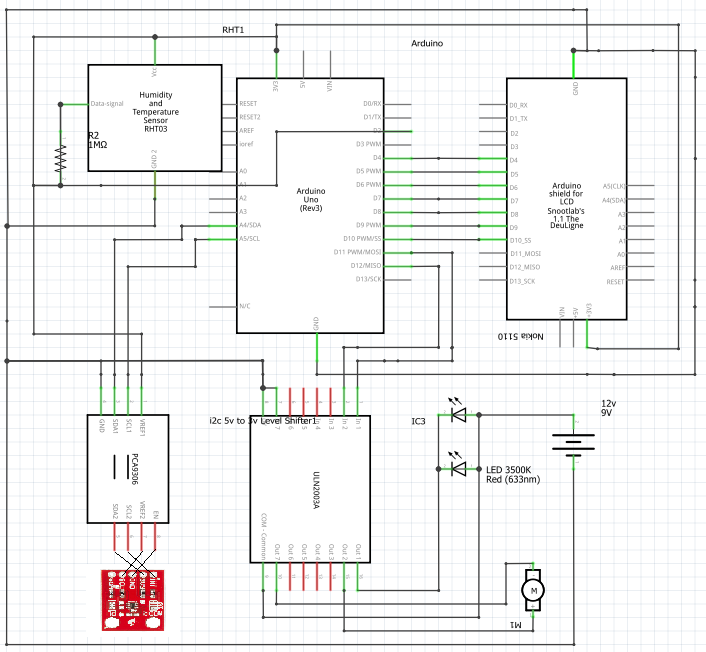
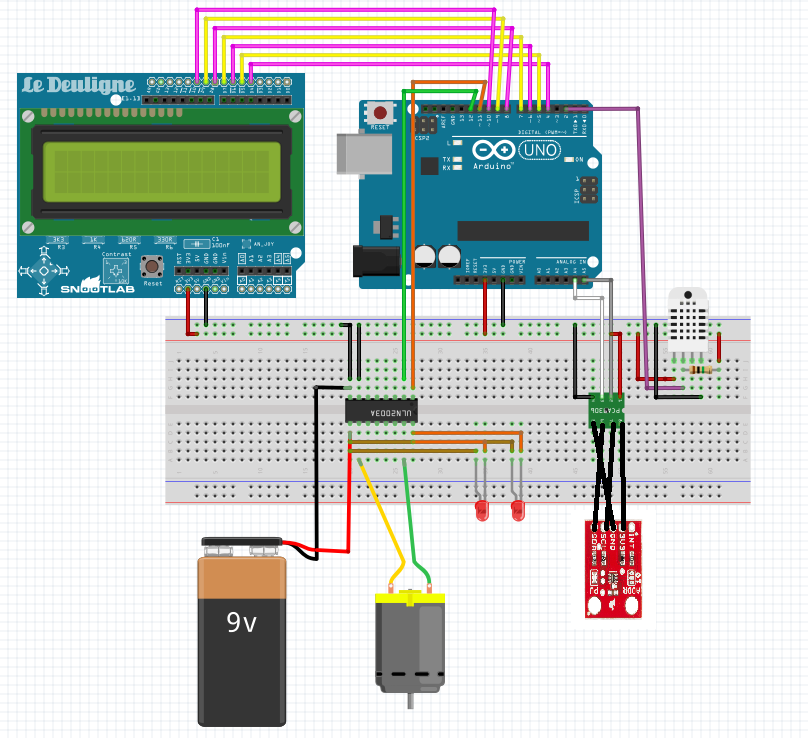
7.9 Tests and Results
In this Section, the Team explains all tests (See section 1.6 Functional Tests) performed and presents its results.
The Team performed all the tests they thought that were necessary in the beginning. While developing the product they also decided to perform the soil tests to find the best way to keep the soil moist.
7.9.1 Electronics Tests
The Team tested all electronic components separately. It was important to do this, to be sure that all the components worked.
7.9.1.1 Temperature and Humidity Sensor
The temperature and humidity sensor measured the temperature and the humidity in the terrarium. The expected temperature range is between 15 °C and 25 °C.
As defined in section 1.6 Functional Tests, the Team tested the DHT22 sensor alone in order to know if it worked correctly. This was the first functional test that the team had planned. First of all, the Team wrote a program to control the following system (see Figure 59).
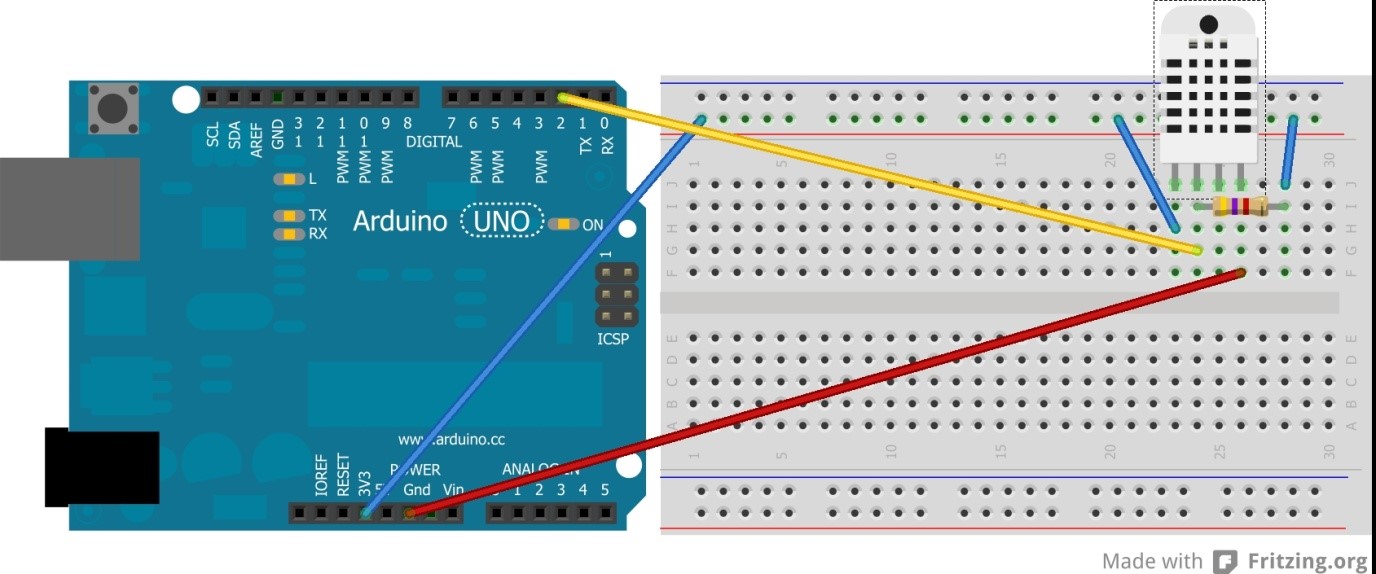
The next step was testing the sensor with a piece of ice. In this case the sensor should show an increase in humidity and a decrease in temperature. The results of the test are the following (see Figure 60), proving the sensor was working correctly In the following video, is it possible to see the temperature dropping below 25 °C.
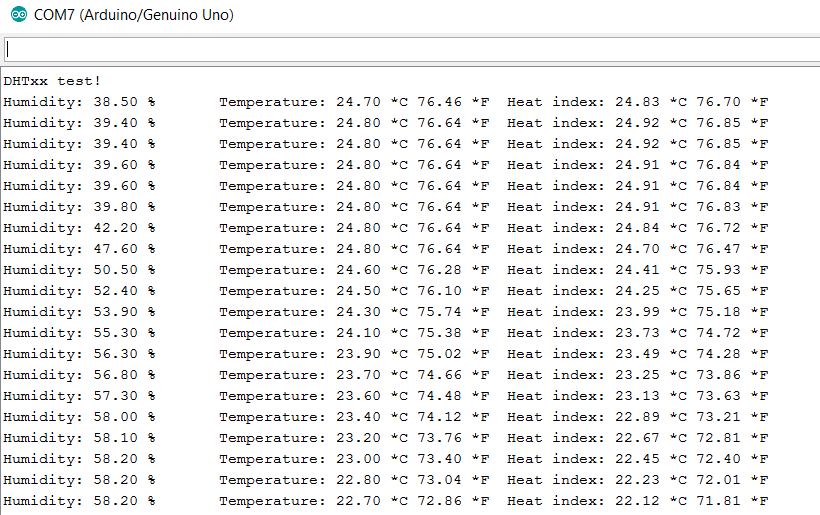
An identical test was done with a hairdryer. In this case the sensor should show an increase in humidity and an increase in temperature. The readings were consistent and proved that the sensor was working properly (see Figure 61). This video documents the temperature rise.
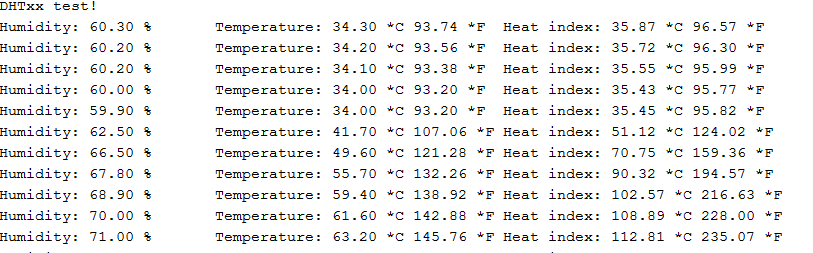
7.9.1.2 Temperature and Humidity Sensor (DHT22) + the Fan
The next test was controlling the fan according to the values given by the sensor. The program specified, according to the living conditions required by snails, that the fan should start to rotate from 25 °C. At the beginning, the monitor displayed a temperature of 27 °C. Logically, the fan started to spin. To see if the rest of the program worked, the fan was turned to the sensor to circulate air and to decrease the temperature to 25 °C. When the temperature reached 25 °C, the fan stopped proving that the circuit, as well as the program was working.
7.9.1.3 LED Lighting
In order to test the operation of the LEDs, we have supplied them with a current of 12V. To do this, we used an adapter between the fan and the mains current to convert the latter from a 230V current to the desired 12V current. As the lights went on, the test proved that the lighting worked.
7.9.1.4 The TSL2561
The Team tested the TSL2561 sensor alone in order to know if it works correctly. First of all, there was a specific program written to control the system (see Figure 62).
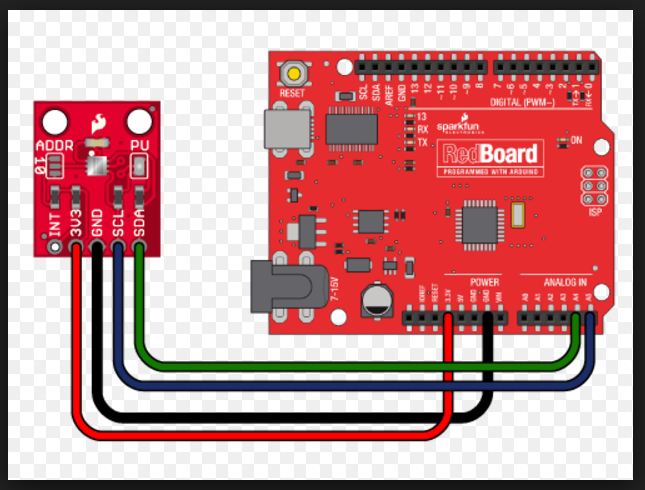
In order to know if the sensor worked properly, the Team obstructed the passage of light by putting an obstacle between the sensor and the light sources. During the first test, the monitor showed the unique value of 65536 lx. After some research, the Team found that there was a contact issue. Thus, welds were made in order to reinforce the contacts. The second test allowed the Team to see that everything worked. When the light was obstructed the value in lx decreased, as can be seen on the screenshot of the monitor (see Figure 63). It can also be seen in this Video.

7.9.1.5 The TSL2561 + LED Lighting
The Team tested this part of the program controlling the LED according to the values given by the sensor. The program specified, according to the living conditions required by snails, that the LED lighting should be turned on if the brightness was less than 50 lx. At the beginning, the monitor displayed a luminosity of 500 lx so, as expected, the LED lighting were off. When the Team obstructed the passage of light, the LED lighting lit.
7.9.1.6 The Whole Electronic System
To sum up the tests, they are summerized in Table 27
| Part | Test | Outcome | Solution |
|---|---|---|---|
| DHT22 | Ice | Humidity rise and temperature fall | - |
| DHT22 | Hair dryer | Humidity and temparature rise | - |
| DHT22 Fan | Air circulation | The fan started with T ≥ 25 °C | - |
| TSL2561 | Daylight illuminance | Wrong reading (65536 lx) | Rewire |
| LED | Operation | LED on when powered with 12 V | - |
| TSL2561 LED | Light dimness | LED on with illuminance ≤ 50 lx | - |
| System | Breadboard assembly | Operational | - |
| System | Soldered assembly | TSL2561 not powered | Rewire and solder |
When all the tests were done seperatly, the Team tested the whole electronic system, including the LCD screen. The whole system works as can be seen in this video
7.9.2 Soil Tests
Moisture along with available calcium content are two extremely important environmental factors that dictate the health of molluscan fauna such as snails. Soil tests were not considered earlier but were added later in the project because of research done during the project on how to keep the soil hydrated. [97][98] [99].
In order to keep the soil moist, two different strategies were used in the present work, namely the addition to the soil of calcium alginate microspheres or sodium polyacrylate particles. Alginate is a natural biodegradable polymer extracted from brown algae that forms hydrogels under mild conditions, in the presence of divalent cations, such as calcium. Sodium polyacrylate is a superabsorbent polymer that has the ability to absorb as much as 200 to 300 times its mass in water. It is frequently used in agricultural since it can absorb water when it rains and release it when needed [100].
Preparation of the alginate microspheres
Using a 1 ml syringe, a 3 % (w/v) Na-alginate (Pronova Biopolymers) solution was extruded dropwise into a 0.1 M CaCl2 cross-linking solution, where spherical-shaped particles instantaneously formed and were allowed to harden for 30 min. At completion of the gelling period the microspheres were recovered and rinsed in water in order to remove the excess CaCl2 [101] [102].
Preparation of the sodium polyacrilate particles
Two grams of sodium polyacrylate crystals were added to 1000 ml of water and let them swell for 72 hours.
Relative Humidity soil tests
In order to investigate the capacity of the two materials to release water and keep the soil humid, humidity tests were performed using the setup shown in Figure 64. Three soil boxes were prepared, namely:
- Box 1: soil (used as control);
- Box 2: soil + calcium alginate microspheres
- Box 3: soil + polyacrylate hydrated particles
The same ratio of soil mass and calcium alginate microspheres or polyacrylate particles mass were used (700 grams of soil to 82.81 grams of microspheres or particles). A humidity sensor was placed inside each of the boxes, connected to an arduino, in order to collect the relative humidity soil changes over 72 hours. The soil boxes were covered with a perspex box positioned to allow the circulation of air.
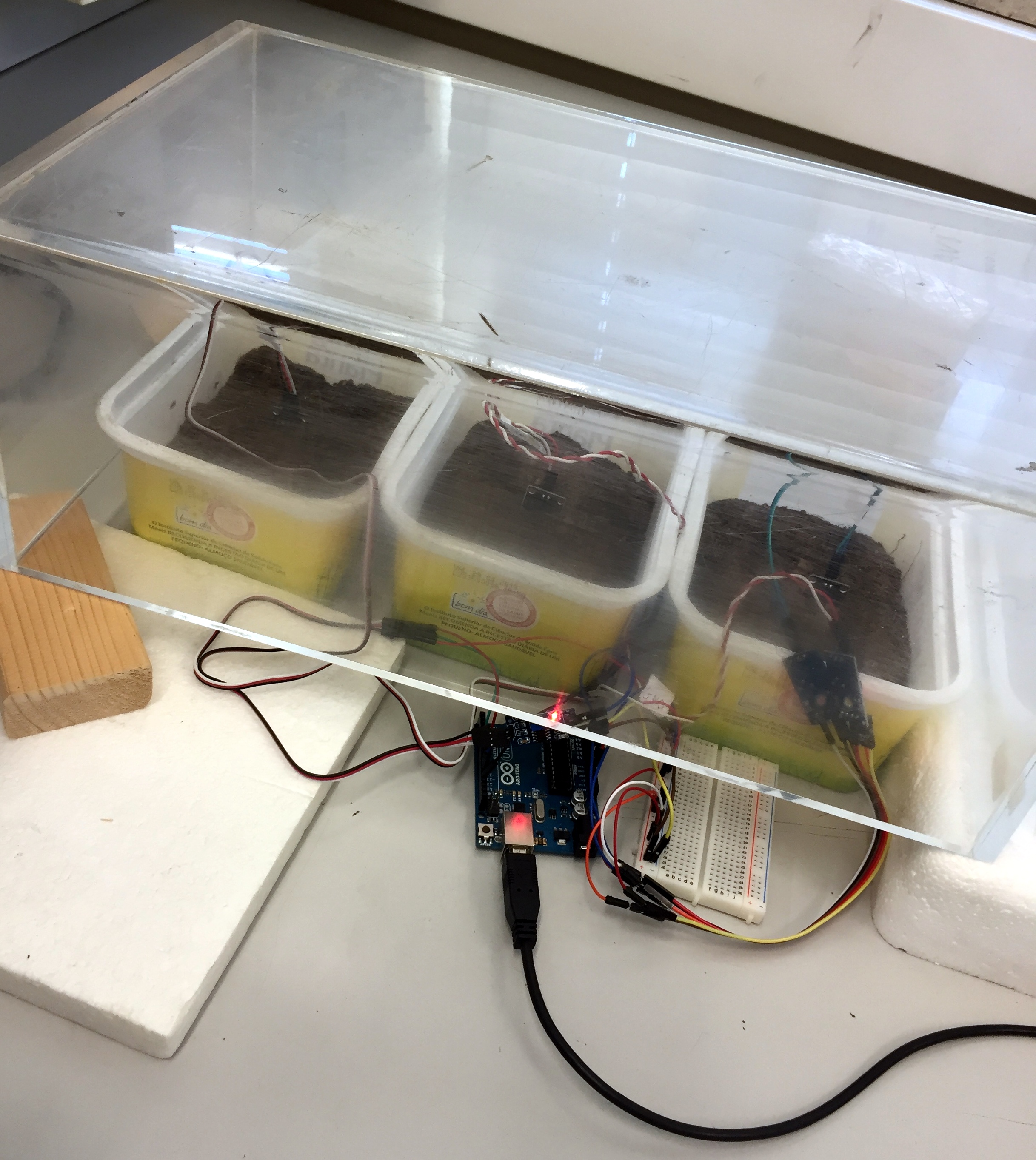
Figure 65 shows the results obtained. As expected, the relative humidity of the soil (Box 1) decreased during the test as opposed to what happened with the presence of calcium alginate microspheres or polyacrylate hydrated particles. For both materials, there is a burst of water release for the first 24 hours of the test and then it stabilises. The quantity of water released was higher for the calcium alginate microspheres in comparison to the polyacrylate particles. The amount of material to be added to the soil must be adapted to the desired humidity level.
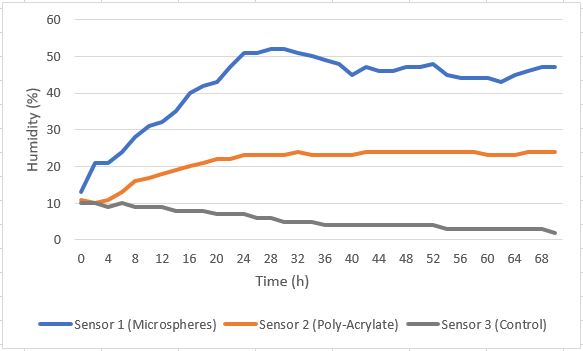
The calcium alginate microsphere solution is the material of choice to keep the soil moist, not only because the humidity level was the highest attained during the whole test, but also because as they degrade, they release calcium into the soil, and calcium is very important for the snails health (see Section Environment requirements). Snail shell is made of calcium carbonate and keeps growing as long as the snail grows. In this particular application microspheres can act simultaneously as a water and calcium reservoir. Additionally, alginate microspheres can also be used as a controlled-release product of other substances that are identified as necessary for snail’s development, such as, for instance, vitamins.
7.10 Prototype
In Figures 66, 67, 68, 69, 70, 71, 72, 73, is the building process of the prototype displayed. The prototype included all the electronics to provide the optimal living conditions for the snails.
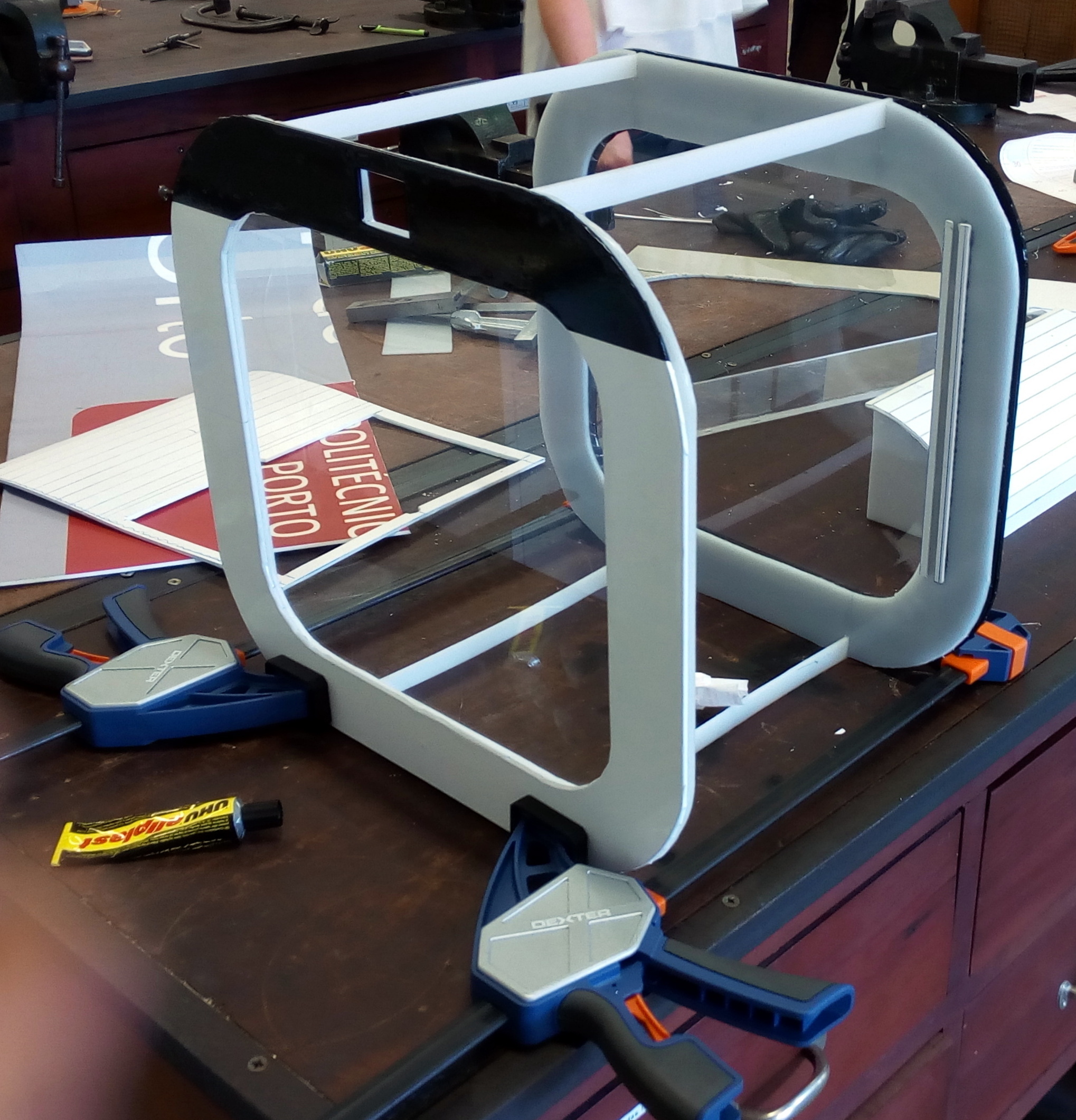
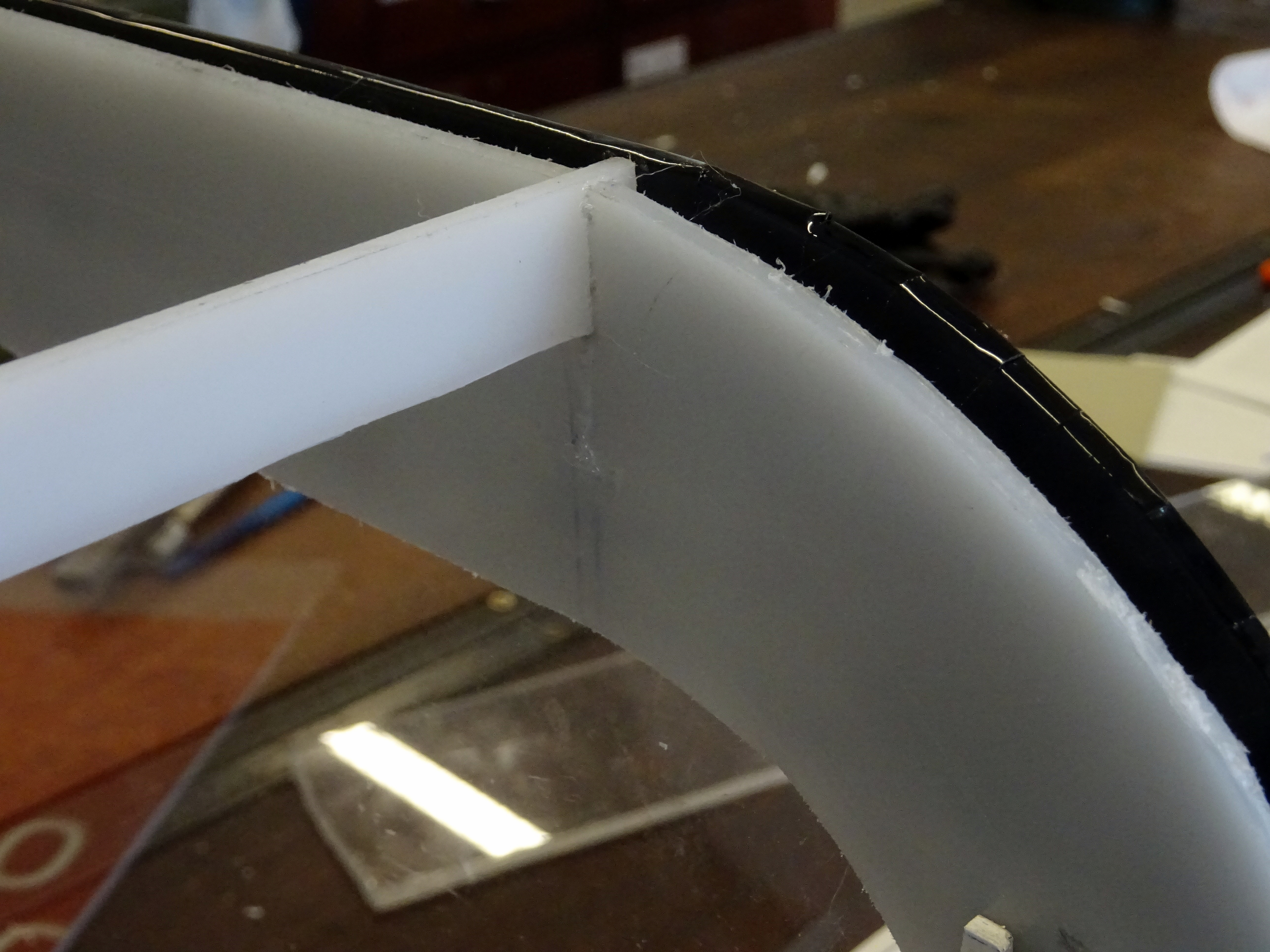
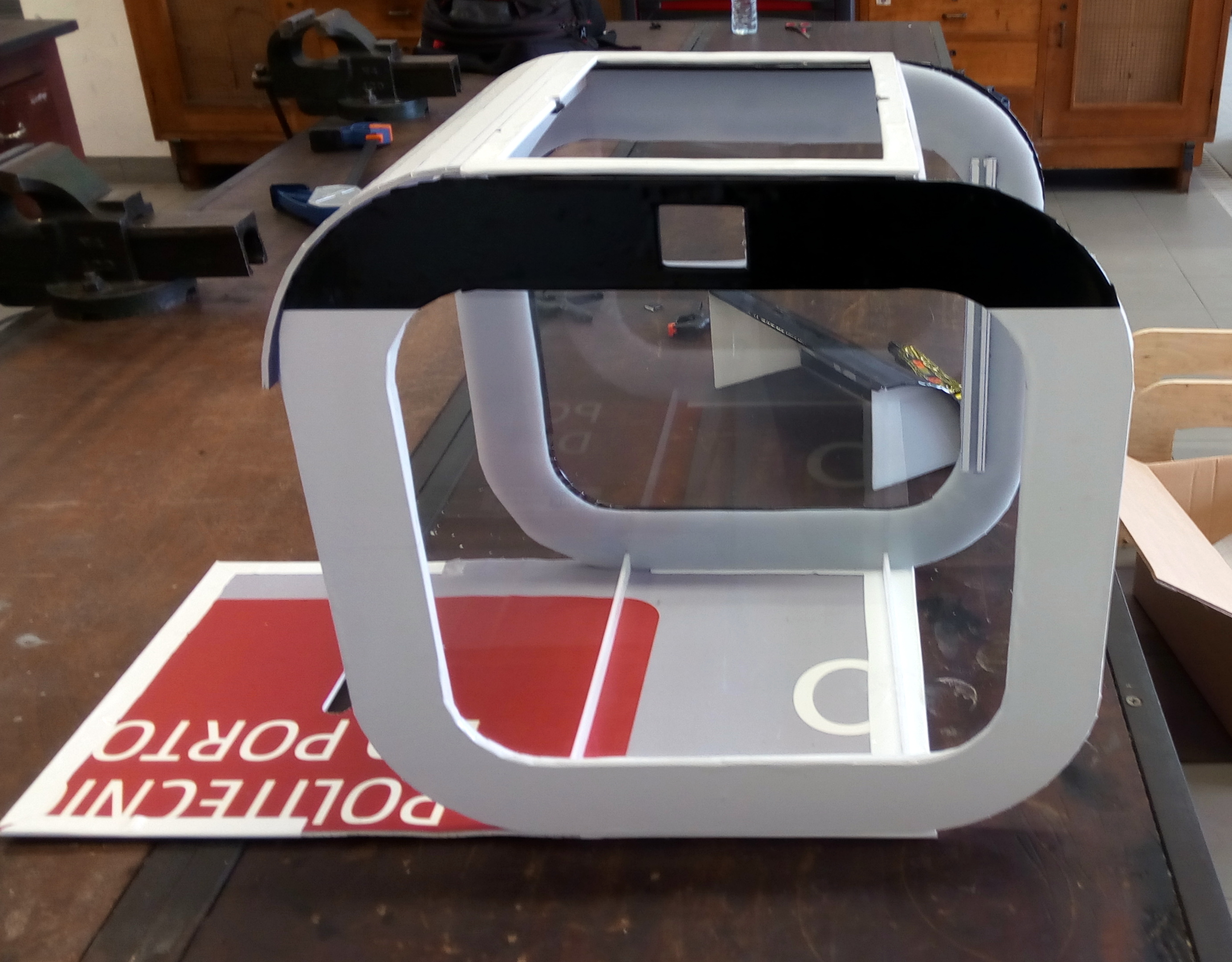
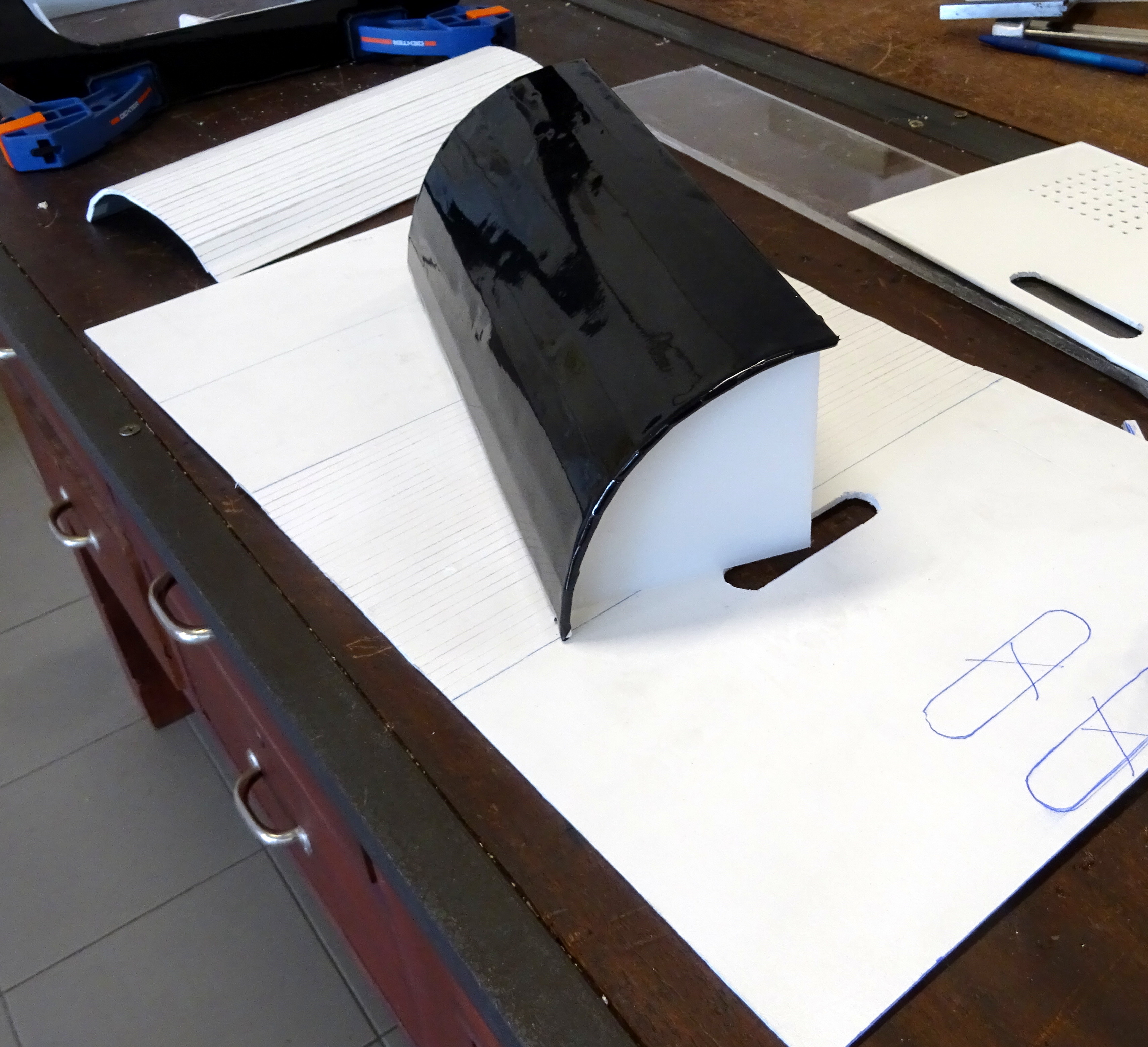
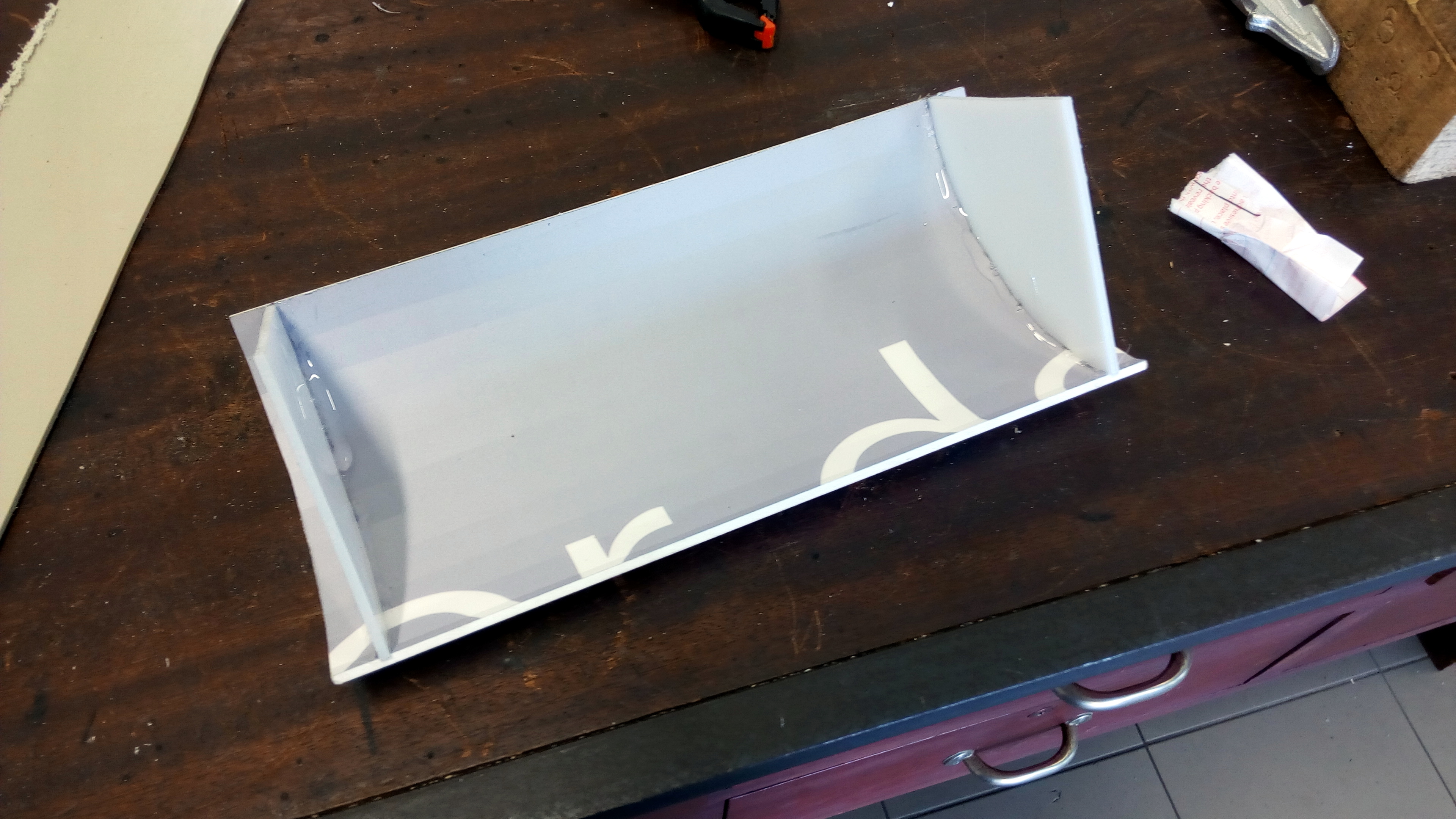
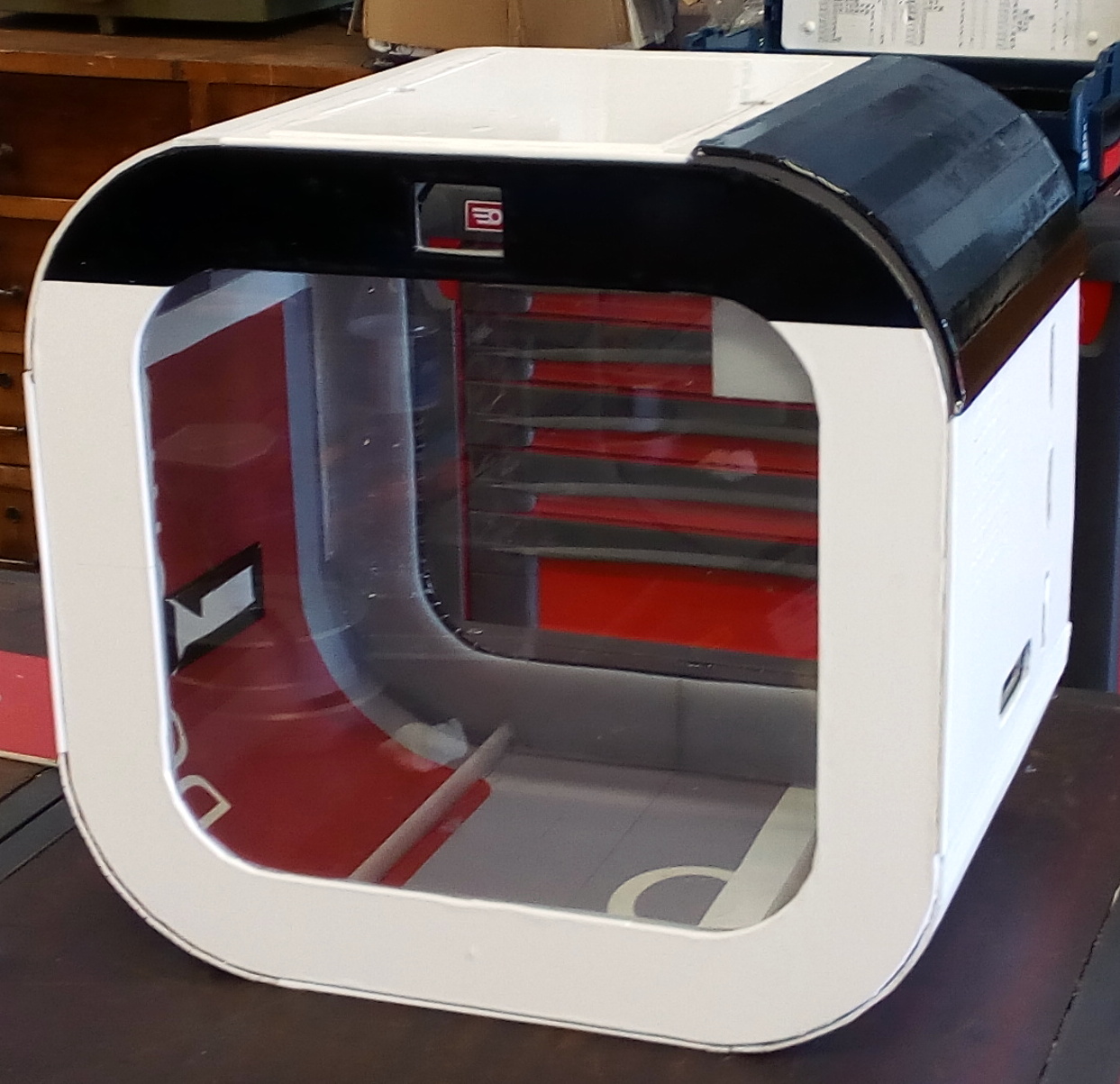
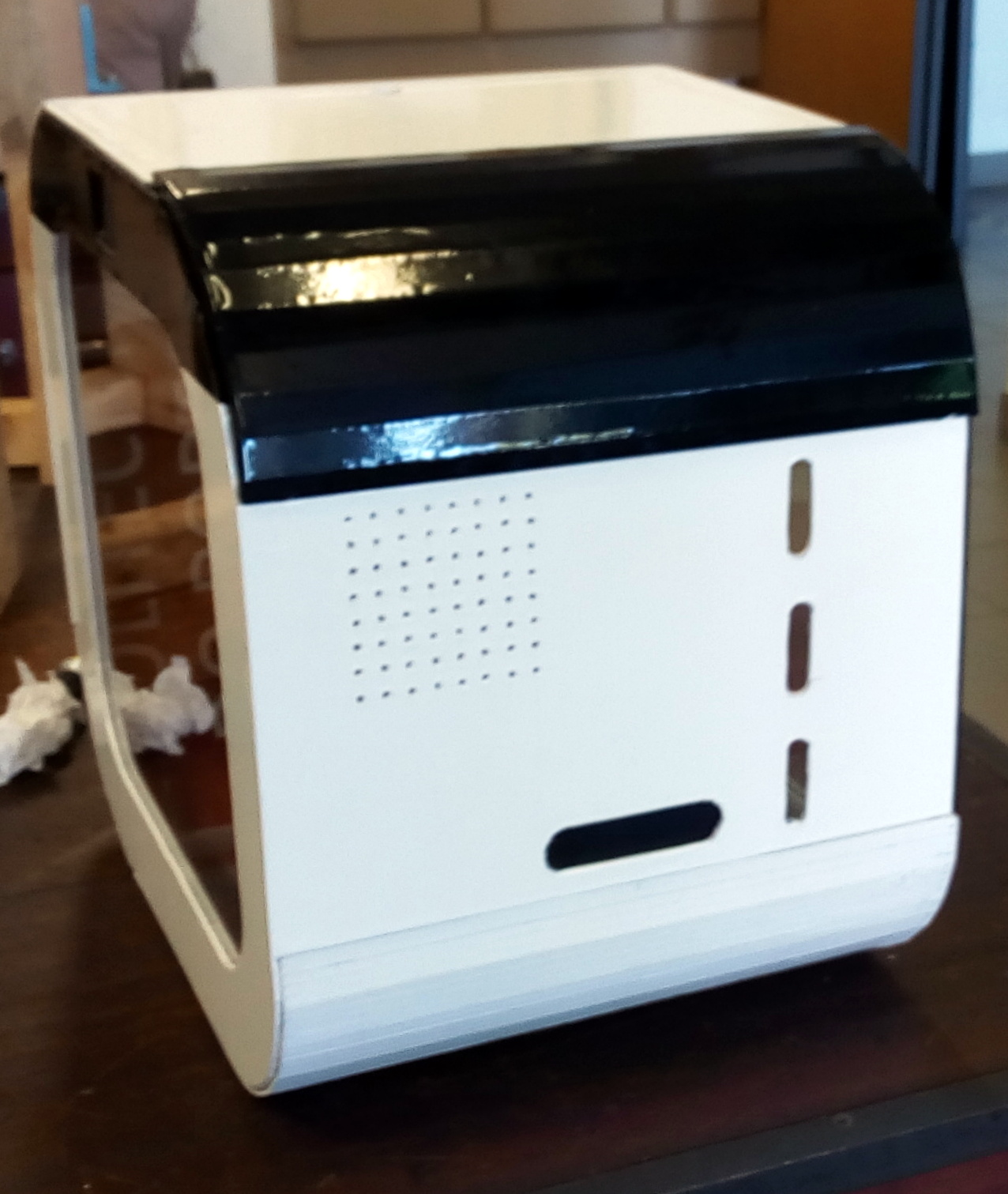
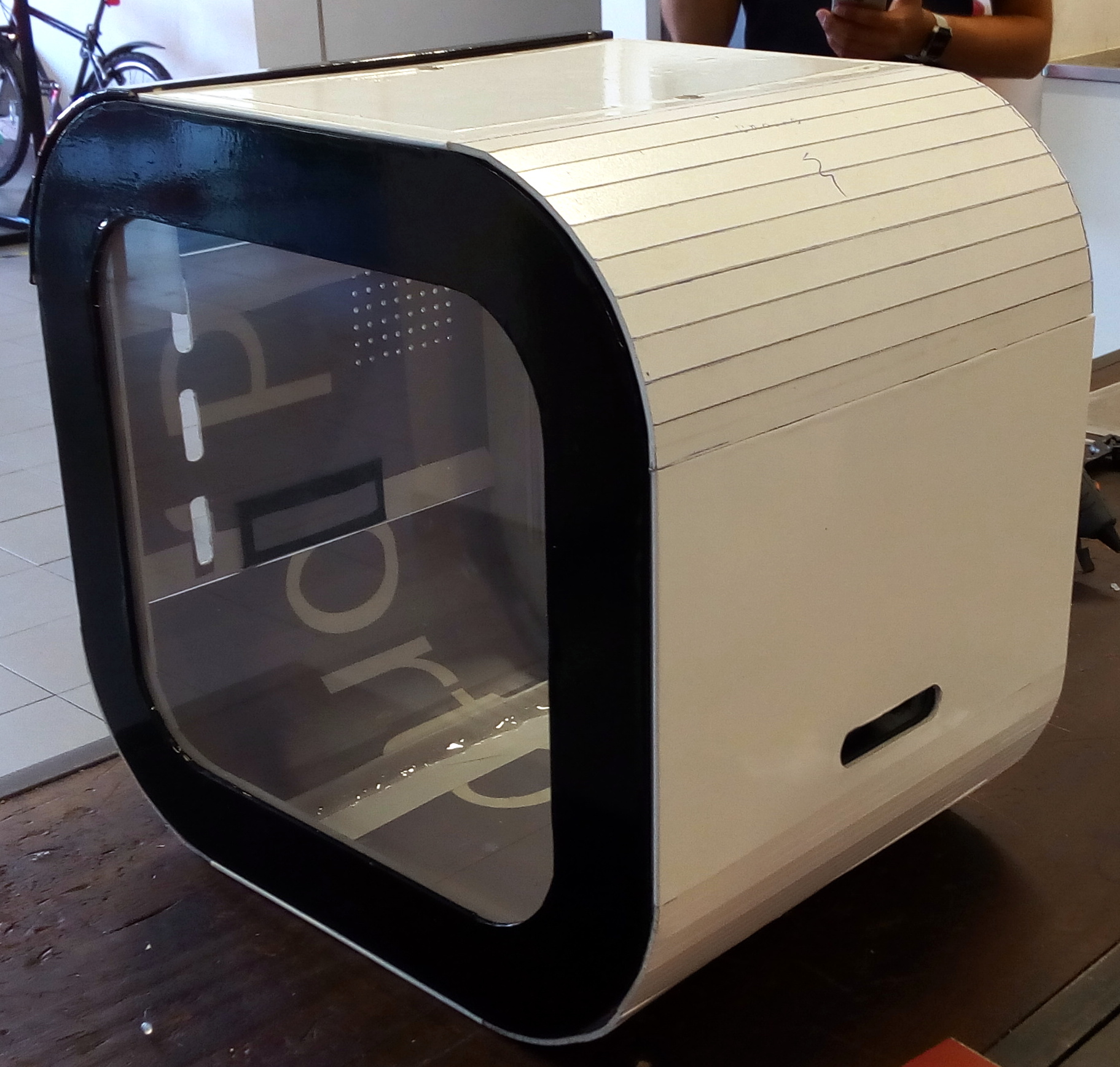
7.11 Conclusion
The Product Development section is the most important part of the project. This is where the design of the product is presented. The Team has created various 2D and 3D designs, as well as a 3D model out of cardboard. This section is where all the materials have been narrowed down and chosen. The Team did research on the materials that have been chosen to make sure that the materials are fit for purpose, and also to make sure that the electronic components are capable of what is required from them. In this part of the project all the programming was created and described, and electronic schematics done. The Team also did many different tests and experiments in this section of the project.
The Product Development Section proved to be very rewarding for the Team as they learned the most in this Section, and learned new skills they didn't have before. The Team developed the prototype and learned what would and would not work in the final product.
8. Conclusions
With this report, the Team developed a product which achieved the requirements that were set, as can be seen in Section 1.5 Requirements.
First, the Team did some research about Escargot Nurseries in the State of Art. The Team found out that there were no competitors for the product they wanted to develop. Project management was an important tool for the team members to identify all the tasks and time limits, to guide the cost and the budget, to measure the risks and to analyse the responsibilities of the people that were involved. In the marketing Section, the Team chose their logos and commercial names and decided to launch the product in France using an online marketplace. To develop the “EscarGO”, the Team needed to think about sustainability and ethics. After all those steps, the Team could develop and built a prototype with a potential market.
8.1 Discussion
The EPS programme provided an innovative educational experience for the team members, in terms of the learning approach, drawing knowledge from different fields in a series of subjects, as well as the different attributes and cultures of each member of the group.
The objectives of the Team were to design and build a unique and innovative product that would help people to produce their own snails at home, whether for recreational purposes or consumption. The main objective was to bring families together and educate children about animals and food.
This product had to be sustainable and protect the environment. The Team tried to reduce its environmental impact, by creating a low impact system and using low impact materials. An innovative sustainable tool that was used, was the curtain system. With the curtain system, the service intensity was increased. Increased hygiene was also a positive side effect of the curtain method. For this project, the Team used two curtains. This way the same amount of energy was used, but a larger number of snails could be kept in the enclosure.
The design of the “EscarGO” needed to be simple but attractive with not too much technology. From the results of the marketing study (where a survey was conducted), the potential user wanted a simple product, so the Team took this in account while developing the prototype. The “EscarGO” is meant to be placed in the kitchen or the living room of a house. At the beginning of the project, when the Team started with designing the prototype, the Team was thinking of adding a pivoting system to the “EscarGO”, but it was decided not to use this system because it was too difficult to make and not user-friendly enough. The solution was to get the top off the product to get the curtains out to clean. It was also more user-friendly because there was no extra space needed.
There were some problems with programming during the project because of some bad connections and nobody in the Team had ever worked with Arduino before. But the Team solved everything and almost all tests could be done. There were also time constraints and the heating element could not be added on time for the prototype but will be used in the final product. Because of the time constraints, it was not possible to test the water tank. While the Team was developing the electronic system, they discovered a more ingenious solution. For the prototype it was necessary to connect the Arduino board to a computer at all times in order to operate the program. This is because the time had to be synchronized with the computer, and would loose the time data if switched off. This solution was not optimal and not practical. In order to be connected to a computer, the Team thought of including a Real Time Clock (RTC), price; 5.90 € but unfortunately the Team did not have time to buy it for the prototype.
8.2 Future Development
For the future development of the product the Team thought of different ways that the “EscarGO” could be used. One alternative to snails is using the product to produce insects. Alternatively, the product could also be changed to suit small reptiles, and developed further to house snakes. There are already plenty of those on the market, but the Escargot Nursery concept is a much more attractive design.
Another addition that the Team considered is adding controls so that the humidity and temperature can be changed to suit different insects or reptiles. Controls for the time function, such as a real-time clock, would also be included in the final product, but for the prototype the Team was limited by cost so these details couldn't be added.
In the prototype, there is a water tank included to keep the soil moist. The team did some tests with poly-acrylate and microspheres. The microspheres are an improved solution compared with the water tank so for the future the Team wants to include the microspheres in addition to the water tank. These are not harmful for the snails and the family can make those microspheres together to make the family bond stronger.
Another test that needs to be completed is, testing if the snails are comfortable within the prototype. This was necessary because they need to live in the “EscarGO”. The team did not have time to test the prototype with the snails because to monitor the growth and quality of life of the snails would require a minimum of 3 months of living within “EscarGo”.
8.3 Project Conclusions
During this project, the Team built a product while simultaneously keeping in mind the budget and deadlines. The product the Team produced incorporated ideas from the whole Team. The Team had discussions about the best way to make the product simple but attractive, and listened to each team member and used the best ideas. Each person came from different countries, with different cultures and had different fields of study. Sometimes there were communication problems, but the Team solved everything and working with this combination was a rewarding experience.
Each member had a personal opinion about EPS:
Lauri Borghuis: EPS was for me a good opportunity to work in a multidisciplinary group and live in a foreign country. A disadvantage of EPS was that the groups were made based on Belbin and not based on interest in topics. In our Team, there was no one that had ever worked on Arduino before, so it was really hard to program everything. With the help of some supervisors we finally figured it out. I learned a lot of knowledge from my team members and it was really good for my development in the English language.
Benjamin Calon: Going abroad on my own was far out my comfort zone. Developing and designing new products is what I`m trained to do, but working in a multidisciplinary and multicultural group was a new and enriching experience. Most of the classes were a revision of my bachelor, but hearing it from other professors gave me new insights. The Portuguese class was really fun and useful in day to day life. Just the time division bothered me: in the beginning a lot of classes and little time to develop the actual product. After all I learned so much hard and soft skills while having the time of my life.
John MacLean: EPS was a brilliant opportunity for me to work with people from all over Europe on a project similar to what I would be expected to work on in a professional environment, with the coordinators acting as clients, with them changing requirements as we went along. It taught me a lot about improvisation, and the need to adapt quickly to changing situations. A disadvantage of the EPS project is that we had to do a lot of classes that didn't seem relevant to the project, when we were just wanting to work, and provide the best solution that we could. I think that we could have included more in our final prototype had we started building earlier, and had more time available in the workshop.
Juliette Portefaix: For me, the EPS program allows you to develop additional skills in a normal curriculum. Indeed, it was an opportunity to learn to work in an international and multicultural group. I really enjoyed learning new things. As I had to develop the electronics for the prototype. I developed my knowledge in programming and electronics. One of the disadvantages to this program is the meetings, that were too close together we had with the supervisors. Indeed I would find it more interesting to make meetings only when the group really needed it.
Ramon Quero: To live in a foreign country and speaking a different language while working on a multicultural team was a life changing experience. I feel very lucky to have had this opportunity. I have learned many things I did not know before about many different fields of knowledge and I have worked in a professional atmosphere similar to what I may have to deal with in the future. Despite these facts, the EPS programme was a bit disappointing for me. It is not about engineering as I was told, it is mainly product development with quite a lot of electronics. I have learned many things that most likely will not be useful for my future professional working life at all. The organisation was awful as well. The teams did not work any better or worser than any other teams I have worked on before, putting together more people from the same degree may work better. Many classes came completely out of time, some should have been given before the selection of the project while others came far too late. It was an effort to live in a foreign country studying and many last minute reschedules made impossible to work or enjoy this experience some times since we could not miss any lesson but they could be cancelled at any occasion. All in all, EPS left me with mixed feelings.
This European Project Semester was a good opportunity to work in a multidisciplinary group of students. They all learned a lot from each other's different fields and cultures. The Team wants to thank all the supervisors and teachers for all their help and support.


