This is an old revision of the document!
Warning: Trying to access array offset on null in /home/especiais/epsatisep/public_html/2017/EPS2017-wiki1/lib/plugins/caption/syntax/reference.php on line 68
Warning: Undefined array key "tpjctpn" in /home/especiais/epsatisep/public_html/2017/EPS2017-wiki1/lib/plugins/caption/syntax/reference.php on line 68
Warning: Undefined array key "texistingp" in /home/especiais/epsatisep/public_html/2017/EPS2017-wiki1/lib/plugins/caption/syntax/reference.php on line 68
Table of Contents
PlayGround
Report
EscarGO® - The Escargot Nursery

Authors:
- Lauri Borghuis
- Benjamin Calon
- John MacLean
- Juliette Portefaix
- Ramon Quero

Acknowledgement
Team one “Caracol” would like to thank European Project Semester (EPS) and Instituto Superior de Engenharia do Porto (ISEP) for the chance to participate in this project, which is a once in a lifetime opportunity for us to grow and develop ourselves both professionally and personally.
The team would also like to thank the panel of supervisors for the support, help and advice they gave the team on a weekly meeting basis, as well as the teachers that offered some very helpful pieces of advice during the semester.
Glossary
| Abbreviation | Description |
|---|---|
| B2B | Business to Business |
| B2C | Business to Consumer |
| CD | Compact Disc |
| CNISF | Conseil National des Ingénieurs de France |
| COD | Cash On Delivery |
| EPS | European Project Semester |
| EU | European Union |
| FAQ | Frequently Asked Questions |
| IOT | Internet Of Things |
| ISEP | Instituto Superior de Engenharia do Porto |
| LCD | Liquid Crystal Display |
| LED | Light-Emitting Diode |
| PESTLE | Political, Environmental, Social, Technological, Legal and Economic |
| PETA | People for the Ethical Treatment of Animals |
| PMMA | Polymethylmethacrylate |
| PP | Polypropylene |
| PVC | Polyvinyl Chloride |
| RAM | Responsibility Assignment Matrix |
| ROHS | Restriction Of Hazardous Substances |
| SEO | Search Engine Optimisation |
| SMART | Specific / Measurable / Attainable / Relevant / Time Based |
| SWOT | Strengths / Weaknesses / Opportunities / Threats |
| USB | Universal Serial Bus |
| WBS | Work Breakdown Structure |
| 3D | Three-Dimensional |
1. Introduction
1.1 Presentation
The team were undertaking the EPS Project in Portugal, studying at ISEP in Porto. The team named “Caracol”, which means snail in Portuguese, consisted of five students all from different countries, cultures, speaking different languages, and above all with differing knowledge bases. This diversity, which could have been an obstacle, was instead the driving force that enabled the team to make this project unique, creative and innovative.
The team was composed of:
- Lauri Hannah Borghuis, from The Netherlands, studying Biology and Medical Laboratory Research
- Benjamin Calon, from Belgium, studying Product Development
- John MacLean, from Scotland, studying Mechanical Electronic Systems Engineering
- Juliette Portefaix, from France, studying General Engineering
- Ramon Quero, from Spain, studying Engineering and Architecture.
Team “Caracol” (See Figure 1) was a multidisciplinary, hardworking group of people who wanted to improve and develop communication and team working skills as well as other soft-skills, while learning about marketing, ethics and project management. Because of the multidisciplinary aspect of EPS, each team member learned something new from a field of study that they had not experienced before.

Each member had a personal motivation to enroll on the EPS project:
Lauri Borghuis: “EPS seems to me to be an excellent opportunity to make new social contacts with international students. I chose EPS to work in a group with international students with all different fields of study, so I can learn from their fields, and I can share my knowledge. Furthermore studying for six months abroad is good for my development in the English language”.
Benjamin Calon: “The EPS project trains us in a different way than normal school courses. It gives us soft skills to work with students from different backgrounds (professional and cultural). Going out of my comfort zone, improving my language skills and enjoying the local culture are the ingredients for an extraordinary experience”.
John Maclean: “EPS gives me a chance to live abroad for a few months and experience a different culture. It allows me to meet people from all over Europe and make friends and connections for life. It puts me far out of my comfort zone and also gives me a chance to develop another language”.
Juliette Portefaix: “EPS is for me a great opportunity to discover a new way of working. It is a chance to discover a new culture and new people. EPS also enables me to develop my management skills, and to learn to work in a team. Finally it’s the best way to improve my English”.
Ramon Quero: “I see EPS as a nice chance to improve my teamwork skills by working in a project with colleagues from different nations and backgrounds, an opportunity to speak in a foreign language and to learn other skills like communication, marketing or project management. It is also an unforgettable life experience”
1.2 Motivation
The project that has been chosen was an “Escargot Nursery”. This option was chosen for several reasons.
First of all, this was the subject which allowed the mix of each of the differing specialties thus allowing each member to bring their own experience and skillset from the various specialties.
Another reason for making this decision was that the team believed it was the most original and unusual project. None of the team members had any prior knowledge of escargot before the start of the project which provided its own challenge, but also allows the whole team to learn something completely new. It enabled the team to satisfy their curiosity, and be more open minded to new disciplines.
With this product the team wanted to address some of today's concerns (See following section). They felt passionate about the idea of creating an educational product that could make modern families' lives a little better.
1.3 Problem
In the modern era, more people are aware of the use of genetically modified organisms. Genetic modification is being used to improve food's colour, to make the food look more attractive or to increase the shelf life of the products. There are people who fear genetically modified food, and there are others who believe that it is the future and the way to end world hunger. The problem with genetically modified vegetables is that there is not enough scientific knowledge to prove the long term effects [1].
The digital revolution has improved our communication channels through the likes of social media, mobile phones, and video conferencing, but it has also isolated people becoming addicted to their smartphones and not living real social life. Social media comes with its pitfalls also, with people trying to project the perfect life, and comparing themselves to others. Depression and mental health issues have become more common among young people [2].
The team saw this reality and decided they wanted to crate something that would help towards a happier healthier lifestyle. They realised more people are opting for organic food, and want to know where their food has come from. Also, many more people are wanting to grow their own food at home and want to reduce their carbon footprint. This product fits into this brief well.
One of the problems that comes with this project is that the snails have to be kept within the cage with no chance of escape. One of the issues is the laws in a particular country might not allow the production or domestic use of snails as they are believed to be pests or non native species, which could severely harm the ecosystem, such as the Giant African Snail [3].
1.4 Objectives
The goal is to design and build a unique and innovative product that will help people to produce their own snails at home, whether for recreational purposes or consumption. The main objective is to bring the family together and educate children about animals and food. Additionally the product provides two meals a year for a family of four as the Cornu aspersum grows to the optimal size in six months [4].
The team believes that this product fulfills a genuine desire with families who want to learn more about food, and be more sustainable in food production. Producing food at home allows for a reduction in food travel, as food can travel from all over the world before it ends up in the supermarket. This reduces the carbon footprint of the food that reaches the dinner table. It also provides a project which families can do together to bond.
This product should be sustainable because sustainability and protecting the environment around us is becoming more important because of the impact of climate change. The team is trying to reduce their environmental impact, by creating a low impact system and using low impact materials. The design needs to be simple but attractive.
Temperature and humidity monitoring are also very important, so the sensors need to transmit all the relevant information to the controller, and allow full automation, with little human interaction.
1.5 Requirements
The Escargot Nursery has to meet several requirements:
- Attractive aethetically pleasing design
- Set, display and control the internal temperature, light and humidity
Some other project requirements are:
- Use sustainable materials
- Use low cost hardware solutions
- Stick to the budget (100 €)
- Comply with the following European Union (EU) Directives:
- Machine Directive (2006/42/CE 2006-05-17);
- Electromagnetic Compatibility Directive (2004/108/EC 2004 12 15);
- Low Voltage Directive (2014/35/EU 2016-04-20);
- Radio Equipment Directive (2014/53/EU 2014-04-16);
- Restriction of Hazardous Substances (ROHS) in Electrical and Electronic Equipment Directive (2002/95/EC 2003-01-27);
- Mandatory adoption and use of the International System of Units (The NIST International Guide for the use of the International System of Units)
- Use open source software and technologies.
1.6 Functional Tests
To evaluate the work, the team had to perform certain functional tests. These tests give an insight into whether the Escargot Nursery is ready to be released to the market.
- Temperature + Humidity Sensor: Testing if the sensors work in the right way, it is possible to use ice to lower the temperature, and see if the temperature sensor works. To see if the humidity sensor works, it is possible to put rice around the sensor.
- Light Sensor: Testing if the light sensors work, the lights need to be on, on time. It can be tested by covering the light sensor during day time and see if the lights go on.
- Cooling Fan: Testing if the cooling fan works if the temperature increase above 25 ºC. Putting a heating pack in the “EscarGO” and see if the cooling fan starts to cool the temperature in the enclosure.
- Electric Heater: Testing if the heater works if the temperature decreases below 15 ºC. Putting a cooling pack in the “EscarGO” and see if the electric heater starts to work.
- Liquid Crystal Display (LCD): Testing if the LCD works, if it displayed the temperature, light and humidity.
- Snails: Testing if the snails can survive in the Escargot Nursery. Put snails in the “EscarGO”, care for them and see if they will survive.
1.7 Project Planning
Every project needs to be planned carefully because a project plan gives an overview of all the tasks and deliverables that need to be completed. Having a good project plan and following it well allows the smooth running of the project, and keeps the project running on schedule. Table 1 shows the planning used for this project. In chapter 3.3 there is a comprehensive project plan including a Gantt chart.
| Task | Responsible |
|---|---|
| Project Plan | |
| Task Allocation | All |
| Gantt Chart | Juliette |
| System Diagrams & Structural Drafts | Benjamin |
| System Schematics & Structural Drawings | Benjamin, John |
| Budget Planning | Ramon |
| Research | |
| Target | Benjamin |
| Sustainability Research | Lauri |
| Ethics Research | Juliette, John |
| Marketing Plan | Benjamin, Ramon |
| Research on Materials | All |
| Design | Benjamin |
| Building & Testing | |
| Building Prototype | All |
| Environment | Lauri |
| Programming | John |
| Testing | All |
| Delivery | |
| Report | All |
| Presentation | Juliette |
| Leaflet | Lauri |
| List of Materials & Components | John |
| Paper | John |
| Poster | Lauri |
| Manual | Ramon |
| Website | Ramon |
| Wiki | All |
| Video | Ramon |
| Product | All |
1.8 Report Structure
This report follows a logical sequence, composed of eight chapters. Each of these chapters were divided into sections. The report was organized in such a way as to make the reasoning and explanations as clear as possible. The chapters are:
- Introduction: Presentation of the team, of the reasoning and the motivation behind the choices, the main problems the team faced, and some requirements for the project.
- State of the Art: Existing products, technological system and snail's life-cycle.
- Project Management: Overview of how the team will manage the project, the management tools such as a Gantt chart, cost and time diagrams.
- Marketing Plan: Description of the current market situation and presentation of our marketing strategy.
- Eco-efficiency Measures for Sustainability: Explanation of the choices to make the project as sustainable as possible.
- Ethical and Deontological Concerns : Description of the ethical concerns the team has addressed.
- Project Development: All of the technological choices, tests and results.
- Conclusions: The conclusion the team has garnered from the project, any alternative solutions that may work.
2. State of the Art
2.1 Introduction
To get started, an explanation of Escargot Nursery is introduced. This chapter also comprises the description and comparison of five existing products meant for home use, and four snail farm products which are already on the market, in order to draw conclusions and to take up relevant ideas that could be used in this product. This chapter adds information about the Cornu aspersum life-cycle and their optimal living conditions. In addition, there is an explanation of technologies used in “EscarGO” required for snail breeding.
2.2 What is an Escargot Nursery?
An Escargot Nursery is a product designed to grow snails, providing them with a comfortable living environment. The Nursery needs to be able to host an amount of snails with ample space, along with soil coverage and other things they may need to grow correctly. (See 2.4 Escargot Research).
“EscarGO” was the commercial name chosen for the indoor snail farm the team was developing during the EPS program (See 4. Marketing Plan)
2.3 Existing Products
2.3.1 Products for Home Use
There were some existing products similar to this project (See Table 2), meant for home use. These products were the direct competitors of the “EscarGO” project, since they were designed for domestic use. Most of them were very basic without any technology. The “EscarGO” had to push the boundary and not to be only something technologically better and more advanced than what was already on the market, but also something that was aesthetically pleasing.
| Name | Product | Price (€) | Animals | Technology | Size (cm) | Other specifications |
|---|---|---|---|---|---|---|
| Grow your own escargots by S'cargo [5] | 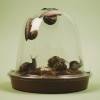 | 46 | Snails | No technology | 30 x 30 x 30 | Bell shaped propagator and saucer as attractive snail farmhouse with sterile bedding. Instructions to help you keep the snails healthy and growing. Some special dry snail food to give them a good start. |
| Aqueon® Glass Aquarium [6] | 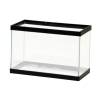 | 14 | Fish | No technology | 31 x 16 x 20 | Material: glass, features: no assembly required |
| Zoo Med™ ReptiHabitat® Bearded Dragon 40 Gallon Terrarium Kit [7] | 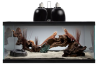 | 172 | Reptiles | A custom dual screen top provides easy access to the habitat and keeps your reptile safely inside. Including UV lighting. A dual temperature/humidity gauge to maintain temperature. | 91 x 45 x 45 | Lamp bedding, food samples |
| All Living Things® Hermit Crab Habitat Kit [8] | 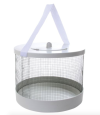 | 30 | Crabs | No technology | 30 x 30 x 25 | Kit includes a soaking dish, seashell palm tree, sponge, sprayer, resin coconut hut and instruction manual. Cage is made from plastic and metal for durability |
| biOrb® FLOW 4 Gallon LED Aquarium [9] | 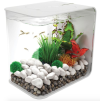 | 90 | Fish | biOrb 12V Transformer. biOrb Air Pump. Airstone. Standard LED light unit. | 21 x 30 x 31 | Ceramic Media 450 g. Filter cartridge. Water Conditioner 5 ml. Beneficial Bacteria liquid 5 ml. Material(s): Acrylic Aquarium |
The team decided to choose a concept similar to the design of an aquarium, because the product needs to be simple yet attractive. The use of transparent sides would allow the users to see and enjoy the growth of their snails. In order to distinguish the product from the competitors, the team decided to include several technological aspects in the design, like lighting, temperature and humidity control. (See Temperature, Humidity and Control System).
2.3.2 Snail Farm Products
There were already existing snail farms on the market, using different technologies to farm them. Since most of the home-use competitors of the “EscarGO” were not designed for snails, a comparison between bigger snail farming solutions was made. The team considered this comparison relevant to the development of the product, due to the lack of techniques used in the products for domestic use. These technologies were dedicated to raise a much larger number of snails, whereas this project is designed for a much smaller number and for domestic use.
| Name | Picture | Size (m) | Description | Advantages/Disadvantages |
|---|---|---|---|---|
| Hutch Box | 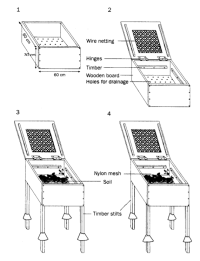 [10] [10] | Not given | This system is a square or a rectangular box. The floor is filled with sieved black soil to a depth of 18 - 25 cm. In addition, at the bottom of the box, there are holes in order to evacuate the excess water. The lid is in wood or steel frame lids with chicken wire and nylon Mesh. This system is particularly adapted to semi-intensive breeding. | Advantage: easy to move, to feed the animals and to take care of them. Disadvantage: the cost of the system. |
| Trench Pens | 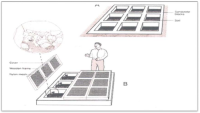 [11] [11] | 0.6 × 0.6 to 1 × 1 | This system is directly inserted into the ground. In addition, the wall consist of sandcrete blocks or mud bricks in either case. | Disadvantage: need to kneel to take care of the animals. |
| Mini-Paddock Pens | 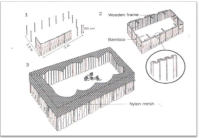 [12][13] [12][13] | The walls should be 50 cm high and be dug at least 20 cm into the ground | This system is a small square, usually within a larger fenced area. Built of bamboo, nylon mesh, or timber, chicken wire and nylon mesh. | Advantage: sustainable system because of the materials. Disadvantage: the snails are less protect against predators than the previous systems. |
| Free Range Pens | 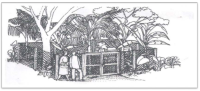 [14] [14] | 10 × 20 | Large system. The vertical fence must be extended inwards, to prevent snails from escaping. | Advantage: mimics the natural environment of the snails so the life conditions are optimal. Disadvantage: it required a lot of space and it may be expensive. |
The purpose of these large scale farming technology was to raise snails for food production. The team realized that the “EscarGO” could have some different purposes such as promoting sustainability (See 5. Eco-efficiency Measures for Sustainability), ethics (See 6. Ethical and Deontological Concerns) and family values, as well as having a much more attractive design.
To conclude, unlike “EscarGO”, the systems above were for outdoors and not for indoor use. Again, the team agreed on the need for an environmental control system included in the product (See Temperature, Humidity and Control System), but also added the idea of a using nylon mesh to prevent snails from going into the heating system and applying the curtain system (See 2.5.1 The Curtain System) . Additionally, a natural environment had to be recreated, for instance, adding plants and rocks.
2.4 Escargot Research
The Helix Pomatia is the most consumed snail in France. It is a wild snail that does not bear the promiscuity of intensive farming. Moreover, it takes ne year to grow. The team decided to use the breed Cornu aspersum because this is one of the most common snail breeds and the most consumed snail in France. This breed is ready for consumption after six months [15].
2.4.1 Life-Cycle
The Cornu aspersum belongs to the class Gastropoda, they prefer an undisturbed habitat with adequate moisture and good food supply. The snail is hermaphrodite so a single snail may have male and female reproductive organs. The age of sexual maturity is reached between its first and second year of life and the breeding season is at the beginning of summer. Prior to reproduction, the Cornu aspersum perform courtship behaviours before mating, like reciprocal tactile contact. Just before mating, the snails shoot structures called “love darts”, The use of love darts is a form of sexual selection. The whole mating process takes 4 to 12 hours [16].
After mating, both snails can deliver a set of eggs, which increases the chance of survival. When fertilization occurs, eggs develop. Laying eggs happens about 3-6 days after the copulation. The snails will produce around 80-86 spherical pearly-white eggs into crevices in the topsoil or sheltered under stones. Before laying their eggs, the snails build a nest digging a hole in the soil, between vegetation or on the ground. The snail digs with the aid of its ventral foot until obtaining a hole with a depth of 2.5 to 4 cm. The size of the egg is around 4 mm. The Cornu aspersum breed can produce up to six batches of eggs in a single year, each new-born will take one to two years of mature depending on the weather and region [17] [18].
Under favourable conditions, eggs hatch after approximately two weeks. The shells of hatch-lings are fragile and translucent and snails emerge with a soft shell. They therefore need to feed themselves calcium by consuming the remains of their egg and even other eggs that have not yet hatched. Eggs are particularly sensitive to dehydration and cold temperatures. The baby snails have, in addition to a soft shell, an almost transparent body that acquires strength and colour as it grows. The first colour they usually have is bluish but then turns to brown. They grow remarkably fast, but very few reach one year of age. Shells continue to grow with the snail over the course of its life, and the rings it has are indicators of their age. A single snail can live 2 to 7 years [19] [20].
2.4.2 Living Conditions
Cornu aspersum are herbivores, a polyphagous grazer with a wide spectrum diet. It finds its food in fruit, trees, herbs, cereals, flowers and bark of trees but occasionally, they add to their diet organic matter in decomposition. The Cornu aspersum is very sensitive to temperature, light intensity and humidity
Feeding requirements
The snails move through all of the terrarium, to get food. Snails tend to keep company when feeding, and are generally social creatures. Sometimes several snails feed together on one piece of food, even if there are other food sources available. The snails will prefer to eat plants rich in calcium and reject plants rich in metals like zinc and nickel. There are herbs and vegetables that snails almost always want to eat, like cucumber, but even these lose their attraction if they are not given a change in diet, just like any other creature, they tire of the same food source and need a varied diet. Other vegetables are only taken at certain times of the year. It is also possible to feed the snails with leaves from vegetables, like cabbage, turnip leaves or leaves from carrots and radishes. Kitchen waste from vegetables can be fed as well, for example aubergine peel, tomato slices and cucumber peel [21] [22].
Feeding activity is essentially nocturnal and occurs only when relative humidity is sufficient, around 80 %. The snails don’t eat at random, snails use distance chemoreception and taste to discover their choices, feeding preferences being influenced by the biochemical composition of the plants and especially by secondary metabolites [23].
Environment requirements
Activity of the snails necessitates a temperature of between 15 and 25 ºC and a humidity between 75 and 90 %. The optimal temperature is 21 ºC, if the temperature comes below 7 degrees, snails hibernate. If conditions are unfavorable, adult snails are able to remain asleep for a few months. They cannot withstand long periods of frost. Micro-habitats are variable, but the snails preferably choose habitats with greater light intensity and structural complexity. The Cornu aspersum lives in coastal dunes, grove and bush land, between rocks. The snail isn’t dependent on a limestone underground, it needs habitats with hiding places in rock and wall crevices or below a deep vegetation cover [24].
The soil is a major part of the habitat because good soil allow the snails to grow well. The snails dig into the soil to lay their eggs, so the soil should not contain too much sand or clay. The organic matter needs to be 20-40% because this enhances cation exchange capacity of calcium which stimulates growth. In the soil there needs to be adequate calcium, the primary content of their shells. A good option to introduce calcium is to add ground limestone at a suggested concentration of 4.5 kg per 100 square feet (9.3 m2). Snails need dampness. A soil moisture content of 80 % is recommended. In the hours of darkness, air humidity above 80 % will promote the activity and growth of the snails. The soil needs to be changed every three months [25] [26].
Climate
The team focus on France, and in most of France there is a Cs climate, based on the Köppen climate system. A Cs climate means a warm temperature climate with dry winters. For the Cornu aspersum this is the preferred climate [27].
Light requirements
Light is very important to the snails, the light influences their behavior. To have an optimal reproduction and breeding process, this factor needs to be controlled. The Cornu aspersum needs 16 hours of light. A simple timing device can be set for the time lengths. A system that can be used is watertight fluorescent tubes, they have the capacity to deliver a 40 Watt power output and spaces at distances. It will acquire a diffusion of light within the reproductive environment [28] [29].
Space requirements
Population density is also very important, too many snails affects the successful growth and breeding capacity of snails. Snails tend not to breed when packed too densely or when the slime accumulates too much. The slime suppresses the reproduction of the snails. The snails grow slower when they are in a densely populated area. Another disadvantage of high density is the high rates of parasitism and transmission of diseases. An advised density for Cornu aspersum is 1-1.5 kg per m2. An adult snail is around 10 grams, so it is possible to put 100 snails on one square meter [30] [31].
2.5 Escargot Nursery Structure Requirements
In order to host 50 snails in optimal conditions the team had to provide the snails with enough (half of a square meter) space as stated above (See 2.5.2 Living Conditions). To increase their living surface while keeping a product’s size that would fit its home use, the team would apply a curtain system (See the following section). It was also important to keep the volume inside the box as low as possible. That way the “EscarGO” would require sustainable amount of power to keep the humidity and temperature at the appropriate intervals.
The materials should also stand the test of time the way the competitor’s product do (See 2.3 Existing Products) Polypropylene (PP) plastic was the material the team decided to use to achieve this.
2.5.1 The Curtain System
A new method for snail farming is the curtain system. The curtains hang in the box and the snails can climb up the curtains. With the curtains, it is easier to keep more snails, because of the larger surface area for the snails to live on [32].
The use of the curtains have many more advantages, the feces of the snails falls down to the ground without contact with any other snail. This method has no impact on the life cycle of the Cornu aspersum. They do not need to be placed in horizontal position, they can also move, mate and sleep in vertical position. It is also easier to make daily inspections because you have visible contact with the snails without touching them [33].
The curtains can be made of nylon. This is a textile and is easy to clean.
2.6 Temperature, Humidity and Control System
With the control system, the requirements are as follows. The enclosure needs to be able to maintain a comfortable temperature for the snails, but also it should not require much energy. It is recommended that the enclosure will stay inside the home, so what has been proposed is a heater that will turn on if and when the temperature reaches below 15 ºC, and a cooling fan that will turn on if the temperature reaches over 25 ºC. The reason for this is the market research suggests that people want as simple a system as possible, that rarely uses any energy.
Humidity is another aspect that will need to be controlled. A moisture sensor will be inserted into the enclosure, and there will be a sprinkler hose pipe or an atomizer inside to release water if the environment is not humid enough. This must be short bursts as over watering or flooding may drown the snails, and also there is a possibility of a small water tank on the system for the humidity control so that the tank does not need to be fed with a constant water supply.
Another requirement of the system is to display the temperature and humidity on a small LCD screen. Humidity and temperature are easily controlled using Arduino boards and software, which is a great benefit of using Arduino. One of the concerns with the project is that because there needs to be a humid environment for the snails, and they also require oxygen, there is the issue of dampness and humidity getting into the room that the terrarium is stored in. This needs to be carefully controlled and monitored because dampness can cause damage to the room around the enclosure.
The team considered using solar panels on the top of the tank to provide some energy, but because the tank is designed for us indoors this was no longer an option as there would be no direct sunlight or very little, for the solar panels to work efficiently. The cost to benefit ratio proved this option was not feasible.
2.7 Advantages of the Escargot Nursery
As per the “space requirements” section, it is possible to put 100 snails on one square meter. This is why the team has chosen the dimensions 400 x 300 x 350 mm with a curtain system, so the project takes up less space With the curtain system that has been chosen there can be a larger concentration of snails in a smaller area.
Another advantage of the “EscarGO” was the inclusion of the environmental control system, that provides a comfortable ambient environment, with little input from the end user. The team decided the systems of heating and cooling needed to be automatic, so the consumers do not need to interact with the system much, and do not need to be home at all times such as they do with other pets.
Product’s design was also an advantage compared to other similar products. The product is designed to be sat in a home, such as in a living room or kitchen, so the product needed to be attractive enough that it would blend well with other pieces of furniture.
2.8 Disadvantages of the Escargot Nursery
As with any product the “EscarGO” has some disadvantages. Despite it being useful for the breeding of snails, the addition of an environmental control system to the product made it need a power source, while the competitors do not need any.
The cleaning of the “EscarGO” would be slightly more difficult than the other products as a result of the inclusion of the curtain system. The curtains need to be cleaned more often than other parts of the snail enclosure.
2.9 Conclusion
Based on this study of the state of the art, the team decided to adopt the curtain system to increase the usability of the product. They also decided to include light, humidity and temperature control to the “EscarGO” so that the user did not need to pay attention to the snails that often because they felt the need to make the product more user friendly.


