This is an old revision of the document!
Warning: Trying to access array offset on null in /home/especiais/epsatisep/public_html/2017/EPS2017-wiki1/lib/plugins/caption/syntax/reference.php on line 68
Warning: Undefined array key "fgantt" in /home/especiais/epsatisep/public_html/2017/EPS2017-wiki1/lib/plugins/caption/syntax/reference.php on line 68
Warning: Undefined array key "tdeliv" in /home/especiais/epsatisep/public_html/2017/EPS2017-wiki1/lib/plugins/caption/syntax/reference.php on line 68
Warning: Undefined array key "fwork" in /home/especiais/epsatisep/public_html/2017/EPS2017-wiki1/lib/plugins/caption/syntax/reference.php on line 68
Warning: Undefined array key "Mat" in /home/especiais/epsatisep/public_html/2017/EPS2017-wiki1/lib/plugins/caption/syntax/reference.php on line 68
Warning: Undefined array key "fwork" in /home/especiais/epsatisep/public_html/2017/EPS2017-wiki1/lib/plugins/caption/syntax/reference.php on line 68
Warning: Undefined array key "fprototype" in /home/especiais/epsatisep/public_html/2017/EPS2017-wiki1/lib/plugins/caption/syntax/reference.php on line 68
Warning: Undefined array key "tram" in /home/especiais/epsatisep/public_html/2017/EPS2017-wiki1/lib/plugins/caption/syntax/reference.php on line 68
Warning: Undefined array key "comm" in /home/especiais/epsatisep/public_html/2017/EPS2017-wiki1/lib/plugins/caption/syntax/reference.php on line 68
Warning: Undefined array key "tmatrix" in /home/especiais/epsatisep/public_html/2017/EPS2017-wiki1/lib/plugins/caption/syntax/reference.php on line 68
Warning: Undefined array key "trisk" in /home/especiais/epsatisep/public_html/2017/EPS2017-wiki1/lib/plugins/caption/syntax/reference.php on line 68
Warning: Undefined array key "tstakeholder" in /home/especiais/epsatisep/public_html/2017/EPS2017-wiki1/lib/plugins/caption/syntax/reference.php on line 68
Warning: Undefined array key "fgraph" in /home/especiais/epsatisep/public_html/2017/EPS2017-wiki1/lib/plugins/caption/syntax/reference.php on line 68
Table of Contents
PlayGround
3. Project Management
3.1 Introduction
According to its definition, a project is above all unique. So, there is no pre-established organization for its realization. Thus, project management is the set of tools, techniques and methods that enable the project manager and his or her team to lead, coordinate and harmonize the various tasks carried out within the framework of the project. The aim of the project management is to respect all the relative imperatives related to the projects like time, delays, costs, quality risks. In order to make our project successful, the team has run the following project management study, including :
- Scope
- Time
- Cost
- Quality
- People
- Communication
- Risk
- Procurement
- Stakeholders Management
3.2 Scope
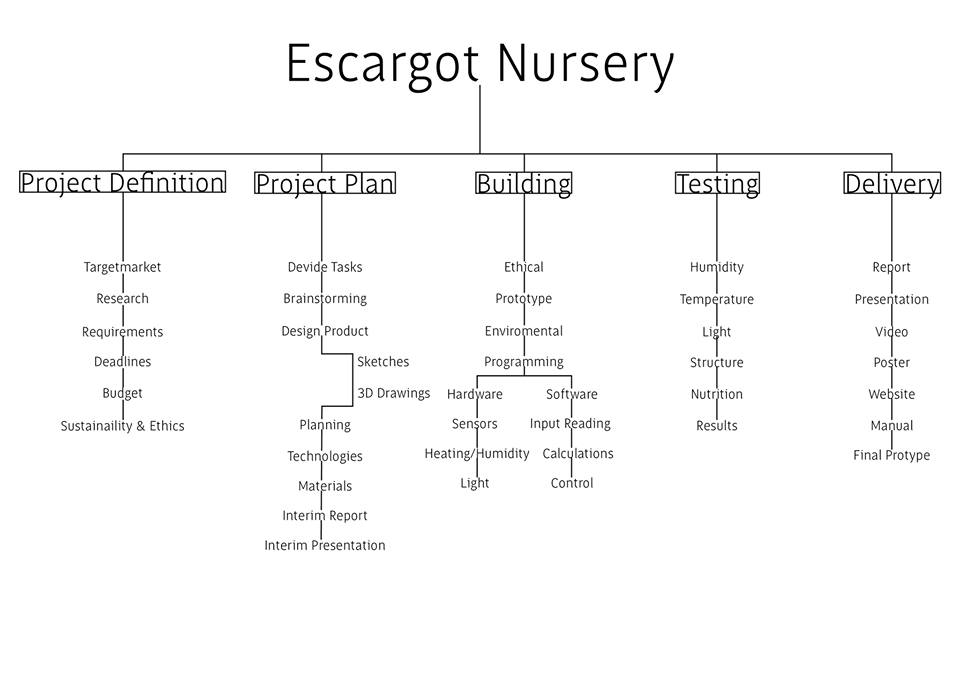
The Work Breakdown Structure (WBS) is an important part of Project Management. The team has recorded all tasks and divided them into categories. By doing this, the team could make the WBS as shown in Figure 1.
3.3 Time
Gantt Chart and Deliverables
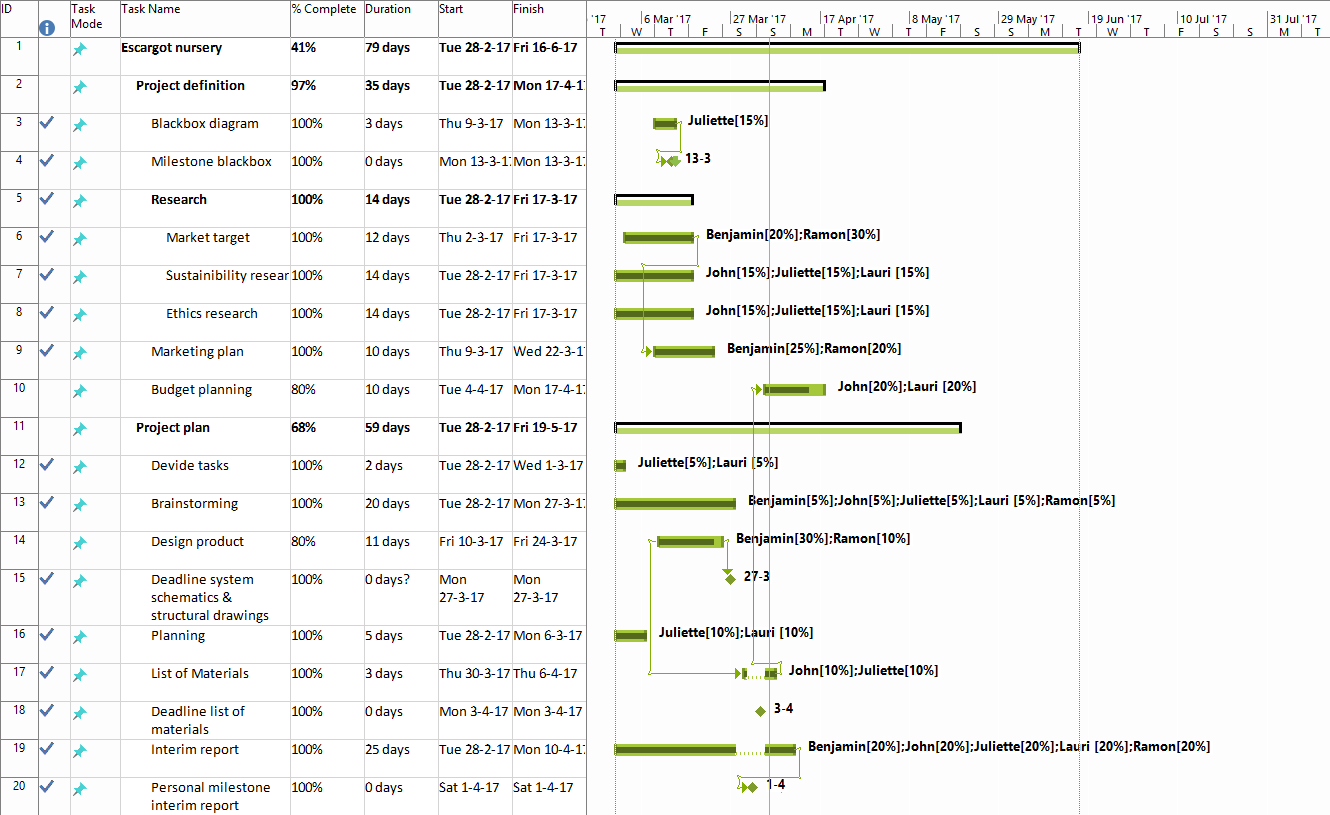
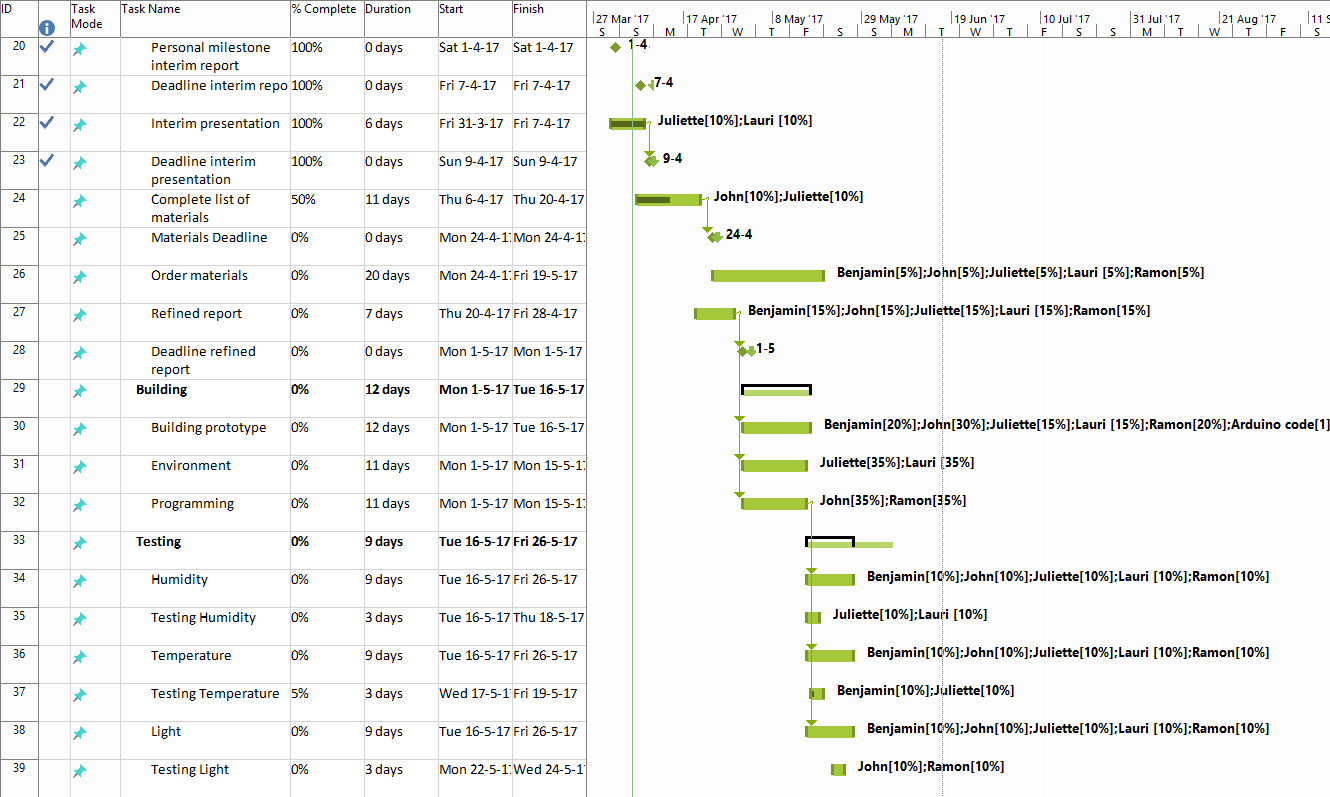
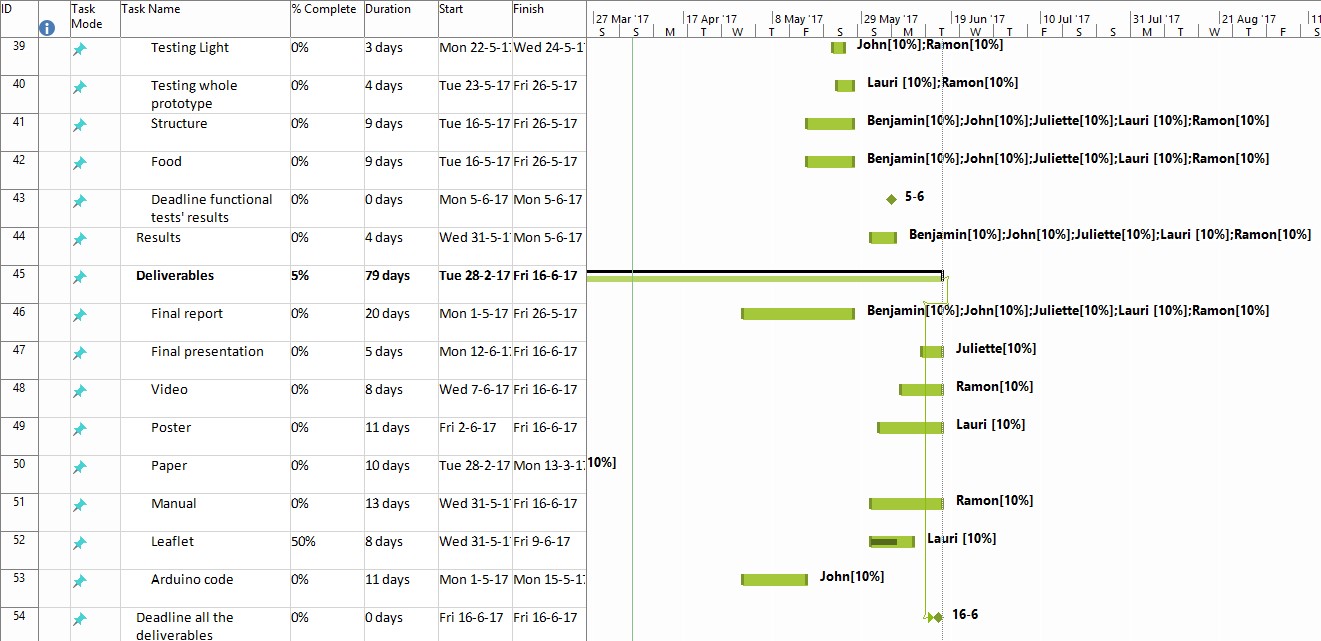
The team established the planning of the project using a Gantt chart (See Figure 2).
In Table 1 there is a summary of all the deliverables of the project.
| Deliverable | Deadline |
|---|---|
| Gantt Chart | 2017-03-06 |
| “Blackbox” System Diagrams & Structural Drafts | 2017-03-13 |
| System Schematics & Structural Drawings | 2017-03-27 |
| List of Materials (What & Quantity) | 2017-04-03 |
| Upload Interim Report & Presentation | 2017-04-09 |
| Complete List of Materials (local providers & price) | 2017-04-24 |
| Interim Presentation | 2017-04-20 |
| Upload Refined Interim Report | 2017-05-02 |
| Upload Functional Tests' Results | 2017-06-05 |
| Upload Final Report, Presentation, Video, Paper, Poster and Manual | 2017-06-18 |
| Final Presentation, Individual Discussion and Assessment | 2017-06-22 |
| Hand in a CD with the Corrected Deliverables | 2017-06-26 |
| Hand in the Prototype and User Manual to the Client | 2017-06-29 |
| Receive the EPS@ISEP Certificate | 2017-06-29 |
3.4 Cost
When managing a project, it is essential to monitor the costs to remain within budget. The costs relating to a project are the costs of the materials used and also the cost of the labor or the workforce. (See Figure 3)
Cost management can be done through a pre-established process:
- First, the plan for cost management needs to be produced. This means that all the internal procedures must be established so the budget can be assigned in the correct areas.
- Next a cost estimation will need to be done to evaluate the cost of materials.
- Then the budget can be determined.
- During the project the team will need to manage costs. This step consists of updating project costs and managing changes affecting the base cost reference.
As the budget has been set by ISEP, which is 100.00 € to build the prototype, the principal requirement in regards to cost during this project is to manage the costs and stay within the budget.
The material ressources are showed in Table 2
| Product | Quantity | Cost (€) |
|---|---|---|
| 16×2 I2C LCD Display | 1 | 8.50 |
| Fan 12V 40 x 40 x 10 mm Velleman | 1 | 3.70 |
| Arduino Uno | 1 | 22.90 |
| Luminosity Sensor Breakout - TSL2561 | 1 | 6.50 |
| DHT22 | 1 | 9.80 |
| Resistors | 4 | 0.20 |
| NPN Transistor | 2 | 0.98 |
| PANASONIC ELECTRIC WORKS JS1-12 V-F General Purpose Relay | 1 | 1.53 |
| 4n35 optoisolator | 1 | 0.68 |
| Socket | 1 | 0.18 |
| Solenoid 12 V | 1 | 9.40 |
| Capacitors | 4 | 0.60 |
| LED Strip | 1 | 2.96 |
| Arduino Power Supply AC/DC 230VAC/12V 2A | 1 | 7.50 |
| PVC Sheets | 3 | - |
| Polymethylmethacrylate (PMMA) | 2 | 4.40 |
| Plastico autocolante | 4 | 7.04 |
| Clear plastic tube | 1 | - |
| Nylon Mesh | 1 | - |
| UHU Allplast | 1 | 2.64 |
| Total | 89.51 |
Thus, the total cost of the materials is 87.75 €
The work resources are shown figure 3

3.5 Quality
According to standard ISO 8402-1986 quality is “the totality of features and characteristics of a product or service that bears its ability to satisfy stated or implied needs.” The quality of a product is a pillar of the success of any business. If the product is of good quality, consumers will be more inclined to buy products from the company again, i.e. Brand Loyalty, but also if people experience a high quality product and service they are more likely to recommend the product to their friends and family, which has the added bonus of being free advertisement. Quality is the key indicator of the success of the project, but it’s also an obligation since companies must comply with a certain number of standards in terms of quality such as ISO 9000. With such high importance being put on quality, most big companies have a department dedicated to quality management [1].
Quality management is a process that starts at the very beginning of a product's design. When designing a product, the product designers and engineers make sure that the materials that are used are fit for purpose, for example a hairdryer cannot be made from plastic that can melt easily. Using quality management techniques such as acceptance sampling, engineers can determine if the materials that are used within the product are of satisfactory standards. For example if a company is using a particular brand of bolts, they will test 3 % of the batch, depending on batch size, and if the bolts are not accepted then the bolts will be sent back to the supplier [2].
In the “EscarGO” project the materials will be purchased from reputable sources, and non-destructive tests will be conducted before use of the prototype. Software will be used to build 3D models, and also for the electronics. Using open source software, the design of the electronics will be carried out and simulations will be undertaken before the electronic components are built and assembled.
Testing the prototype is an important part of the quality, the team wants to deliver a producht of quality. Figure 4 shows that all the parts that needs to be tested, like humidity, temperature and light will be tested one by one. This is important because when a tests fails, the team knows directly what the reason is. After testing the parts one by one, the whole prototype will be tested.

Quality needs to be ensured for the duration of the life of the product, by providing after sales service in case of any problems and a warranty. The after sales service is also a measure of the success of the “EscarGO” society because if customer problems are solved quickly, they will be more satisfied.
In the factory, quality can be improved through continuous improvement processes such as 5S.
3.6 People
Human resource management or people management is an important part of project planning. It includes the activities and processes, in which each team member is involved. The tasks are assigned to a team member, but every team member assists the others with input in team meetings. The tasks are assigned on a skills basis. The team consists of so many differing backgrounds and specialisms which brings something different to the team. (See the following section).
3.6.1 RAM
The group used a Responsibility Assignment Matrix (RAM) (See Table 3) as an essential part of their project planning.
| Task | Benjamin | John | Juliette | Lauri | Ramon | Supervisors |
|---|---|---|---|---|---|---|
| Gantt Chart | A | R | A, C | |||
| BlackBox | A | R | A, C | |||
| Structural Drafts | R | A | A, C | |||
| State of the Art | R | R | R | R | A, C | |
| Eco-effiency Measures for Sustainability | R | R | R | A | A, C | |
| Ethical and Deontological Concerns | A | R | R | A, C | ||
| System Schematics | A | R | A, C | |||
| Structural Drawings | R | A | A, C | |||
| Cardboard Model | R | R | R | R | R | A, C |
| Marketing Plan | R | A | R | A, C | ||
| Project Management | A | R | R | A, C | ||
| List of Materials | R | A | I | A, C | ||
| Interim Report | R | R | R | R | A, C | |
| Interim Presentation | R | A | R | R | R | A, C |
| Building | R | R | A | R | A, C | |
| Programming | A | R | I | T | A, C | |
| Testing | R | T | T | T | T | A, C |
| Website | A | I | R | A, C | ||
| Video | R | A | R | A, C | ||
| Leaflet | R | A | R | R | A, C | |
| Paper | R | R | A | A, C | ||
| Poster | A | R | R | A, C | ||
| Manual | I | A | R | A, C | ||
| Final Report | R | R | R | R | R | A, C |
| Final Presentation | R | R | R | R | R | A, C |
- R: Responsible
- A: Approval
- C: Consultant
- I: Informant
- T: Tester
3.7 Communications
In order to achieve the best possible project, it is essential to ensure good communication within the group. Indeed, since everyone comes from different countries, with different languages there may be problems with comprehension. Thus, it is very important to be clear, rigorous and to repeat the explanations if necessary.
Moreover, as everybody comes from different specialties, all having differing knowledge bases, that is why it is very important to communicate in order to develop ideas, and consider perspectives from fresh eyes. In addition, communication is essential in order to resolve any problem that may arise within the group. To work in good conditions it is important that there is a good atmosphere without underlying problems.
These days there are many means of online communication that can be used to improve communication when the team not together at school.
First of all, when the team wanted to organize meetings, ask their colleges for help or divide the tasks, the team can use the Messenger application in Facebook. Messenger is very useful when several people want to work on the wiki because, since it is no possible to work at the same time on it, the team had to make sure that nobody was working on it to avoid two people working at the same time. The team also used both Dropbox and Google Drive so that everyone can upload their work to a shared online platform and furthermore, different people can work at the same time on the same document on Google Docs. The fact that everyone had access to everything, allowed the whole team to have a view on the whole project. So, everyone could express their opinion on the work accomplished.
The Figure 5 represents the distribution of the various means of communication mentioned above. Oral communication represents half the diagram because the team spent a lot of time in school working together. Google Drive was used more than Dropbox because it allowed the team to write in a shared document, several at the same time and that is more convenient. The team also used a lot of Messenger because it allowed them to talk in real time even if they are not together. At the beginning Whatsapp was used but since it was not practical for everyone, it was abandoned as a means of communication
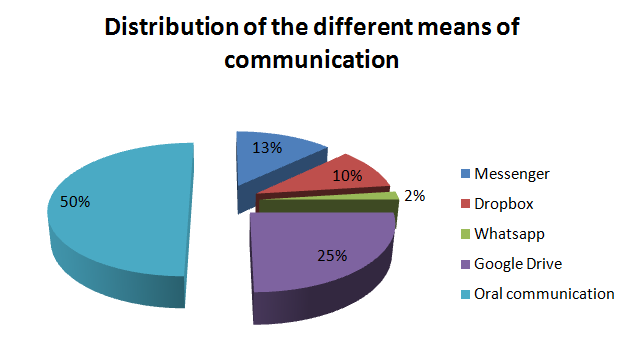
Table 4 shows the Communication Matrix.
| What | Why | Who | When | To whom |
|---|---|---|---|---|
| Deliverables | To develop the project | The team | On the date of the deadline | The supervisors and the team |
| Weekly supervisor meetings | To discuss about the progress of the project | The team | Every Thursday | The Supervisors |
| Agenda | To inform supervisors about the topics of the meeting | Team member who is responsible for the agenda that week | Before every Thursday | |
| Brainstorming sessions | To discuss about the different ideas, project planning | The team | Multiple times a week | Other teammembers |
3.8 Risk
Risk management is an ongoing process that identifies the risks involved with each task and provides a solution to mitigate risk to the health and safety of the individual or group that are involved in the task. In this project, to avoid risk, the team decided to identify and analyze all the potential risks that may arise and think about possible solutions.
Risk management includes the following six processes:
- Establish objective
- Identify risks
- Assess impacts
- Assess risks
- Risk control
- Monitoring
Table 5 shows the risk management.
| Risk | Cause | Effect | Trigger | Response | Impact | Probability | Rank |
|---|---|---|---|---|---|---|---|
| Broken Components | Poor Quality of the Components | It will be not Possible to Build a Fully Working Prototype of the Product | Prototype Testing Failure | Quality Check of Components on Arrival (Mitigate) | High | MediumLow | 3 |
| Not Meeting the Interim Deadlines | Bad Planning | Lower Grade | Teachers and Coordinators Bad Input | Good planning. Weekly Tasks. Communication (Avoid) | MediumLow | Low | 7 |
| Illness of the Team Members | Bacteria or Virus | Slowing Down the Work Rate and Quality | Team Member Feels Sick | Follow a Healthy Lifestyle (Accept and Transfer) | Medium | Low | 4 |
| Faulty Components Delivered | Components Broken Because of Bad Protection While Transporting | Cannot build the prototype before the deadline | Material Delivery Check | Check for Shop's Reviews Before Buying (Avoid) | High | Low | 5 |
| Tests Fail | Bad or Wrong Components | A Non Working Prototype | Prototype Testing | Test All the Components One by One, Before Testing the Entire Prototype (Accept and Mitigate) | High | MediumLow | 2 |
| Inappropriate Material Selection | Bad Materials Research | Impossible to Construct the Designed Model | Prototype Testing | Ask Teachers and Supervisors for Advice (Mitigate and Transfer) | High | Medium | 1 |
| Conflict with Stakeholders | Bad Communication | Slowing Down the Development of the Project | Communication With the Stakeholders | Implement Comunication Plan and Measure and Meet Stakeholders Expectations (Avoid) | Medium | Low | 6 |
3.9 Procurement
Procurement is the process of acquiring and buying products, goods or services from external suppliers. The process is used to make sure that the team receive products at the best possible price but also quality compared with other external suppliers, i.e. the best value.
For this project, the team was only allowed to choose suppliers from Portugal, which means that there are more restrictions on what can be used in the final product, because in some countries the components that are needed to build the prototype, are cheaper, better quality than in Portugal and in some cases cannot be found in Portugal.
3.10 Stakeholders Management
Stakeholder management is an important part to make the project successful. A stakeholder is a person that has influence over the team or is influenced by the team, whether that be an investor in the business, or someone who's livelihood is tied up in the business. A part of the stakeholders management could be, making sure that the team is meeting the deadlines, making a product of good quality and that the product is going to make money.
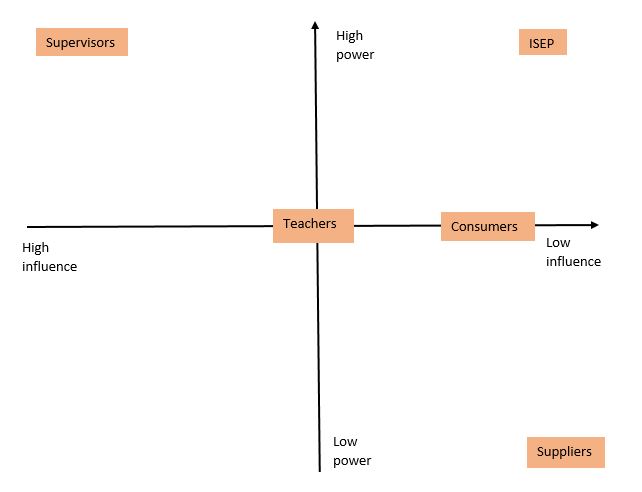
In this project there are different stakeholders with different expectations. The stakeholders in this project are the supervisors, the team members and the university. Table 6 shows the stakeholders.
| Who | Role | Expectations | Power | Influence |
|---|---|---|---|---|
| The team | The team develop the project | Learn new skills and develop a working product | High | High |
| Supervisors | Supervise the project | Receive an interesting project and a working product | High | High |
| Teachers | Give information about different subjects | Gain knowledge that is necessary and receive an interesting project | Low | Medium |
| Suppliers | Provide materials | Sell the materials | Low | Low |
| Consumers | Buy the product | Receive a good working product | Low | Medium |
| ISEP | Sponsor | Receive interesting projects | High | Low |
The graph in Figure 6 gives another view of the influence of the stakeholders.
3.11 Conclusion
To conclude this chapter, project management is one of the main aspects of the realisation of a project. Project management is a useful and important tool for the team members to identify all the tasks and time limits, to guide the cost and the budget, to measure the risks and to analyse the responsibilities of the people that are involved.
The main objective was to organize the project planning in an efficient manner. The project planning ensured each team member was clear of their responsibilities, identified the time limit and the tasks that needed to be done. The team made a Gantt Chart with all the time limits and tasks highlighted for each team member. With using the Gantt Chart, the team was up to date with all the tasks and time limits.
In the next chapter the team introduces the marketing aspect of “EscarGO”.


