This is an old revision of the document!
Warning: Trying to access array offset on null in /home/especiais/epsatisep/public_html/2017/EPS2017-wiki1/lib/plugins/caption/syntax/reference.php on line 68
Warning: Undefined array key "fsustlc" in /home/especiais/epsatisep/public_html/2017/EPS2017-wiki1/lib/plugins/caption/syntax/reference.php on line 68
Warning: Undefined array key "ffrimport" in /home/especiais/epsatisep/public_html/2017/EPS2017-wiki1/lib/plugins/caption/syntax/reference.php on line 68
Table of Contents
5. Eco-efficiency Measures for Sustainability
5.1 Introduction
The idea is to reuse as many materials as possible and upcycle for the prototype and to use sustainable materials for the product. This reduces waste but also keeps costs down. Natural materials are what is preferred where possible, and natural vegetation for feed rather than synthetic man made pellets or feed.
This project promotes sustainability at home. The Escargot Nursery would be a fascinating way to teach children about where their food comes from and what it takes to produce food instead of throwing it in the trolley at the supermarket.
It is believed that this project fulfills a genuine need in the market, and sustainability and protecting the environment around us is becoming more and more important to people, as humans have become consumer orientated and do not produce their own food as most used to at the start of the 20th century.
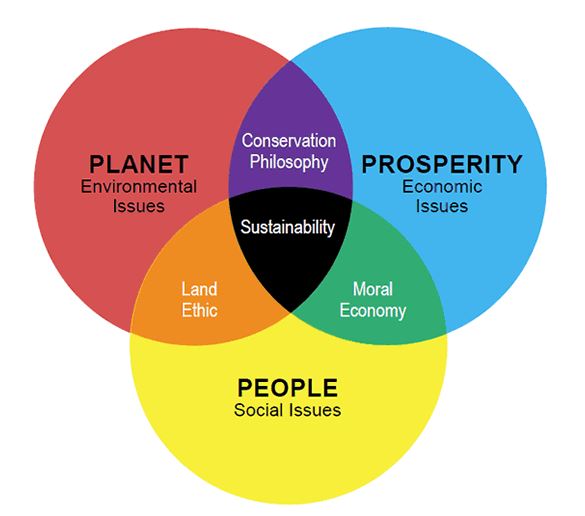
As can be seen in Figure 1, sustainability is a widespread issue, with many sub-sections. Economic, environmental and social issues. It is the consideration of all these concepts that makes sustainable development more and more important and are all contribute to our understanding of sustainability.
5.2 Environmental
Environmental sustainability is protecting the natural environment and its resources to protect the planet. Environmental sustainability concerns the ability to be able to reuse materials or resources indefinitely, so the use of trees, for wood and paper because trees can be grown back easily. Avoiding the use of fossil fuels as once consumed cannot be regenerated. Once we deplete the world's oil supplies then that means that we cannot create polymer plastics anymore. Recycling waste thermoplastics is essential in reducing our dependence on new production and allows for more resources to be available in future. The team can also recycle glass and metals, which limits our need for additional mining and damage to the natural environment. If the resources and materials used cannot be reused or reproduced indefinitely then they cannot be defined as sustainable [2].
Being able to recycle the product is not enough, because if the rate of yield is larger than the rate of recycling then this is not a sustainable model. Waste needs to be controlled carefully as the ability for the planet to absorb our waste is at an unsustainable level. Landfill sites are not able to handle the amount of waste humans produce, and the fact that we dispose off plastic, a non-biodegradable material, in landfill is a huge issue. Landfill sites have many pockets of harmful gases such as methane, ammonia, sulfides and carbon dioxide that gets trapped when the landfill is buried, this produces another harmful effect as these gases can ignite. If they ignite this releases more harmful elements to our environment and contributes more to the greenhouse effect [3].
Therefore, in accordance with the above reasons it is essential for this project to use environmentally friendly materials such as natural materials or materials that can easily be recycled. Nevertheless the used materials should meet the expected properties to withstand humidity and higher temperatures. By using recycled and sustainable materials to build this product, the families who buy the product will be able to buy the product in good conscience.
5.3 Economical
Economic sustainability is the ability of an economy to support a defined level of economic production indefinitely. In a sustainable economy, growth strengthens competitiveness and an increase in employment is combined with better management of space, the protection of nature and a reduction in environmental impact [4].
In most countries in the developed world, if a company is a high polluter then it has pay more taxes. This means that more companies are prepared to reduce their carbon footprint and act in a more environmentally friendly way to save money if not for the environment. This kind of legislation helps to change mentalities and encourages people and businesses to act in a better way. If people are having to be more environmentally friendly at work and being educated about the issues at work, then they are more than likely to take these kind of behaviors and practices home with them and educate their families on these issues [5].
The introduction of eco-friendly and innovative products such as the Escargot Nursery benefits the market and economy, as there are more choices for consumers. Sustainability is the modern way and is a trend at the moment so people are more likely to choose such a product.
An important part of economical sustainability regarding to this project is the use of the local economy. This project will use local providers and suppliers in Portugal. This benefits the economy here and if the product is designed, built, and produced here and then exported, this model benefits any local economy, producing jobs, addition of taxes to the government, which is then able to spend the extra funds on additional services for the people.
5.4 Social
Although for most people sustainable development means only the protection of nature but, an additional pillar of this concept is the social dimension. The social dimension aims to promote and improve the social equality. Sustainable development should enable everyone to have equal access to concepts such as: food, housing, health, human rights [6].
There are generational, and social obstacles surrounding sustainability. For example if a person has been used to never recycle their household waste, it can be a challenge to persuade them to change their habits. There are also those who do not believe in Climate Change which becomes a problem if they are in positions of power, such as in large companies or in government where they can affect real damage if they are not held accountable. To affect change in attitudes in regards to sustainability and the environment is, above all, a matter of education. The goal for the future is for everyone to participate in sustainable development so we can create a better world together and save our environment from the damage humans have inflicted upon it [7].
Refreshingly, there are more and more people who make sustainable development and respect for the environment a lifestyle. People try to minimize their “carbon footprint” by favoring local products, which reduces the carbon footprint of the food by not having to travel. In a way, sustainable development is becoming trendy and fashionable [8].
Following on from this point, the Escargot Nursery project fits perfectly into the social aspect of sustainable development because it promotes education and bringing people together. The project promotes education because it teaches children where their food comes from and it also teaches them the process of raising animals. It teaches children that nowadays, it’s essential to protect nature and animals for the continued use of planet earth. In addition, this project allows families to come together and enjoy time together taking part in a project that the whole family will be involved in, which is a fantastic opportunity for family bonding. Lately, children are playing more and more computer games, spending less time with family, and more time on their smartphone and social media. This project breaks the mold and reunites the family.
5.5 Life-Cycle Analysis
From a sustainable development perspective, it’s important to study the whole life cycle of the product and not only its production. Nowadays, contrary to what was thought before, the recyclability and the disposal of a product is one of the most important aspects of the product’s life. In Figure 2, is demonstrated the life cycle of most products. These types of studies often allow designers or buyers to compare multiple products environmental impacts. This analysis can also be used as a means of communication for businesses, lawmakers/government, or consumers [9].
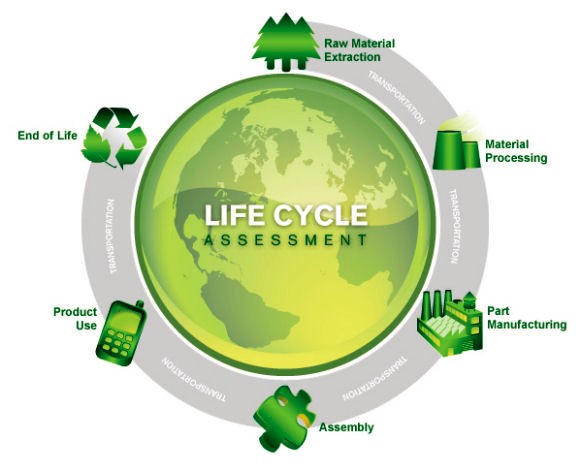
The life cycle can be summarized in three phases. First, “cradle to gate” that includes three parts of the life cycle from Figure 2. The first stage is the extraction of raw materials, then, the materials are taken for processing, and eventually the construction of the final product in various factories. Then, there is the “cradle to grave” aspect in relation to the utilization of the product and its useful life. For instance, during the distribution, of the product, companies pack the products in packaging that generates waste, and more often than not the packaging is plastic and non-recyclable. In addition, when the consumers use the product, they consume resources like energy or water and this has an impact on the environment because of the pollution generated and the carbon emissions produced. These days consumers are demanding more energy efficient products, and because we have so many electrical products around the home their continued use is expensive. This is why you are seeing more A rated energy efficient products, and more and more Light-Emitting Diode (LED) lighting used in new homes. The final stage is “cradle to cradle”, the reuse of the materials. Engineers and designers, when they are conceiving a product, are more aware than ever of the end of life of the product, and how the product will be disposed of at the end of its useful life [11] [12].
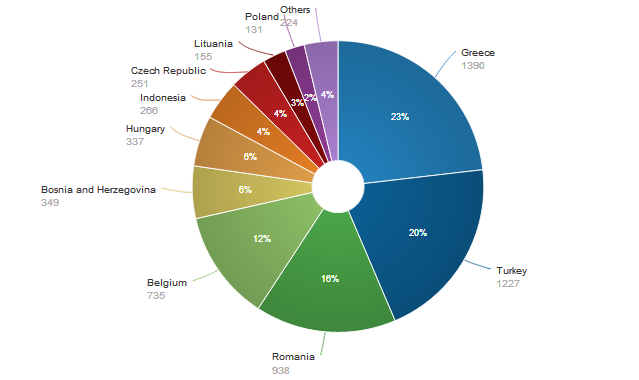
France does not produce enough snails to meet demand (See Figure 3) . In fact from May 2013 until March 2014 there was 6000 tons of snails declared as imports into France. The peak time for consumption is over the festive period, as escargot is considered a festive tradition. Therefore the Escargot Nursery meets a huge demand for anyone willing to produce them at home. It also reduces the transport costs and therefore the carbon footprint of the food [13].
5.6 Conclusion
To conclude this chapter, nowadays sustainability is crucial and the team must take it into consideration when designing the product. Sustainability is a concept which includes the environmental, economic and social concepts. To make “EscarGO” sustainable, the team need to take these three concepts into account with equal importance. Based on this study, the team chose to use PP for the structure for the final product, because its impact on the environment is lower compared to other plastics and it is resistant to the growth of bacteria. Thus, its impact is 73 mPt/unit while the impact of polyamide, another widely used plastic, is around 700 mPt/unit that is really unsustainable [15]. Due to the budget, the team chose to use Polyvinyl Chloride (PVC) for the prototype.
Then, to comply with the social aspect, the team has decided to make education for children and cohesion of family one of these main concerns. To conclude, based to this study the team decided to use the curtain method in order to increase the surface where snails can live. As it increase the efficiency of “EscarGO”, this method is really sustainable.
6. Ethical and Deontological Concerns
6.1 Introduction
Ethics is the set of values that can be applied personally or professionally which dictates a person's actions. On the other hand, deontology is the set of rules and duties that govern a profession, the conduct of those who practice it, the relationships between them and their clients and the public. For instance, under article 3.04.01 which is the code of deontology of engineers, an engineer must apply his or her signature to any document or plan prepared under his or her management. Engineers can decide to refuse a signature, which them values and the code of ethics allows them to do if the work is not of satisfactory quality or not done in an ethical or sustainable way [16].
Thus, the project must respect all the aspects of ethics and deontology in the following areas:
- Engineering ethics
- Sales and marketing ethics
- Environmental ethics
- Liability
6.2 Engineering Ethics
Since the beginning of the industrial revolution, the profession of engineering, science and research has developed in leaps and bounds and has become a pillar of respectability within companies. It was therefore necessary to introduce rules and regulations to govern the professional ethics inherent in this profession. The first ethics code for the engineer appeared in 1910 and it was promoted by the Institution of Civil Engineers in the United Kingdom. During the 20th century, numerous codes of ethics were published in the United States and in others countries [17]. Today, there are several codes of ethics and deontology governing the profession of engineering in most countries.
This project has to respect engineering ethics. In each of those codes, there are some common concepts that the team has to respect. The team chose to focus on France because that is the target market for this project. In France, there is an ethics charter for engineers which was drafted by CNISF (Conseil National des Ingénieurs de France) in 2001 [18] [19] [20].
The team chose to present this one because France is the largest market for snails. In this charter the team finds the following concepts [21]:
- First, there is the concept of engineers in society. Engineers are highly educated, and their specialist knowledge means they are in a unique position to be trusted to use their education and specialist knowledge. The engineer must use their knowledge and understanding in an ethical way and a way that protects the environment as much as possible.
- Another aspect is engineering competency. Engineers are source of innovation and progress. They develop products, manufacturing processes, research problem solving and much more. In addition, engineers has to adopt a rigorous, systematic way of working. They must admit when they are wrong, take the advice of others and correct any mistakes.
- Engineers have to be open minded, they must be fair without discrimination and listen to the opinions of everyone and take on board criticism but also be able to assert themselves if the design concept is not safe, or not achievable. They have to respect the culture and the values of the company they work for and the people affected by the work of that company. They must work ethically i.e. engineers must not plagiarize, make signatures out of convenience, deliberately use harmful materials, etc.
- To conclude, there is the section referring to engineering and their mission. The engineer must respect the constraints imposed on them while integrating economic, human, financial, social and environmental factors. They must also anticipate risks and hazards in order to limit negative impacts.
During the process of the project, these values need to be adhered to. This project responds perfectly to the different points because the team works towards sustainable development. Furthermore, the project promotes innovation because, at the moment, there is no similar product on the market.
6.3 Sales and Marketing Ethics
In today’s world, markets present a battle of interest between different players, such as competition for resources, customers and price. People want to have a product of good quality at the best price, which doesn’t always mean the cheapest price, and companies want to increase their gain [22].
Given that the purpose of the project is to build a product that can be sold, the team also has to respect sales and marketing ethics. Sales and marketing ethics are particularly important for the image of the company. Indeed, the credibility of the company as well as the confidence that the customers have in the company, are at stake. It’s also essential to respect sales and marketing ethics in order to avoid sanctions, fines or even legal issues [23].
The team wants to develop a long-term relationship with the customers, so one of the most important points that the team has to take in consideration is not to lie about the benefits of the product. Indeed, during the advertising the team has to promote only the real advantages of the product and not to invent or overstate the products benefits. This point is important for the customers trust and also on a legal level [24].
Then the price is a concern of sales and marketing ethics. First, the price has to be fair. The customer needs to know exactly what they are going to pay for the product. The team wants to offer a high quality with fair prices. The price has to be clear. It is important not to hide charges in the price or services that the product will need to work. So any additional parts or replacement parts after use need to be made clear to the customer [25].
In addition, the marketing of the product has to respect the cultural diversity and it has to be nondiscriminatory towards all people.
During marketing and sales activities companies use surveys, focus groups, and specialists to gather information. To behave ethically the companies have to respect the privacy of the customers and inform them why they are collecting data, and the data needs to be kept relevant and not asking more than what is needed for the particular application. Furthermore, the companies can’t sell the gathered information on and they have to destroy it after the data is no longer needed [26].
6.4 Environmental Ethics
Environmental ethics is a part of the environmental philosophy and is not just about the relationship between humans and environment, but it is also about the value and the moral status of the environment and its nonhuman inhabitants [27].
The study of environmental ethics focuses on the impact of the product on the environment. Humans can’t help using and modifying parts of the natural world, since we depend on the nature for food, clothing and shelter, for our water supply, and for the air we breathe. But the unforeseen impacts of human actions are now creating problems like global warming and the elimination of multitudes of species [28] [29].
With environmental ethics, the team can ensure that we are doing their part to keep the environment safe and protected. The design of the “EscarGO” will be created to be as environmentally friendly as possible by using only materials that aren’t harmful for the environment for the final product, like PP, which is more sustainable than other plastics.
6.5 Liability
Another aspect of ethics research, is the liability ethics. Liability law determines when someone in general or liability suffers in a particular case for damage or injury suffered by another person [30].
Legal liability concerns both civil law and criminal law and can arise from various areas of law, such as contracts, torts, taxes, or fines given by government agencies. The primary goal of civil liability is to restore or to compensate for damage suffered [31] [32].
Product liability is an important part of this project. The team is responsible for the product, also for the injuries this product may cause. It is important to take responsibility towards supervisors and the customers. If something unfortunate happens, the consequences of which are the fault of the team [33].
To complete the creation of the Escargot Nursery, is it necessary that the team comply with the following EU directives:
- Machine Directive (2006/42/CE 2006-05-17);
- Electromagnetic Compatibility Directive (2004/108/EC 2004 12 15);
- Low Voltage Directive (2014/35/EU 2016-04-20);
- Radio Equipment Directive (2014/53/EU 2014-04-16);
- Restriction of Hazardous Substances (ROHS) in Electrical and Electronic Equipment Directive (2002/95/EC 2003-01-27);
According to the previous directive :
- When designing the product, the team must create a product that does not compromise the safety and health of users.
- Our electronic part must be designed with the aim of limiting electromagnetic emissions from equipment in order to ensure that, when used as intended, such equipment does not disturb radio and telecommunication, as well as other equipment.
- The “EscarGO” electrical equipment within certain voltage limits provides a high level of protection for European citizens
- The team does not need to use hazardous substances in the “EscarGO” electronic equipment.
6.6 Conclusion
To conclude, the team has to respect all the codes of ethics mentioned above, the team has to take care with the sales and marketing of the product to make sure it is done in an ethical way. The team needs to be ethical in every aspect of the construction of the Escargot Nursery to be sure that the product meets with the ethical requirements and European directive that were set. Due to this study, the team will work to promote only the real benefits of the product and to show the value of these aspects. Furthermore, the team will particularly pay attention to the respect of environment, using sustainable materials both for the prototype and the product. In the next chapter the team will explain the development of the product taking in ethical and deontological concerns.


